%20(1).png)

To become a registered nurse in New Zealand, you need to complete an approved nursing degree, pass a final exam, and get registered with the Nursing Council of New Zealand (NCNZ). The journey involves hitting specific academic benchmarks, getting through demanding clinical placements, and proving you meet the Council's 'fit to practise' standards—which includes things like police and health checks.
Choosing to become a nurse is a huge commitment, but thankfully, the path is clearly marked out. It's best to think of it as a journey with three main stages: your education, putting it all into practice, and finally, getting professionally registered. Each step builds on the last, getting you ready for a hugely rewarding role in healthcare. Seeing the whole map from the get-go helps you plan properly and know what to expect.
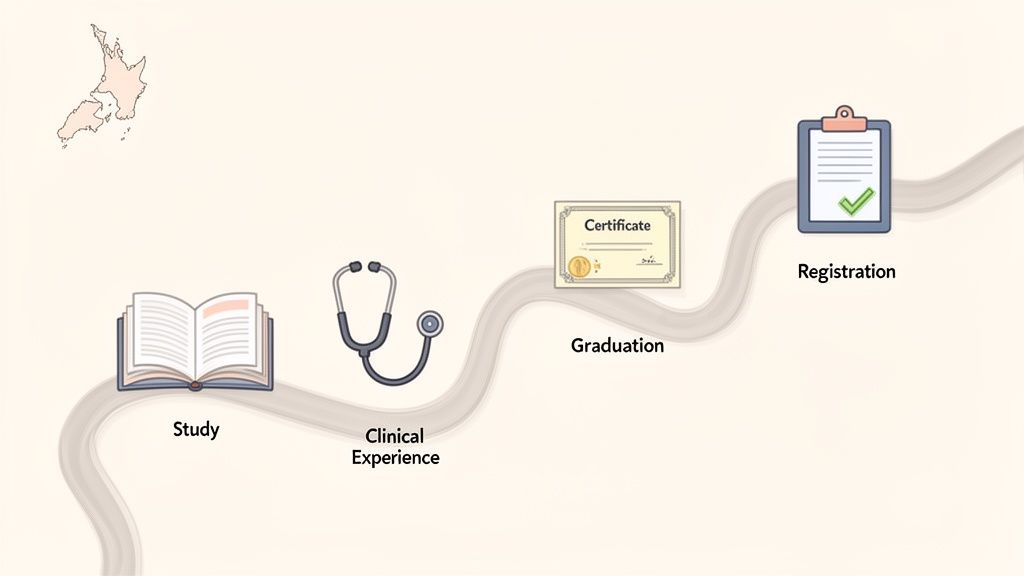
The biggest and most important part of your journey is your formal education. In New Zealand, this almost always means getting a Bachelor of Nursing degree, which is typically a three-year programme from a university or polytechnic. There are other ways in, though. You might find graduate-entry master's degrees if you already have a degree in another field, or bridging programmes if you're an internationally qualified nurse looking to practise here.
No matter which route you take, the core elements are the same. Your degree will be a blend of theory in the classroom and a whole lot of hands-on experience during your clinical placements.
These placements are where the rubber really hits the road. You’ll be working alongside experienced nurses in real healthcare settings like hospitals, local clinics, and community health centres, finally translating all that theory into actual practice. They are a non-negotiable part of your training and make up a massive chunk of your degree.
Once you graduate, your focus will shift to that final hurdle: registration. The Nursing Council of New Zealand is the official body that makes sure every nurse is competent and safe to practise. This means you'll need to:
A critical piece of advice for anyone considering this career is to prepare well in advance. The academic demands of a nursing degree are high. Building foundational knowledge before you even apply can make a world of difference.
For many aspiring nurses, especially those who've been out of the classroom for a while, dipping your toes in with a foundational online course can be a brilliant first move. Exploring subjects like human anatomy, physiology, or medical terminology is a low-pressure way to build confidence and double-check that this is the field for you.
This kind of prep gives you a real head start, equipping you with essential knowledge that puts you at a distinct advantage when you begin your formal nursing studies. It’s a smart way to test the waters and make sure you’re truly ready for the challenges ahead.
The path to becoming a Registered Nurse is structured and clear. Below is a table that breaks down the major stages you'll navigate on your journey.
Each stage is a significant milestone, designed to ensure you are fully prepared, competent, and ready to provide safe and effective care to the people of New Zealand.
Deciding you want to become a registered nurse is a huge first step. The next, equally important one is figuring out the best way to get there. In New Zealand, there isn't a single, rigid road to a nursing career; your ideal study pathway really comes down to your background, any qualifications you already have, and your personal circumstances.

Whether you’re just finishing secondary school, already hold a degree in another field, or are an internationally qualified nurse looking to practise in NZ, there's a structured route designed for you. Getting your head around these options is key to making a smart decision that sets you up for success from day one.
For most aspiring nurses in New Zealand, the journey kicks off with a Bachelor of Nursing (Level 7). This is the most common and direct pathway into the profession, and for good reason.
It’s a comprehensive, three-year full-time programme that brilliantly blends academic theory with the hands-on practical experience you need out on the floor. The whole point is to arm you with the full range of skills, knowledge, and clinical reasoning necessary to provide safe, effective care.
To get into a Bachelor of Nursing programme, you’ll generally need one of the following:
This degree is the bedrock of nursing education in Aotearoa. You can't become a registered nurse here without completing an approved Bachelor of Nursing from a provider like the University of Auckland or Massey University. Once you graduate, you’ll need to pass the state final exam to get registered with the Nursing Council of New Zealand (NCNZ). It’s a well-trodden path, with 2,404 RN graduates achieving this in 2025 alone.
What if you already have a degree or are a qualified nurse from another country? The good news is you don’t have to start from square one. The system here is smart enough to offer accelerated options that recognise your prior learning and experience.
If you have a bachelor's degree in a totally different field, a graduate-entry master's programme is likely your fastest route. Often called a Master of Nursing Science or Master of Nursing Practice, these are typically intense two-year programmes. They build on the academic skills you already have, fast-tracking you into the profession.
For internationally qualified nurses (IQNs), the pathway involves a Competence Assessment Programme (CAP). Think of this as a bridging course. It’s designed to get your existing skills and knowledge up to speed with New Zealand’s specific healthcare context, standards, and cultural safety requirements. Completing a CAP is a mandatory step before you can register with the NCNZ.
For those looking at alternative routes into university, a guide to Access to Nursing Higher Education courses can be incredibly helpful.
The most important takeaway is that preparation is everything. Regardless of your chosen pathway, the academic workload is demanding. Taking the time to build foundational knowledge before you start can give you a significant advantage.
Jumping straight into a nursing degree can feel like being thrown in the deep end. The pace is fast, and the concepts are complex. This is where getting a head start with preparatory online courses can be an absolute game-changer.
Imagine walking into your first anatomy lecture already familiar with key medical terms, or having a basic grasp of human physiology. Self-paced online courses let you build this foundational knowledge on your own terms, giving your confidence a massive boost before you even set foot on campus. It’s a low-pressure way to confirm nursing is for you and develop the study habits that will be essential later on.
This approach is particularly brilliant for:
By looking into these preliminary courses, you're doing more than just learning; you're making a smart investment in your future success and making the whole transition into formal study that much smoother. If you want to see what's out there, you might be interested in the variety of Bachelor's degrees available for study in New Zealand.
This is where the rubber really hits the road. Clinical placements are the heart and soul of your nursing education, taking you from the lecture theatre straight into the real-world healthcare environments you’ll soon be working in. It’s the part of your journey where textbook theory transforms into practical skill, sharp clinical judgement, and genuine patient care.

Make no mistake, these placements aren't just work experience; they are a mandatory, assessed part of your degree. To qualify, you’ll need to complete a minimum of 1,100 clinical hours. This hands-on time is absolutely essential for building the confidence and competence you need to register and launch your career.
Your placements are deliberately diverse to give you a taste of the full spectrum of nursing practice. You won't just be parked in one setting. Instead, your programme will rotate you through a variety of healthcare environments, ensuring you graduate with a well-rounded skill set.
This rotation is fantastic for helping you discover which areas of nursing you’re most passionate about. It also guarantees you develop versatile skills that can adapt to different patient needs and fast-paced workplace demands.
You can expect to gain experience in settings like:
You're not thrown in the deep end alone. On every placement, you’ll be assigned a preceptor—an experienced Registered Nurse who becomes your mentor, supervisor, and guide. Their job is to help you connect what you've learned in class with what’s happening right in front of you.
Your preceptor will oversee your work, give you constructive feedback, and help you set learning goals for each shift. This one-on-one relationship is invaluable. It’s your chance to ask endless questions, watch an expert at work, and slowly take on more responsibility in a safe, supervised way. Building a great professional relationship with your preceptors is one of the best things you can do to get the most out of every placement.
Your clinical logbook or portfolio is more than just a requirement; it's a professional diary of your growth. Documenting specific skills, reflecting on challenging situations, and linking them back to nursing competencies will be crucial evidence of your development and readiness for registration.
Thriving on placement comes down to preparation, proactivity, and resilience. The hours can be long and the work is often demanding, so having a few strategies to manage the pressure will make all the difference. While most nursing degrees are hands-on, exploring the different on-campus courses available in NZ can give you a feel for how these practical components are structured.
Here are a few practical tips to help you shine:
If you embrace these opportunities with enthusiasm and a real willingness to learn, you’ll build a rock-solid foundation of practical skills that will serve you throughout your entire nursing career.
You’ve done it. You've graduated with your nursing degree—a massive achievement. But before you can officially step into your new career, there's one final, crucial hurdle: securing your registration with the Nursing Council of New Zealand (NCNZ). This isn't just a bit of admin; it's the official process that verifies you are competent, safe, and ready to practise as a professional nurse in Aotearoa.
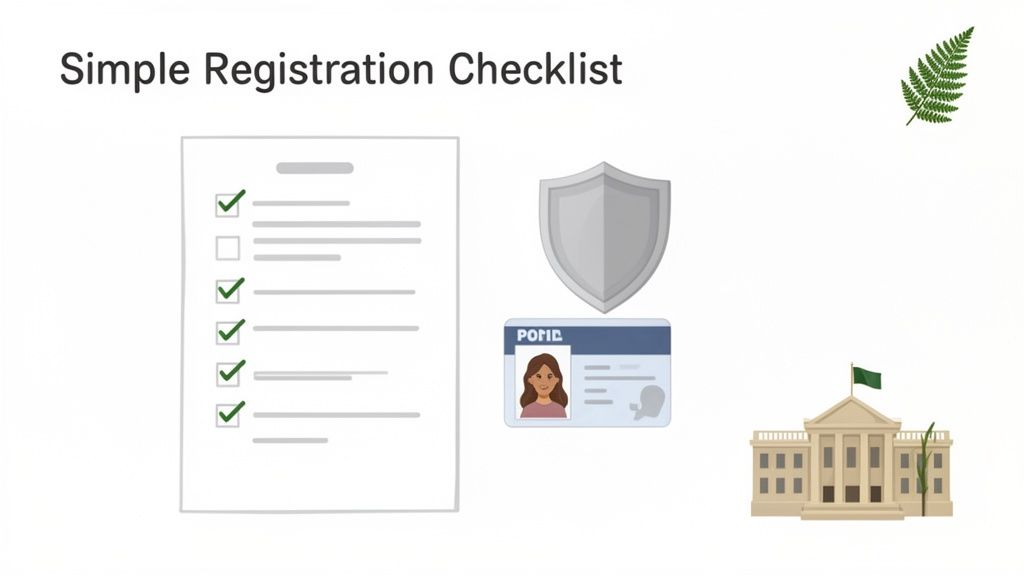
Think of the NCNZ as the guardian of nursing standards. Their primary role is to protect the public by making sure every single nurse on the register meets the required professional benchmarks. The application process can feel a bit overwhelming at first glance, but if you know what’s coming, you can get through it smoothly.
First things first, you'll need to gather a comprehensive set of documents. Organisation is your absolute best friend here. Having everything sorted and ready to go will save you a world of stress and prevent any annoying delays.
You’re essentially providing verifiable proof of who you are and what you've achieved. The NCNZ needs to be 100% certain that the person applying is the same person who earned that hard-won qualification.
The core documents you'll almost certainly need are:
Getting your documents certified correctly is non-negotiable. This usually means a Justice of the Peace (JP), lawyer, or another authorised person needs to see your original documents and then officially stamp the photocopies. Always double-check the NCNZ website for their specific list of who can certify documents for them.
It’s not just about your grades. The NCNZ needs to be confident that you are a person of good character and are fit to practise nursing safely. This involves a series of checks and declarations designed to get a clear picture of your integrity and overall health.
This part of the process is taken very seriously and shows you’re ready to handle the immense responsibility that comes with being a nurse.
You will need to consent to a New Zealand police check. If you’ve lived in another country for more than six months since you turned 17, you'll also have to provide a police certificate from each of those countries.
The key here is honesty. Be completely upfront about any convictions. A minor offence from years ago won't necessarily stop you from being registered, but trying to hide it definitely will. The Council looks at every case individually, considering what the offence was and how long ago it happened.
You must also make a formal declaration about your health. The NCNZ needs to be aware of any physical or mental health conditions that could potentially impair your ability to practise nursing safely.
This isn't about discriminating against people with health challenges. It’s about ensuring public safety. It also means that, if required, the right support or practice conditions can be put in place to help you succeed. Once again, total honesty is the only way to go.
Clear communication is the absolute bedrock of safe and effective nursing care. Because of this, every applicant has to show they have a strong command of the English language to practise safely in New Zealand.
If you did all of your secondary schooling in New Zealand, the United Kingdom, Ireland, Canada, or the USA, you might automatically meet this requirement. For everyone else, you'll need to pass an approved English language test.
The NCNZ accepts two main tests:
Crucially, you must achieve these scores in a single sitting of the test. Don't underestimate these exams—proper preparation is vital, as hitting these exact scores is a strict requirement for registration.
With your hard-earned registration from the Nursing Council in hand, you're officially ready to step into your new career. It's a huge moment, but it’s also when you need a clear-eyed view of the job market for new graduate nurses in New Zealand. Knowing what to expect will help you build a solid strategy for your job search.
The great news is that skilled nurses are in high demand across Aotearoa. To help graduates like you move smoothly from study into professional practice, there are structured systems in place. The most important one to get familiar with is the Advanced Choice of Employment scheme.
For most new graduates, the main path into a job is the Advanced Choice of Employment (ACE) scheme. This is a national programme that coordinates the placement of graduate nurses into their first year of practice, usually within Te Whatu Ora (Health New Zealand) facilities or other approved healthcare providers.
Think of ACE as a centralised matchmaker. You rank your preferred employers and clinical areas, and employers rank the candidates they’re interested in. An algorithm then works its magic to create the best possible matches, which really simplifies the job hunt for hundreds of graduates all at once.
Getting a spot through ACE has some serious perks:
The nursing job market for new grads is generally strong, but it’s also competitive. The demand for registered nurses in NZ is definitely surging, and programmes like ACE are pretty effective at connecting graduates with roles. For RNs, ACE success rates were high at 84.1% in 2023 and 84.4% in 2024.
However, a backlog can still happen, with some reports showing hundreds of RNs still in the talent pool by late 2025. This really highlights why it’s so important to have a competitive edge and be open to different opportunities.
Staying flexible is one of the most powerful strategies you can have. While you might have your heart set on a specific specialty or location, being open to other areas can significantly increase your chances of securing a position quickly.
This is also where preparatory learning can make a real difference. Taking flexible online courses in related fields like community services or health before you even start your degree can give you a broader understanding of the healthcare landscape, which is incredibly valuable to employers.
One of the best things about starting your nursing career in New Zealand is the clarity around pay. Most new graduates hired by Te Whatu Ora are covered by a collective agreement that clearly lays out salary steps based on your experience.
As a new graduate Registered Nurse, you'll start on Step 1 of the pay scale. Your salary then automatically increases each year as you move up the steps, reflecting your growing experience and expertise. This predictable progression gives you financial stability and a clear career path right from day one.
Even with a system like ACE, you still need a strong application that shows off your skills and passion for nursing. Your CV and cover letter are your first chance to make a fantastic impression.
As a new nursing graduate, you might be thinking about crafting a resume with limited experience. The key is to focus on your clinical placements. Detail the skills you developed, the types of patient populations you worked with, and any positive feedback you received from your preceptors. This practical, hands-on experience is exactly what employers are looking for.
Think about specialising in a high-demand area. For example, with New Zealand's ageing population, nurses with an interest in geriatric care are highly sought after. You can learn more about the rewarding pathways available by exploring a career in aged care. Showing a genuine interest in a specific field can make your application stand out and show you're ready to meet the critical needs of the health sector.
Deciding to become a nurse is a huge step, and the path is filled with detailed processes and important choices. It's completely normal to have a long list of questions. To help clear things up, we've tackled some of the most common queries from people just like you, with straight-to-the-point, practical answers.
The most direct route, a full-time Bachelor of Nursing degree, will take you three years. That timeline covers all your lectures, assignments, and the essential clinical placements you'll need to complete.
But what if you already have a degree in another field? In that case, you could look at an accelerated graduate-entry master’s programme. These are more intensive and typically wrap up in about two years. Just remember, these timeframes don't factor in any preparatory or foundation courses you might decide to take before diving into your degree.
This is a question we hear all the time, especially from career-changers or parents juggling family commitments. While some universities might offer part-time options for the theory side of the degree, it’s generally quite tricky to manage.
The biggest hurdle is the clinical placements. These are non-negotiable and demand a significant time commitment, often with inflexible hours that are tough to schedule around a job or family. If you absolutely need flexibility, your best bet is to talk directly with the admissions teams at different universities to see what, if any, arrangements they can make.
The journey is incredibly rewarding, but let's be honest, it has its tough moments. Knowing what to expect can make all the difference.
If I can offer one key piece of advice, it's this: build your support network from day one. Make friends with your classmates, get to know your tutors and clinical preceptors, and never be afraid to use the university's student support services. You aren’t expected to do this alone.
Absolutely not! In fact, it's quite the opposite. Nursing is a profession that truly values life experience, maturity, and a different perspective. So many people come into nursing as a second or even third career, and they often thrive.
Mature-age students bring a wealth of skills with them—think communication, empathy, and creative problem-solving honed in other jobs. As long as you can meet the academic entry criteria and handle the physical demands of the work, your age is a massive asset, not a barrier.
Don't panic. Missing NCEA Level 3 Biology or Chemistry doesn't mean your nursing dream is over before it starts. This is a very common scenario.
Your go-to solution is usually a foundation or bridging course offered by a university or polytechnic. These pre-degree programmes are specifically built to give you the exact science knowledge you need to walk into a Bachelor of Nursing with confidence. They're a fantastic way to get up to speed and show universities you're ready for the academic challenge.
This is also where flexible online courses can be a game-changer. Taking a self-paced course in human anatomy or biology before you even sign up for a full foundation programme can build your confidence and confirm your passion for the subject. It’s a low-risk way to test the waters and prepare yourself for the exciting journey ahead.
Feeling inspired but want to build your foundational knowledge before committing to a degree? Get Course can help you find a wide range of flexible, online courses in health and human services that can give you the perfect head start. Explore your options and prepare for your future nursing career today at https://getcourse.co.nz.


