Social Worker Career: Your Path to a Rewarding NZ Role
Explore the social worker career in New Zealand: qualifications, specialisations, salaries, and job outlook to kickstart your journey.
A career in social work isn't just a job; it's a calling dedicated to helping people navigate the toughest parts of their lives. It's about advocating for those who are often overlooked and working to build a fairer, more supportive society for everyone. This path blends counselling, connecting people with crucial resources, and fighting for social justice, all driven by a deep-seated belief in human rights and the power of community.
What a Social Worker Career Really Looks Like
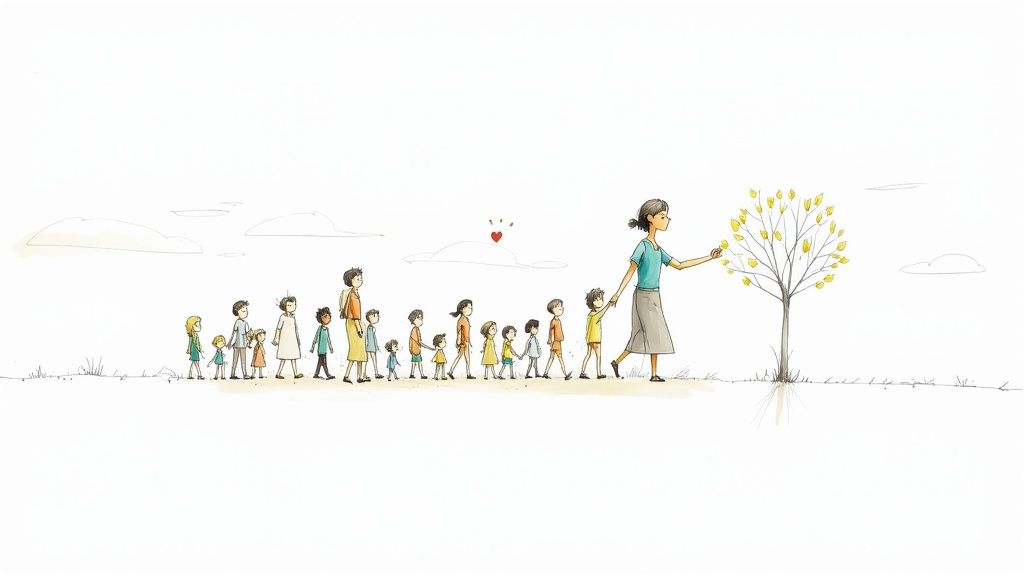
Let's look past the stereotypes and get to the heart of what being a social worker is truly about. At its core, this profession is about empowering people—individuals, whānau, and entire communities—to face life's challenges head-on and build the strength to thrive in the future.
Think of a social worker less as someone who carries people through their struggles, and more as a skilled guide. They provide the tools, point out the resources, and build the confidence people need to navigate difficult terrain on their own terms. This focus on empowerment is what makes the work so meaningful.
The Core Values Driving the Profession
In Aotearoa New Zealand, social work is built on a solid foundation of values that guide every single interaction. These aren't just buzzwords on a poster; they are the principles that shape the day-to-day practice of every social worker in the country.
Key commitments include:
Social Justice: Actively taking on inequality, discrimination, and the systemic roadblocks that hold people back.
Human Rights: Upholding the dignity and value of every person, making sure their rights are always respected and protected.
Adherence to Te Tiriti o Waitangi: Recognising and honouring the principles of The Treaty of Waitangi to ensure practice is culturally responsive and appropriate for Māori.
Social work is about working alongside people, their families, and communities in a holistic way to meet their needs, as well as advocate for wider societal change. It’s this dual focus on both individual support and broader systemic reform that makes the role so impactful.
Diverse Settings and Broad Impact
One of the most exciting things about a career in social work is just how varied it is. You aren't stuck in one type of workplace. Instead, you'll find social workers wherever people need support, whether that's in a busy hospital, a local school, a community organisation, or a government agency.
This variety is clear when you look at where social workers are employed across Aotearoa. Non-governmental organisations (NGOs) are the biggest employers, with 28% of the workforce. Oranga Tamariki is a close second at 26%, and the health sector also employs a significant number. It's also a field rich with experience—a huge 58% of social workers are seasoned practitioners, while only 11% are just starting out, showing a clear path for a long and stable career. You can dive deeper into these numbers with the workforce insights at Figure.nz.
This wide reach means you have the flexibility to shape your career around what you're passionate about, whether it's child protection, mental health, healthcare, or community development.
Your Roadmap to Becoming a Registered Social Worker
Starting a career as a social worker in Aotearoa New Zealand follows a clear and regulated pathway. It's not a field you can just jump into; it demands specific qualifications and legal registration to make sure you're ready for the role's complexities and can uphold professional standards. Think of this as your guide to navigating those essential steps.
The journey always starts with education. This is the non-negotiable first step, as a recognised qualification is the bedrock of your professional practice and your ticket to registration. Without it, you simply can't legally practise as a social worker in New Zealand.
This foundational requirement ensures every aspiring professional has the theoretical knowledge and hands-on skills needed to support individuals, whānau, and communities effectively.
Securing a Recognised Qualification
To kick off your career, you must complete an accredited social work qualification. The Social Workers Registration Board (SWRB), which is the profession's governing body in New Zealand, approves specific programmes that meet the national standards.
The most common pathways are:
A Bachelor of Social Work (BSW): This is a comprehensive four-year undergraduate degree. It covers social work theory, ethics, research, and includes vital practical fieldwork placements.
A Master of Social Work (MSW): This is usually a two-year postgraduate programme designed for people who already have a bachelor's degree in another field and want to move into social work.
These programmes are designed to build your competence and prepare you for the real world of the profession. For those looking to get a feel for the sector, a qualification like a NZ Diploma in Family Wellness and Crisis Intervention can offer valuable insights into the broader community services field.
Understanding the Role of the SWRB
Once you've got your qualification, the next crucial step is getting registered with the Social Workers Registration Board (SWRB). You can think of the SWRB as the guardian of the profession's integrity. Its job is to ensure that every practising social worker in New Zealand is competent, fit to practise, and accountable for their work.
Registration isn't just a piece of paper; it's a legal requirement. Under the Social Workers Registration Act 2003, you must be registered with the SWRB to call yourself a social worker or work in a role that requires social work skills.
This legal mandate is there to protect the public. It guarantees that the professionals they turn to for help have met strict national standards for education, competence, and ethical conduct.
Navigating the Registration Process
The application for registration is a thorough process, designed to confirm you're suitable for the profession. It involves several key steps to ensure you’re ready for the responsibilities that come with a social worker career.
The main steps include:
Submitting Your Qualification: You’ll need to provide proof of your SWRB-recognised social work degree.
Proving Fitness to Practise: This involves declarations about your character and any criminal history. The SWRB conducts police vetting for all applicants to assess their suitability.
Passing a Competence Assessment: You'll need to show that you meet the ten core competencies set by the SWRB, which cover everything from professional values and bicultural practice to communication skills.
This structured process ensures that every registered social worker is not only qualified but also embodies the integrity and ethical principles so essential to the role. For social workers qualified overseas, the SWRB has a specific pathway to assess their credentials, making sure they align with the standards and cultural context of Aotearoa New Zealand before granting registration.
Finding Your Niche in Social Work

A career in social work isn't just one single job. It's a huge field with all sorts of different paths, each giving you a unique way to make a real difference. Finding your specialisation is all about matching what you're passionate about with a specific community that needs your help.
Think of it like being a doctor. A GP has a broad knowledge base, but some decide to specialise as surgeons, paediatricians, or cardiologists. In the same way, social workers often find their focus in specific areas where they feel they can have the biggest impact.
Let’s explore some of the most common and vital specialisations here in Aotearoa New Zealand. By getting a feel for these different roles, you can start to see where you might fit best and what you can bring to the table.
Child Protection and Whānau Support
When most people picture a social worker, this is often the first field that springs to mind. Working in child protection is about safeguarding vulnerable children and supporting whānau to create safe, nurturing homes.
Social workers in this area, often with government agencies like Oranga Tamariki, are right on the front line, responding to concerns of abuse or neglect. It's incredibly complex and demanding work that calls for real resilience, sharp assessment skills, and a deep commitment to the wellbeing of children.
The role involves things like:
Investigating reports where a child might be at risk.
Developing and putting safety plans in place with families.
Connecting whānau with resources, like parenting programmes or financial support.
Working within the court system when it's necessary to ensure a child's safety.
Mental Health and Addictions
Another critical area is mental health and addictions social work. Here, you’ll support individuals and their families as they navigate the challenges of mental illness or substance dependency. This field demands huge amounts of empathy and a solid grasp of different therapeutic approaches.
You could find yourself working in a community mental health centre, a hospital's psychiatric unit, or a specialised addiction treatment service. The main goal is to empower people on their recovery journey, helping them build coping strategies, get the right treatment, and find their place back in the community.
Social workers in this space are advocates and coordinators. They make sure clients get holistic care that looks at the whole picture—not just clinical needs, but also things like housing, employment, and relationships.
Healthcare and Hospital Social Work
Hospitals are fast-paced environments where social workers play a really important part. When someone faces a sudden illness, a serious injury, or a life-changing diagnosis, the fallout goes far beyond just their physical health.
Medical social workers step in to help patients and their families manage the emotional, social, and practical chaos that comes with health challenges. They might arrange for care after a hospital stay, connect families with support groups, or help them find their way through a complex healthcare system. Their work is all about ensuring patients can recover with the best possible support network around them.
Other Impactful Social Work Fields
The opportunities in social work don't stop there; they touch almost every part of our society. You might also find your calling in:
School Social Work: Supporting students with social or emotional challenges that get in the way of their learning and wellbeing.
Justice System: Working in corrections facilities or with youth justice services to support rehabilitation and help reduce reoffending.
Community Development: Partnering with communities to figure out what they need and build local initiatives—a field closely related to broader roles in community services.
Each of these niches offers a different angle for applying the core values of social work. To help make things a bit clearer, the table below breaks down some of the key specialisations.
Comparison of Common Social Work Specialisations in NZ
This table outlines some of the main social work fields in New Zealand, giving you a snapshot of what each involves, who you might work for, and the skills you'll need to succeed.
As you can see, while the day-to-day tasks might look different, the underlying goal is always the same: to support and empower people to improve their lives.
Mapping Your Career Growth and Salary Potential
A career in social work is more than just emotionally rewarding; it offers a clear and sustainable path for professional and financial growth. Understanding this long-term journey is crucial for planning a successful career in a field dedicated to making a real difference in people's lives. Your path will naturally evolve from frontline practice to leadership and even strategic influence.
Think of your career like climbing a ladder. The first few rungs are all about building your core skills and finding your feet. Each step up brings new responsibilities, a chance for greater impact, and, of course, increased earning potential. This isn't just about seniority—it's about deepening your expertise and helping to shape the future of social practice in Aotearoa.
The Typical Career Progression
Your social work journey will almost certainly begin in a hands-on, frontline role. As a new graduate, you'll focus on building a solid foundation in casework, client assessment, and direct support. This is where you put all that theory into practice, developing the resilience and practical skills that are the bedrock of the profession.
From there, several exciting pathways can open up as you gain experience:
Senior Practitioner: After a few years in the field, you can step up to a senior practitioner role. Here, you'll tackle more complex cases, mentor junior social workers, and lend your expertise to team decisions.
Team Leader or Manager: If you've got natural leadership skills, moving into management might be your next step. This involves supervising a team, overseeing programme delivery, and managing budgets.
Specialist or Consultant: You might choose to become a go-to expert in a specific area, like child protection, mental health, or addiction services, acting as a consultant within your organisation or for the wider sector.
Policy Advisor: Seasoned social workers are incredibly valuable in government roles. They use their on-the-ground insights to help shape social policies and laws that affect thousands of Kiwis.
Pursuing postgraduate studies, like a Master’s degree or specialised certifications, can really fast-track this progression. Advanced qualifications often open doors to roles in clinical practice, research, academia, and senior leadership that require a higher level of specialised knowledge.
Understanding Your Salary Potential
While social work salaries in New Zealand have faced challenges in the past, recent pay equity settlements have significantly improved earning potential. This has made it a much more financially sustainable career. Your income will grow steadily with your experience, specialisation, and level of responsibility, ensuring your pay reflects your increasing expertise.
Your salary will generally be influenced by a few key factors:
Experience Level: New graduates can expect a solid starting salary, which grows substantially after you've got a few years under your belt. Senior practitioners and team leaders earn significantly more.
Sector: Pay scales can differ between government agencies (like Oranga Tamariki) and non-governmental organisations (NGOs), though pay equity agreements have helped to close this gap.
Location: You might see slight salary variations between major cities and regional areas, often reflecting the local cost of living.
While social work might not always appear on lists of the top 10 highest-paying jobs in NZ, the recent pay equity settlements mean it now offers a competitive and respectable income. A career as a social worker now provides not just profound personal fulfilment but also the financial stability needed to build a secure future. This balance makes it a highly attractive and viable long-term profession.
Finding Your Place in the Social Worker Job Market
If you’re ready to start your social work career in Aotearoa, you’re stepping into a field that’s both crying out for passionate people and facing some serious hurdles. Yes, qualified professionals are in huge demand, but it’s also a sector dealing with real issues like burnout and questions about its long-term sustainability. Getting your head around this landscape is the first step to not just landing a job, but building a career that lasts.
There’s no denying the need for skilled social workers, a need fuelled by complex social issues right across the country. But this demand is getting more intense because of a looming workforce shortage. The sector is caught in a perfect storm: student enrolments in social work have dropped to their lowest point since 2013, just as a large group of experienced practitioners are getting close to retirement.
This creates a unique situation—it's both an opportunity and a word of caution. While there are definitely jobs out there, the industry is under a lot of pressure. This means you need to be smart about your job search and realistic about the profession's demands. Workforce data also shows some big regional differences. For instance, areas like Gisborne have the highest concentration of social workers at 2.41 per 1,000 people. This shows where resources are currently focused and, more importantly, where the gaps might be. You can dig deeper into the data on the sustainability of the social worker workforce to get a clearer picture of these trends.
Pinpointing High-Need Regions and Sectors
Want a competitive edge? Focus your job search on the areas where the need is greatest. Social workers are essential everywhere, of course, but some regions and specialisations are consistently struggling to find enough qualified people.
Here are a few key areas to keep an eye on:
Rural and Regional Aotearoa: Smaller towns and rural communities often find it tough to attract and keep professionals. This opens up some fantastic opportunities if you’re willing to work outside the major cities.
Mental Health and Addictions: This field is facing a nationwide shortage of skilled practitioners. Demand is high across the board, from DHB roles to community-based NGOs.
Child Protection: Agencies like Oranga Tamariki are always on the lookout for dedicated social workers to support vulnerable children and their whānau.
By zeroing in on these high-need areas, you could significantly boost your chances of landing a role soon after you graduate.
Crafting a CV That Stands Out
In social work, your CV is much more than a list of qualifications. It’s a chance to show your values and your deep understanding of what this work is all about. A generic, copy-paste application just won’t do the job. You need to show employers you have the specific skills and personal qualities they’re desperately seeking.
Make your CV really count by highlighting:
Field Placements: Don't just list where you did your practicum. Detail the skills you built, the client groups you worked with, and any specific achievements or contributions you made.
Bicultural Competence: Clearly state your understanding of and commitment to Te Tiriti o Waitangi. Show how you can work effectively and respectfully with Māori.
Resilience and Self-Care: It might seem personal, but briefly mentioning your awareness of burnout and the self-care strategies you use is a huge plus. It shows maturity and that you’re thinking about a sustainable, long-term career.
Your cover letter is where you bridge the gap between your personal values and the organisation’s mission. Do your homework. Find out what they’re about and explicitly state why you believe in their work and how you can help them achieve their goals.
Acing the Values-Based Interview
Social work interviews aren’t about trick questions. They’re designed to get a sense of your character, your ethics, and whether you’re truly a good fit for the role. Employers need to know who you are as a person and how you’ll handle the incredible responsibility that comes with the job.
Get ready to answer questions that explore:
Your Motivation: Why social work? What is it that drives you to do this challenging work every day?
Ethical Dilemmas: You’ll almost certainly be given a tricky scenario and asked how you’d navigate it. This is a test of your ethical compass and critical thinking.
Cultural Understanding: Expect questions about your experience working with diverse communities and your approach to culturally responsive practice.
Handling Stress: How do you cope with emotionally draining situations or a heavy caseload? What does support look like for you?
Be authentic. Draw on real examples from your placements or volunteer work. This is your chance to show you have the integrity, empathy, and strength to build a successful and truly impactful career.
Common Questions About a Social Worker Career
Thinking about a new career always brings up a lot of questions. When that career is social work—a path known for its unique demands and incredible rewards—it’s no surprise you want to get a clear picture before you dive in.
To help you make confident decisions about your future, we’ve put together answers to some of the most common questions we hear from aspiring social workers in New Zealand. This is a no-nonsense look at everything from timelines and challenges to your first steps after graduation, so you know exactly what to expect.
How Long Does It Take to Become a Social Worker?
One of the first things people want to know is the timeline. Becoming a registered social worker in New Zealand isn’t something you can do overnight; it involves dedicated tertiary study and a formal registration process to make sure you’re fully prepared for the job.
The exact timeframe really depends on where you’re starting from:
Bachelor of Social Work (BSW): If you’re starting from scratch, this is the most common path. A BSW is a four-year undergraduate degree. It gives you a solid grounding in social work theory, ethics, and hands-on skills through fieldwork placements.
Master of Social Work (MSW): Already have a bachelor's degree in another field? A Master of Social Work could be for you. This is typically a two-year postgraduate programme, offering a faster route into the profession.
Once you’ve earned your accredited degree, the final step is applying for registration with the Social Workers Registration Board (SWRB). The processing time can vary, but it's the official green light you need to legally practise. All up, you should plan for two to four years of study before you can officially start your career.
What Are the Most Challenging Parts of the Job?
A career in social work is deeply fulfilling, but it’s crucial to go in with your eyes wide open. The work is emotionally and mentally tough, and knowing what to expect is the first step to building a career that lasts.
One of the biggest hurdles is dealing with emotionally heavy cases. You’ll be working alongside individuals and whānau going through significant trauma, grief, and crisis. Holding space for that level of distress requires incredible empathy, but it can also lead to emotional exhaustion or compassion fatigue if you don’t look after yourself.
Navigating systemic barriers is another major challenge. Often, the very systems designed to help—like healthcare, housing, or justice—are under-resourced or incredibly difficult for people to access. A huge part of your job will be advocating for your clients, which can be frustrating when progress feels slow.
The reality of social work is that you are often a bridge between a person in crisis and the resources they need. Sometimes that bridge is strong and easy to cross, but other times you have to build it one plank at a time, fighting against the current.
This is exactly why self-care isn't just a buzzword in social work; it's essential for survival. To avoid burnout, you have to develop solid strategies for managing stress, setting boundaries, and getting support through professional supervision and your colleagues.
The high emotional stakes and systemic pressures are real. In New Zealand, recruitment and retention are major issues, with research showing that 16% of surveyed social workers plan to leave the profession within the next five years, often due to burnout and high workloads. You can learn more about these trends in the SWRB workforce surveys.
Can I Specialise Right After I Graduate?
It's completely normal to feel drawn to a specific area like child protection, mental health, or community development. However, you’ll rarely see a new graduate step straight into a highly specialised role. Most employers—and the profession as a whole—strongly recommend starting in a more generalist position first.
Think of it like building a house. You can’t install the fancy wiring or plumbing until you’ve poured a solid, reliable foundation. A generalist role is your foundation. It’s where you’ll sharpen your core clinical skills and learn to think on your feet.
Here’s why that foundational experience is so important:
Building Your Toolkit: You'll get hands-on experience with the essentials: risk assessment, crisis intervention, case management, and client advocacy. These are the skills you'll use every single day, no matter where you end up.
Learning the Landscape: A generalist role shows you how different systems (health, justice, education) connect and overlap. That big-picture view is priceless, even when you eventually specialise.
Finding Your Fit: It’s a chance to test the waters. You might even discover a passion for a field you never considered during your studies.
After a few years of building that strong base, you'll be in a much better position to move into a specialty. You won’t just have the core skills to succeed; you’ll also have a much clearer idea of where your talents and passions truly lie, setting you up for a long and impactful career.
Ready to take the first step towards a meaningful career in social work or community services? Get Course offers a range of flexible, online courses designed to help you build the skills and knowledge you need. Explore your options and start your journey today.
Find Your Course
Compare courses across every field we write about, and enquire in under a minute.