What is cybersecurity awareness training - A Practical Guide to Safer Online
What is cybersecurity awareness training? Discover essential topics, practical tips, and steps you can take to defend against online threats.
Cybersecurity awareness training is all about teaching people how to spot, avoid, and report digital threats. Think of it as developing your digital self-defence skills—instead of just reacting to an attack, you learn the instincts to stop it from ever happening in the first place.
What Is Cybersecurity Awareness Training Really?
At its heart, cybersecurity awareness training flips the script, turning the human element from the weakest link in security into its strongest asset. Sure, technology like firewalls and antivirus software is essential, but it can't stop a person from accidentally clicking a malicious link or sharing a password when they shouldn't.
This is the critical gap that training fills. It’s less about tech and more about changing behaviour and building good security habits, empowering everyone to become an active part of the defence.
Moving Beyond Technical Jargon
The goal isn't to turn everyone into a cybersecurity expert overnight. Far from it. The real aim is to make digital safety practical and easy to grasp for anyone, regardless of their technical background. Good training cuts through the complex jargon by focusing on real-world scenarios and simple, actionable steps.
Effective programmes usually cover core topics like:
- Phishing and Social Engineering: Learning how to identify deceptive emails, texts, and calls designed to trick you into giving away sensitive information.
- Strong Password Practices: Creating and managing secure passwords that are tough for attackers to guess or crack.
- Safe Internet Browsing: Recognising unsecured websites and understanding the very real risks of using public Wi-Fi.
- Protecting Sensitive Data: Knowing how to handle confidential information responsibly, both at work and at home.
The table below breaks down how your newfound awareness directly counters common threats.
Understanding Your Role in Cybersecurity
A quick overview of common threats and how awareness training empowers you to become an active defender against them.
Ultimately, this training gives you the confidence to navigate the digital world safely.
Why Awareness Is Your First Line of Defence
Cyber attackers often bank on human error to succeed. They know it's far easier to trick a person into opening a digital door than it is to break down a reinforced firewall. For instance, a single click on a convincing but fake invoice can unleash ransomware that paralyses an entire business.
Cybersecurity awareness builds a proactive security culture. It shifts the mindset from "IT will handle it" to "we all have a role to play in keeping our data safe."
This foundational knowledge is no longer just a nice-to-have; it's essential. It protects your personal finances, secures sensitive workplace data, and builds a collective resilience against online threats. To really empower your team and establish robust digital defences, you can explore this complete guide to cybersecurity training for employees.
Why This Training Is a Must-Have in New Zealand

The need for cybersecurity awareness training isn't just some global trend—it's a serious issue hitting us right here at home in New Zealand. These threats aren't distant problems for overseas corporations anymore. They’re actively targeting everyday Kiwis, our local small businesses, and major organisations across the country.
This isn’t just a hunch. The data paints a pretty clear picture of the risks we’re all facing. Cyber incidents are on a steady climb, which means it’s more and more likely that you or someone you know will be in the crosshairs.
The frightening reality is that a single click, a momentary lapse in judgement, can have massive consequences. When was the last time you got an unexpected text about a package delivery or a strange alert from your bank? Without knowing what to look for, it's dangerously easy to tap on a dodgy link and hand over your personal details to criminals.
The Growing Threat Landscape for Kiwis
Cyber attackers are getting smarter. They’re tailoring their scams to exploit our trust in familiar Kiwi brands and government services. We're seeing everything from fake NZ Post tracking links to incredibly convincing emails that look like they're straight from Inland Revenue. These threats are designed to look legitimate and catch us off guard.
This surge in attacks shines a light on a critical vulnerability. Here in New Zealand, CERT NZ responded to 1,968 incidents in Q1 2023 alone. That’s a 12% jump from the previous quarter. This spike shows just how frequently Kiwis and local businesses are being targeted by phishing and unauthorised access attempts, which themselves saw a staggering 35% rise.
Worse still, without the right training, people are falling for it. One test found that 12.1% of New Zealand business employees clicked on phishing links, and 8.4% went as far as entering their passwords on fake sites. You can dig into the full CERT NZ report to see just how these local trends are shaping up. This data proves the threat isn't just real; it's growing.
It's no longer a question of if you'll encounter a cyber threat, but when. Cybersecurity awareness training gives you the skills to spot it and know exactly what to do when it happens.
It's About Real Impact, Not Just Numbers
Behind every one of those statistics is a real person or a local business dealing with the fallout. For an individual, a successful scam can mean stolen savings, identity theft, and a huge amount of stress. For a small business in Hamilton or a community group in Dunedin, a ransomware attack could shut down their entire operation, leading to financial ruin and a shattered reputation.
These scenarios are exactly why cybersecurity awareness is so critical:
- Protecting Your Finances: Learning to spot scams is the best way to guard your bank accounts and credit card details against fraudsters.
- Securing Small Businesses: When employees know how to recognise threats, they can prevent data breaches that a small business might never recover from.
- Safeguarding Community Trust: When organisations handle personal data securely, they protect the trust they’ve built with their customers and community.
Building these skills is an investment in your own resilience, both personally and professionally. If you’re keen to get started, you might want to explore some of the best free online courses available in NZ to kick off your learning journey. At the end of the day, cybersecurity awareness is about giving you the control to protect what matters most.
Core Skills You Will Learn in Effective Training Programs
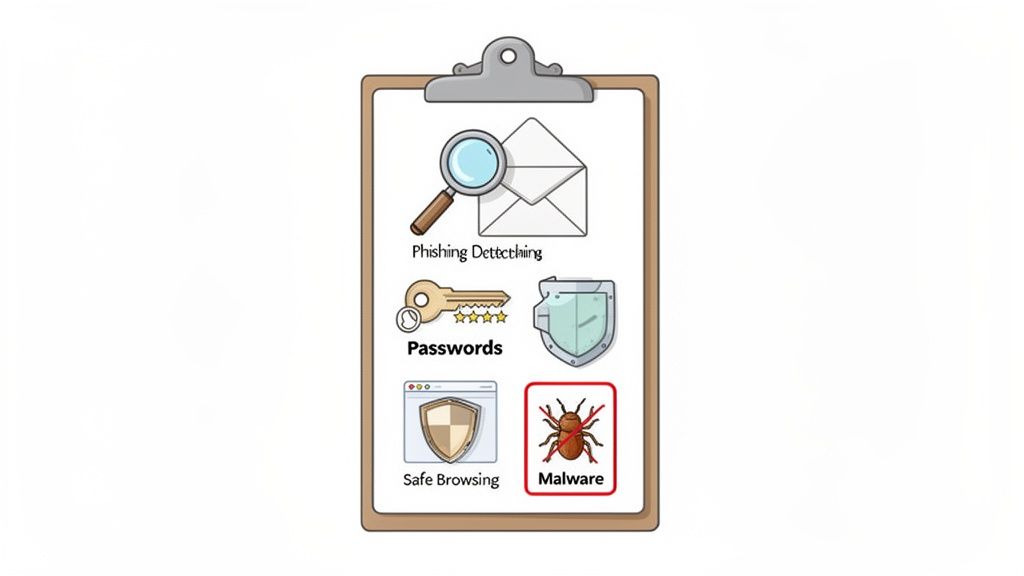
A good cybersecurity awareness programme isn't about memorising technical jargon. It’s about giving you a set of practical, real-world skills you can use the moment you finish a module. Think of it as building a toolkit for your digital life, one that helps you protect both your personal and professional information.
The best training cuts through the complexity, breaking down digital threats into simple, recognisable patterns. The goal is to build your instincts, turning you from a passive user into an active defender of your own data.
Spotting Phishing and Social Engineering
One of the most valuable skills you'll walk away with is the ability to spot phishing—the number one weapon in a cybercriminal's arsenal. These are the sneaky emails, texts, and messages designed to trick you into handing over logins, financial details, or other sensitive data.
You’ll learn to spot the red flags that give these scams away. For instance, that "urgent" email from your bank demanding you verify your account by clicking a dodgy link? That’s a classic. Training teaches you to hover over links to see where they really go, check for sloppy spelling, and question any message trying to rush you into a bad decision.
This skill also helps you defend against social engineering, where attackers manipulate your trust to bypass security. It could be a convincing phone call from someone pretending to be from IT, asking for your password to "fix" a problem.
By understanding the psychology behind these attacks, you develop a healthy scepticism. You learn to pause, think critically, and verify requests through official channels before ever sharing information.
This instinct alone can stop a huge number of potential security breaches in their tracks.
Creating and Managing Strong Passwords
Passwords are the front door keys to your entire digital world, yet so many of us use weak, predictable ones across multiple accounts. Effective training goes beyond just telling you to use a "strong" password; it actually shows you how to create and manage them without the headache.
You'll learn simple strategies for building passphrases that are both memorable and incredibly tough for computers to guess. For example, instead of the flimsy "Password123", you might learn to create something like "MyDogFluffyLovesCarrots!", which is much harder to crack.
More importantly, you’ll understand why using a unique password for every single account is non-negotiable. If one website gets breached, criminals won't be able to use that stolen password to get into everything else. Training often introduces you to password managers—secure digital vaults that remember all your unique passwords for you.
Recognising Malware and Ransomware Threats
Malware is the catch-all term for malicious software, from viruses and spyware to the particularly nasty threat of ransomware. Ransomware is a digital nightmare where attackers encrypt all your files, locking you out until you pay them a hefty fee.
A quality training programme will teach you exactly how these threats get onto your devices:
- Suspicious Attachments: You'll learn to instinctively distrust unexpected attachments, especially official-looking files like invoices or shipping notifications you weren't expecting.
- Dubious Downloads: Understanding the danger of grabbing software from unofficial websites is key to avoiding malware that’s bundled with it.
- Infected Websites: Training helps you recognise the signs of unsafe sites that might try to sneak malicious code onto your computer.
Learning to identify common cyber threats is a cornerstone of any good security awareness course. The table below summarises some of the key threats, what attackers are trying to achieve, and the tell-tale signs to watch out for.
Key Cybersecurity Threats and How to Spot Them
By learning to spot these delivery methods, you can avoid the simple actions that lead to infection. The goal is always prevention. These practical skills are what cybersecurity awareness training is all about, and you can find many great courses to build your expertise in Information Technology.
How to Build a Strong Security Culture
Knowing the theory behind cybersecurity is one thing, but turning that knowledge into instinct is where real change happens. A strong security culture is built when safe digital habits become second nature—not just for individuals, but across an entire organisation.
This is the shift from passive awareness to active defence. It’s about creating an environment where security is a shared responsibility, not just another task for the IT department. And to get there, we need to move beyond the simple, once-a-year training session that’s quickly forgotten.
Making Training Engaging and Effective
For any cybersecurity awareness training to actually stick, it needs to be more than a dry presentation of facts and figures. People learn best when they’re engaged, so the most effective programmes use clever techniques to grab attention and make the lessons memorable.
Storytelling is a powerful tool. Instead of just listing the dangers of phishing, a good programme might share a real-world story of how a small Kiwi business was hit hard by a single fraudulent email. This narrative approach makes the threat feel real and the consequences relatable, ensuring the lesson hits home.
Another key is making it interactive. Passive learning rarely leads to lasting change.
Here are a few approaches that genuinely work:
- Interactive Online Modules: These let learners click, drag, and answer questions. It turns a boring lesson into an active experience.
- Simulated Phishing Exercises: Sending out safe, simulated phishing emails helps people practise their detection skills in a controlled environment. They get immediate feedback without any of the real-world risk.
- Gamification: Adding elements like leaderboards, points, and badges brings a bit of friendly competition into the mix and makes the whole learning process more enjoyable.
These methods help reinforce the core concepts of what is cybersecurity awareness training by making learning dynamic and practical.
Fostering a Continuous Learning Mindset
A one-off training session is like a single workout—it feels good for a day, but it won’t get you fit. A true security culture is built through consistent, ongoing effort. The threat landscape is always shifting, with new scams and attack methods popping up constantly.
A strong security culture thrives on continuous learning. It frames cybersecurity not as a destination to be reached, but as an ongoing journey of adaptation and improvement.
This means regularly reinforcing key messages and sharing updates on new threats. Short, frequent touchpoints are far more effective than long, infrequent sessions. Think a monthly security newsletter or a quick weekly tip—enough to keep awareness top-of-mind without causing information overload.
For individuals, this mindset is just as important. Taking ownership of your digital safety means staying curious and proactive. Self-paced online learning is a fantastic way to do this, letting you build valuable skills on a schedule that fits your life. This flexible approach means you can dive deeper into topics that genuinely interest you, turning awareness into a lasting habit.
Seeing the Results of Your New Cybersecurity Skills
After putting in the time and effort with cybersecurity awareness training, how do you know if it's actually making a difference? The great thing is, the results aren't just theoretical; they show up in real, tangible ways in our everyday digital habits. Measuring the impact is all about spotting that fundamental shift in behaviour, whether it's for yourself or across an entire organisation.
For a business, the proof is in the data. Key indicators often show a direct, measurable return on the training investment. For instance, a company can track a noticeable drop in the number of staff who click on links during controlled phishing simulations. That’s a clear sign the lessons on spotting fake emails are sinking in and becoming second nature.
Another powerful metric is a jump in the number of employees actively reporting suspicious emails and messages. This kind of proactive behaviour is a massive win. It signals a healthy security culture where people feel empowered and responsible for helping defend the organisation—a real shift from being a potential target to being part of the solution.
Spotting the Success in Your Own Habits
On a personal level, the signs of success are more subtle but just as important. It’s about the small, consistent actions you start taking without even thinking about it. You know the learning has stuck when safe practices become automatic.
You’ll know your new skills have taken root when you find yourself:
- Instinctively using Multi-Factor Authentication (MFA): You switch on MFA for all your important accounts not because you have to, but because you genuinely understand it’s a critical layer of protection.
- Creating stronger passwords without being told: Instead of recycling the same old password, you naturally create complex, unique passphrases for different services. It just feels right.
- Spotting scam messages instantly: You can quickly identify the classic red flags of a phishing text or social media scam and delete it without a second thought.
- Pausing before you click: You automatically question urgent requests for information or tempting links, taking a moment to verify them through a trusted channel first.
The ultimate measure of success is a change in mindset. You start to see the digital world through a more critical lens, navigating online interactions with confidence because you know exactly what to look for.
The Real-World Benefits for New Zealanders
This change in behaviour is especially crucial in New Zealand's current digital environment. CERT NZ received around 2,140 incident reports in Q3 2023 alone, with a huge chunk of attacks on businesses stemming directly from human error or successful phishing attempts. This highlights a critical vulnerability that effective training directly fixes.
By measuring changes in behaviour and incident rates after training, organisations can see a direct link between education and a reduction in successful cyber attacks. You can discover more insights into New Zealand's cyber threat reports to get a better handle on the local context.
Ultimately, whether you're looking at it from a company-wide or an individual perspective, the impact of good cybersecurity awareness training is clear. It’s visible in a stronger, more confident digital presence where informed decisions replace risky clicks. That newfound confidence is the most valuable return you can get on your investment in learning.
Your Next Steps in Mastering Digital Safety
Knowing what digital threats are out there is a great start, but turning that knowledge into a real defence takes ongoing effort. Your own awareness is the single most powerful tool you have. It’s that gut feeling that stops you from clicking a dodgy link, and it’s the habit of using strong, unique passwords for everything. That’s the real goal of cybersecurity awareness training.
Embracing this journey isn’t just about dodging scams. It’s about building the confidence to handle any online situation, protecting your money, securing your personal information, and helping create a safer digital space for everyone.
Finding a Path That Fits Your Life
For most busy adults, the idea of going back to traditional study feels impossible. This is where flexible, self-paced learning really shines. Modern online courses are built to slot into your existing life, letting you pick up valuable, sought-after skills on your own time.
You don't need to be an IT whiz to get started. These programmes are designed to build your skills from the ground up, with a strong focus on practical knowledge you can use right away. Gaining a certificate in an area like IT or business doesn’t just boost your personal security; it also adds a powerful credential to your CV.
Continuous learning is just a smart career move. In a world where digital skills are a must-have in almost every job, showing you’re committed to staying current can open doors to new roles and opportunities for growth.
Building Your Skills for a Safer New Zealand
The need for these skills is a serious national issue. In 2023/2024, CERT NZ dealt with 7,779 incidents, with the vast majority hitting everyday Kiwis and small businesses. While the government has initiatives in place, many people simply don’t have access to proper training, which leaves a massive gap. This is where self-paced online courses come in, giving New Zealanders the flexible learning they need to face today’s cyber challenges.
This is your chance to take control. By investing in your own learning, you’re not just protecting yourself—you’re becoming part of the solution. You can start exploring practical learning opportunities right now. Check out the wide range of online courses available that can help you upskill at your own pace and build a more secure digital future.
Frequently Asked Questions
It's natural to have questions when you're navigating the world of digital safety. Here, we tackle some of the most common queries about cybersecurity awareness training, giving you clear, straightforward answers to help you on your way.
How Often Should Cybersecurity Awareness Training Be Conducted?
Effective cybersecurity training isn’t a one-and-done event; it's an ongoing process. Because digital threats are constantly evolving, your knowledge needs to keep pace. Most experts agree that formal training should happen at least once a year.
But that’s just the starting point. This annual session should be backed up with regular, bite-sized updates throughout the year. Think simulated phishing exercises, quick security reminders, or alerts about new scams. This continuous approach keeps security front-of-mind and helps good habits stick for the long haul.
Is Cybersecurity Training Only for IT Professionals?
Not at all—this is a very common misconception. Since human error is behind most security breaches, cybersecurity is truly everyone's responsibility. Every single person who uses a computer, smartphone, or email is a potential target.
That’s why this training is vital for staff in every role, from administration and marketing to sales and operations. It’s also essential for anyone who simply wants to protect their personal information, finances, and family from online threats.
The reality is simple: if you are online, you are a target. Training provides the skills needed to be a defender, not a victim, making it relevant for everyone, regardless of their technical background.
What Is the Single Most Important Skill I Can Gain?
While there are many crucial skills, the ability to recognise and correctly respond to phishing attempts is arguably the most critical. Phishing is the gateway for a huge number of cyber attacks, including devastating ransomware infections and costly data theft.
Learning to critically assess emails, texts, and other messages is a complete game-changer. Developing a healthy scepticism towards unsolicited or urgent requests gives you the biggest and most immediate boost to your personal and professional security. This one skill can prevent countless problems down the line.
Can I Learn These Cybersecurity Skills Online on My Own?
Yes, absolutely. High-quality online courses are specifically designed for self-paced learning, making them a perfect fit for busy adults. Platforms can offer structured programmes that cover everything from the basics to specific IT skills, all from the comfort of your own home.
This flexible approach means you can gain valuable knowledge and earn certificates on a schedule that works for you. It puts you in the driver's seat, allowing you to upskill for a new career or simply become a safer, more confident online user.
Ready to take control of your digital safety? Get Course New Zealand offers a wide range of flexible, online courses designed to help you build in-demand skills at your own pace. Explore your options and start your learning journey today at https://getcourse.co.nz.
Find Your Course
Compare courses across every field we write about, and enquire in under a minute.