Your Guide to a Degree Online Psychology in New Zealand
Explore every degree online psychology in NZ. Compare qualifications, costs, and career paths to find the perfect course for your goals and lifestyle.
Imagine being able to explore the complexities of the human mind from anywhere in New Zealand, fitting your studies neatly around your life. With a growing need for mental health professionals across the country, an online psychology degree offers a seriously flexible and accessible path into a rewarding field. It's the perfect way to balance learning with work, family, or whatever else you have on the go.
Starting Your Online Psychology Journey in New Zealand
Choosing to study psychology is more than just an academic decision; it's a step towards understanding the intricate dance of human behaviour, thought, and emotion. The demand for people who can apply psychological principles is booming, stretching far beyond clinical settings into business, education, marketing, and community services. This guide is here to demystify the entire process, from foundational certificates to advanced master's degrees, helping you find the perfect fit for your ambitions.
Studying psychology online gives you a unique chance to gain in-demand skills without having to relocate or commit to a physical campus. For busy adults, this flexibility is a game-changer. You can dive deeper into the benefits and structure of remote learning in our complete guide to online study in NZ.
Understanding Your Options
The path you take will depend entirely on where you are now and where you want to be. The good news is there’s a qualification designed for every stage of your journey.
- Entry-Level Certificates: These are ideal if you want to dip your toes in, gaining foundational knowledge without the commitment of a full degree.
- Diplomas: Offering a more substantial introduction, diplomas often act as a handy stepping stone into a bachelor's degree.
- Bachelor's Degrees: This is the core undergraduate qualification and the essential starting block for most professional psychology roles.
- Postgraduate Study: Options like Graduate Diplomas and Master's degrees are perfect for specialising or for career-changers who already have a degree in another field.
Don't think for a second that online study is a lesser option. You get the same high-quality education and respected qualifications as on-campus students. The key difference is the freedom to build your learning schedule around your life, making higher education more achievable than ever before.
To help you map things out, the table below gives a quick overview of the different psychology qualifications available online in New Zealand. It breaks down the typical time commitment and focus for each level, so you can see at a glance which path aligns with your goals.
Online Psychology Qualifications in NZ At a Glance
This snapshot should give you a clearer picture of your potential learning journey and how each option can shape your future career.
Exploring Each Level of Online Psychology Study
Deciding to study psychology online is an exciting move, but it's not a one-size-fits-all journey. Think of it like building a house. You wouldn't put up walls without a solid foundation, and each level of study builds on the last, serving a different purpose depending on your career goals. Whether you’re starting from scratch or adding another level to your existing qualifications, there’s a perfect entry point for you.
This section breaks down each qualification, from introductory programmes right through to the comprehensive knowledge you’ll gain in a bachelor's degree. We'll explore what you learn at each stage, the skills you'll develop, and how different courses are structured. This should give you the clarity to choose the right place to begin your journey with confidence.
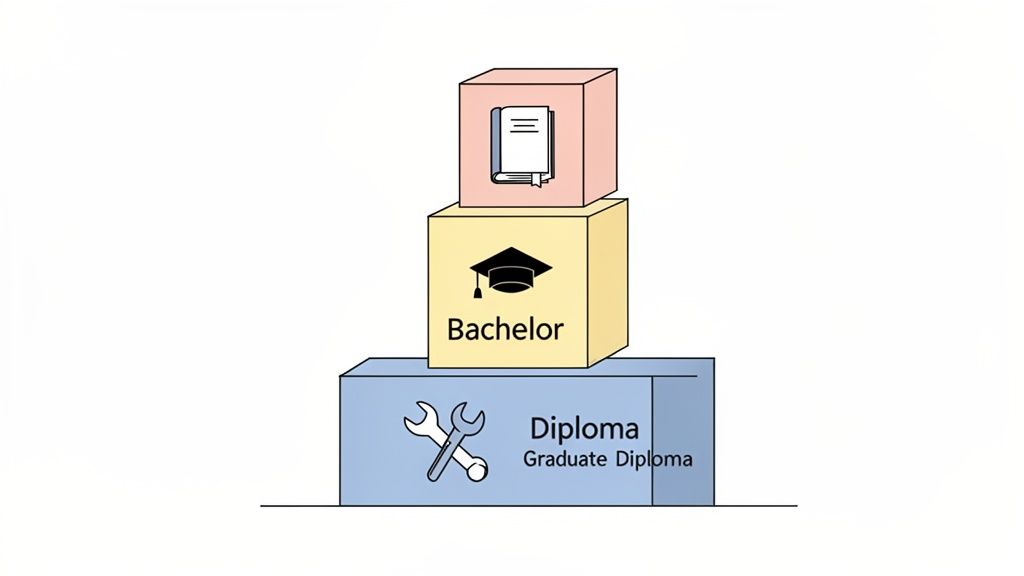
Certificates and Diplomas: The Foundation
If you're new to psychology or want to apply basic principles in your current role, a certificate or diploma is the ideal starting point. These programmes are like the concrete slab and framework of your educational house—they provide the essential structure you need before you can build higher.
Certificates offer a focused introduction to core concepts. You'll typically cover foundational topics like:
- Introduction to Psychology: Understanding the history and major schools of thought.
- Human Development: Exploring how people grow and change from infancy to old age.
- Social Psychology: Learning how individuals think, feel, and behave in social situations.
Diplomas take it a step further, giving you a more comprehensive grounding. They often act as a direct pathway into a bachelor's programme, letting you get a feel for university-level study with less of an upfront commitment. Both are fantastic for gaining knowledge you can apply in support roles across community services, human resources, or education.
Bachelor's Degrees: The Main Structure
For anyone serious about a career in psychology, the Bachelor's degree is the most common and essential qualification. This is the main structure of your house—the walls, rooms, and roof that make it a complete and functional dwelling. It’s a deep dive into the science of the mind and behaviour, giving you a broad and robust understanding of the field.
A typical online Bachelor's degree in psychology covers a huge range of subjects, moving from general principles to more specialised areas. You’ll build crucial thinking and research skills, learning not just what we know, but how we know it.
Earning your psychology degree online provides the same rigorous, high-quality education as an on-campus programme. The key difference is the freedom to learn on your own terms, making it a powerful option for balancing study with life's other demands.
Imagine juggling a full-time job and family commitments while still chasing your passion for understanding the human mind—all from your home in New Zealand. That's the reality for thousands of Kiwis who enrol in online psychology degrees, like the Bachelor of Applied Science (Psychology) offered by some tertiary providers. These qualifications are typically equivalent to three years of full-time study, but a flexible online format lets busy adults complete it part-time over several years.
This level of study is critical because it’s often the prerequisite for the postgraduate training needed to become a registered psychologist. But even on its own, a Bachelor's degree opens doors to a huge range of careers. You can explore the variety of qualifications available, including different Bachelor's degrees offered online.
Graduate Diplomas: Renovating for a New Career
So, what if you already have a bachelor's degree in a completely different field, like business or arts, but you've discovered a passion for psychology? This is where the Graduate Diploma comes in. Think of it as a career renovation—you're not tearing down your existing structure, but reconfiguring it for a new purpose.
A Graduate Diploma in Psychology is designed specifically for degree-holders from other disciplines. It acts as a bridging qualification, covering the core, undergraduate-level psychology subjects you missed. This intensive programme gets you up to speed without you having to start another three-year bachelor's degree from scratch.
Completing a Graduate Diploma typically allows you to:
- Meet the prerequisites for postgraduate study in psychology, such as a Master's degree.
- Gain eligibility to apply for registration with professional bodies after further training.
- Apply psychological principles in your existing field, adding valuable new skills to your professional toolkit.
For career changers, this pathway is an efficient and popular choice, providing a direct route into the world of psychology. It respects the value of your previous study while giving you the specific knowledge needed to move forward in a new and exciting direction. Each level, from certificate to graduate diploma, offers a unique entry point into the fascinating study of the human mind.
What to Expect From Your Online Learning Experience
Dipping your toes into an online psychology degree can feel a bit like stepping into the unknown, but it's a path many have walked before you. The whole experience is designed for flexibility, blending self-directed study with plenty of structured support. Let's lift the hood and see what your day-to-day study will actually look like.
Most online courses are run through a central online learning portal. Just think of it as your virtual campus. It's the one-stop shop for everything you need: lecture recordings, reading materials, places to submit assignments, and discussion forums to connect with tutors and other students. This setup means you can build a study routine that genuinely fits around your life, not the other way around.
To really get the most out of your studies, you'll want to build some solid academic habits. Knowing how to improve your reading comprehension skills is a game-changer when you're digging into complex psychological theories and research papers.
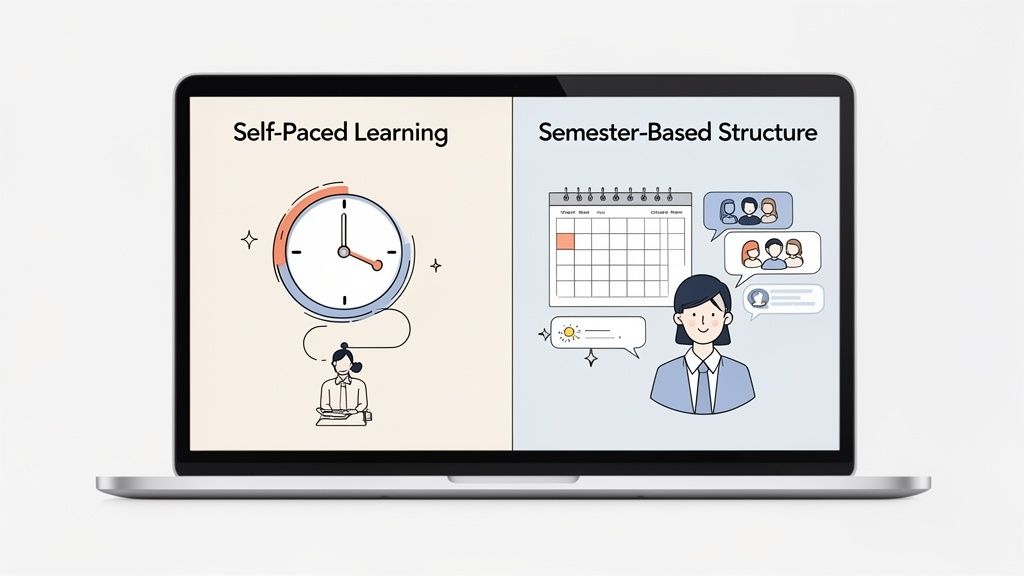
Structured Semesters vs Self-Paced Learning
One of the biggest forks in the road you'll encounter is the learning pace. Getting your head around this difference is crucial for finding a programme that clicks with your lifestyle and level of self-discipline.
- Structured Semesters: This approach mirrors what you’d find at a traditional university. You enrol in units for a set period (like a semester) with fixed start dates, assignment deadlines, and exam blocks. It provides a clear rhythm and keeps you moving forward with a group of your peers.
- Self-Paced Learning: This option offers the ultimate freedom. You can often start whenever you like and work through the material at your own speed, as long as you finish within a generous overall timeframe. It’s perfect if your work schedule is all over the place or you prefer to power through topics you find easy and slow down for the tricky ones.
For many, the sheer flexibility of online courses is what makes further education possible. It tears down the barrier of a rigid timetable, opening up learning to so many more people.
A Look at Workload and Commitment
New Zealand's psychology education scene is really embracing flexible online options. Some tertiary education providers are leading the charge, making it possible for more people to become researchers and clinicians. Their psychology majors, which you can do via distance and online, delve into everything from brain function to decision-making and behaviour.
So what does the workload look like? A typical full-time first-year student might take on eight 15-credit courses, for a total of 120 credits for the year. That usually breaks down to 60 credits per semester, though some providers offer summer school to help you get ahead.
Don't be fooled by the flexibility—the workload is just as rigorous as on-campus study. A good rule of thumb is to set aside about 10-12 hours of study per week for every single course you're enrolled in.
That time will be filled with watching lectures, getting through readings, joining in on forum discussions, and chipping away at your assessments. It’s a serious commitment, but the real magic of online learning is being able to spread that time across your week. Whether you're an early bird, a lunch-break learner, or a night owl, you can make it work. Success really comes down to managing your time well and staying connected with the course material and your online community.
Connecting Your Degree to Real-World Career Paths
Think of your online psychology degree as a master key. While many assume it only unlocks the door to becoming a therapist, the reality is it opens up a surprisingly wide range of careers across all sorts of industries.
The skills you'll develop—understanding what makes people tick, analysing data, communicating with empathy, and thinking critically—are in high demand everywhere. This qualification gives you the ability to understand the "why" behind human behaviour, a skill that’s invaluable in any job that involves working with people.
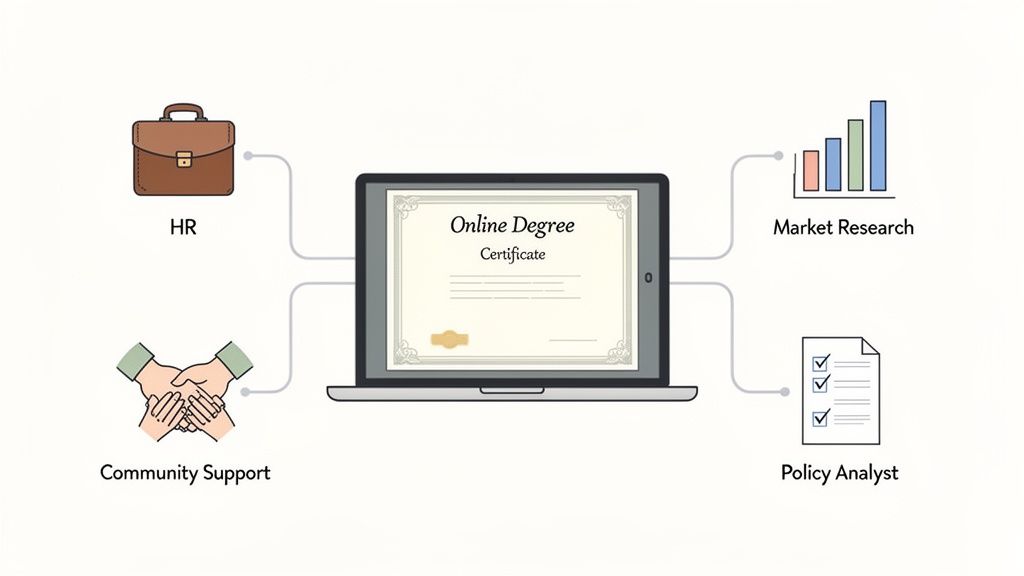
From Theory to Practice in Diverse Fields
The real power of a psychology degree lies in its versatility. You’re not just learning abstract theories; you’re building a practical toolkit for navigating the complexities of human interaction, which is the bedrock of countless professions.
Here are just a few examples of where you could land:
- Human Resources (HR): In HR, you’re constantly dealing with things like employee motivation, workplace conflict, and company culture. A psychology background gives you a massive head start in understanding these dynamics, making you a top-notch candidate for roles like HR Advisor or Recruitment Specialist.
- Market Research: Businesses are desperate to know what makes their customers tick. As a Market Research Analyst, you’d use your research skills to design surveys, run focus groups, and analyse consumer behaviour to help companies make smarter, more informed decisions.
- Community and Social Services: If you're driven by a desire to help others, your degree can lead to roles like a Community Support Worker or Case Manager. You’ll apply your understanding of human development and social challenges to support vulnerable individuals and families in your community.
Mapping Your Qualification to a Career
The level of qualification you earn will often determine your entry point into these fields. A diploma might get you into a support role, while a bachelor's degree opens up more analytical and advisory positions.
For those looking to make a career change, specialised postgraduate programmes are a fantastic way to pivot. For instance, top universities like the University of Auckland are making advanced psychology studies more accessible than ever for New Zealanders. Their Graduate Diploma in Applied Psychology (Online) is a perfect example. It's designed as a stepping stone for career changers, can be completed part-time in under 1.5 years, and doesn't even require a prior psychology degree.
This just goes to show how further study can bridge the gap between your existing qualifications and a new career passion, making the field more accessible for everyone.
The real power of a psychology degree is its universal applicability. It teaches you to think systematically about people, making you an asset in any industry that relies on understanding its workforce, customers, or community.
As you think about your future, it's also important to understand the difference between a therapist and psychiatrist, as these clinical pathways require very specific postgraduate training and registration. That said, the opportunities in non-clinical roles are huge and only getting bigger.
To give you a clearer idea, the table below shows how different qualifications connect directly to specific job roles and the skills you'd be using every day.
Potential Career Paths After Your Online Psychology Studies
This table is really just the tip of the iceberg. Each of these roles leans heavily on the core skills you gain from an online psychology degree, proving that your studies are a springboard into a future filled with diverse and meaningful work. Your journey isn't confined to a single path; it opens up a whole new world of professional opportunities.
Finding the Right Online Psychology Degree for You
Deciding on the right online psychology degree can feel like a massive undertaking. But if you break it down into smaller, more manageable steps, the whole process becomes a lot clearer. It’s not just about picking a subject you like; it’s about finding a provider and a style of learning that genuinely fits your life and career goals. A bit of a structured approach will help you cut through the noise and find the perfect match.
This all starts with some honest self-reflection. Before you even glance at a course brochure, take a moment to map out what you really need and want from your studies. Answering a few key questions first will act as a powerful filter for your search.
Start With Your Personal Goals
First up, what’s your "why"? What's the real reason you want to study psychology? Maybe you're aiming for a specific career, like becoming a market researcher or a community support worker. Or perhaps you're just following a personal passion. Your ultimate goal will have a huge say on the qualification level you should be looking at.
Next, think about how you learn best.
- Do you prefer the steady pace and clear deadlines of a structured semester?
- Or do you need the complete freedom of a self-paced course that can bend around a chaotic work schedule?
Finally, be realistic about your time. How many hours a week can you genuinely set aside for study? Answering this honestly will help you choose between part-time and full-time options and stop you from feeling completely swamped later on.
Comparing Key Course Factors
Once you have a clear picture of your own needs, you can start comparing the practical side of different courses. Don’t just get stuck on the qualification title; it pays to dig a little deeper into what each provider is actually offering.
A course is more than its curriculum. The quality of student support, the expertise of the tutors, and the flexibility of the learning platform are just as important for your success.
When you’re weighing up your options, it's a good idea to create a simple checklist of the essentials. This helps you make a proper side-by-side comparison instead of getting lost in all the marketing jargon.
Think about these key elements:
- Specialisations Offered: Does the course cover subjects that really spark your interest, like developmental psychology, organisational behaviour, or even sports psychology?
- Total Costs and Payment Plans: Look beyond the main fee. Are there extra costs for things like textbooks or exam fees? Does the provider offer flexible payment options to help you manage your budget?
- Student Support Services: What kind of help can you expect to get? Look for access to tutors, tech support, online library resources, and career advice. Strong support can make or break your online learning experience.
Using a Discovery Platform to Simplify Your Search
Jumping between dozens of different provider websites to pull all this information together can be incredibly time-consuming and confusing. This is where a course discovery platform like Get Course becomes a seriously useful tool. It gathers all your options in one place, letting you easily compare programmes based on what actually matters to you.
Think of it as your own personalised search engine for education. You can filter courses by qualification level, subject area, and study mode, saving you hours of tedious research. This frees you up to focus your energy on making a smart, informed decision, feeling confident you’ve found the best online psychology course to kickstart the next chapter of your career.
Your Questions Answered
It’s completely normal to have a few questions when you’re about to take a big step in your education. To wrap things up, here are some clear, straightforward answers to the most common queries we get about studying psychology online in New Zealand.
We’ll cover everything from how Kiwi employers view online qualifications to the exact steps needed to become a registered psychologist. Think of this as the final piece of the puzzle, giving you the confidence to move forward.
Is an Online Psychology Degree Respected by Employers in New Zealand?
Absolutely. In New Zealand, online degrees from reputable institutions are held in the same high regard as their on-campus equivalents. What employers really care about are the skills and knowledge you’ve gained, not how you learned them.
In fact, many employers see real strengths in online graduates. Finishing a degree remotely shows you have fantastic self-discipline, sharp time management, and a whole lot of personal motivation—all qualities that are gold in any workplace.
Can I Become a Registered Psychologist with an Online Degree?
An undergraduate online psychology degree, like a Bachelor's, is the essential first step on the path to becoming a registered psychologist. It gives you the foundational knowledge and research skills that all advanced training is built upon.
However, to get registered in New Zealand, you'll need to complete postgraduate study, usually a Master's or Doctorate. These programmes include a huge amount of supervised practical experience. Your online bachelor's degree is the key that unlocks the door to applying for these advanced, hands-on courses.
What Kind of Assessments Will I Complete?
Online psychology courses use a good mix of assessments to test different skills, and you can complete them all from home.
You can generally expect a combination of:
- Written essays to show your critical thinking and grasp of complex theories.
- Research reports to build your skills in data analysis and scientific writing.
- Case study analyses where you’ll apply psychological principles to real-world situations.
- Online discussion forums to encourage debate and collaboration with your classmates.
- Online quizzes or tests to check your understanding of core concepts.
Some of the more advanced courses might also include virtual group projects or online presentations, all designed to fit into the flexible nature of remote learning.
How Important Is Understanding Te Tiriti o Waitangi?
It is critically important. Modern psychology practice in Aotearoa New Zealand is deeply rooted in a bicultural context, and any quality online degree programme will reflect this in its curriculum.
Reputable courses integrate Māori models of health and wellbeing, like Te Whare Tapa Whā, and a solid understanding of Te Tiriti o Waitangi principles. This ensures you’ll graduate as a culturally competent practitioner, fully equipped to work effectively and respectfully in New Zealand's unique social landscape.
This isn’t just an academic box-ticking exercise; it’s a fundamental part of being an ethical and effective professional in this country.
Your Journey Starts Now
Deciding to study psychology online is a big move, but it's an incredibly rewarding one. It’s a path that offers not just a deep understanding of yourself and others, but also a versatile skill set that is highly sought after across countless industries in New Zealand.
Whether you start with the foundational knowledge of a diploma or dive into a comprehensive bachelor’s degree, there's an online option that will fit your goals. The beauty of online learning is that you can chase your passion for understanding the human mind without putting the rest of your life on pause. You have the power to shape a future where you can make a real difference, whether that's in a clinic, a corporate office, or a community organisation.
The main takeaways are simple:
- Flexibility is power: Online study lets you fit education around your life.
- Qualifications are respected: Employers care about your skills, not the delivery method.
- Many pathways exist: From certificates to degrees, there’s a starting point for everyone.
- Careers are diverse: Your degree opens doors to HR, marketing, social services, and much more.
The next step is to explore the courses that could change your life. Your curiosity about the human mind brought you here—now it’s time to turn that curiosity into a qualification.
Ready to find the perfect course that fits your life and career goals? At Get Course New Zealand, we make it easy to compare flexible, online psychology programmes from leading providers across the country. Start exploring your options and take the first step towards your new future today.
Find Your Course
Compare courses across every field we write about, and enquire in under a minute.