How to Choose a Career Path in New Zealand
Feeling lost? Discover how to choose a career path with a practical guide to self-discovery, exploring the NZ job market, and building an actionable plan.
Choosing a career isn't just about picking a job; it’s about aligning who you are with what you do every day. It's a practical process of figuring yourself out, seeing what the job market looks like, and then making a solid plan to connect the dots. The goal is simple: find a path that supports you financially and makes you genuinely happy.
Your Practical Guide to Choosing a Career Path

Trying to figure out your career path can feel like you’re standing at a massive intersection with signs pointing in a dozen different directions. It’s a huge decision, one that shapes your day-to-day happiness, financial security, and your future. Think about it: the average person spends around 80,000 hours at work in their lifetime. That’s a massive chunk of your life to spend doing something that doesn’t feel right.
This guide is your map. We'll skip the fluffy, generic advice and get straight into a realistic process that works for us here in New Zealand.
A Roadmap for Your Journey
Finding a career that fits isn’t a one-and-done decision. It's a series of thoughtful steps that can take you from feeling completely overwhelmed to feeling confident and in control. We've broken it down into a clear, structured approach:
- Start with Self-Discovery: First, we're going to look inwards and build a personal blueprint. This means getting honest about your natural strengths, what you truly value, and what genuinely sparks your interest.
- Explore the NZ Job Market: Next, we'll look outwards to see where the real opportunities are in New Zealand’s economy. The goal is to make sure your chosen path has real-world potential.
- Build a Concrete Action Plan: Finally, we’ll put it all together. This is where we create a practical plan to close any skill gaps and turn your career ideas into something you can actually achieve.
This journey is just as relevant whether you’re fresh out of uni, feeling stuck in a rut, or thinking about a mid-life career switch. Plenty of Kiwis find themselves rethinking their professional lives, especially as they hit new stages in life. If that sounds like you, our guide on navigating a career change at 30 has some extra insights that might help.
At the end of the day, it’s all about making an informed choice that actually fits the life you want to build—not just earning a living, but feeling engaged and purposeful while you do it.
A satisfying career lives at the intersection of what you're good at, what you enjoy, and what the world actually needs. This guide is here to give you the clarity and the tools to find that sweet spot for yourself. Let’s get started by building your personal career compass.
1. Start with Self-Discovery: Your Personal Career Blueprint

Before you even think about scrolling through job sites or browsing course catalogues, the most important work starts with you. Seriously. Choosing a career that actually fits requires an honest look in the mirror. This first step is all about creating a personal blueprint—a clear guide based on who you are, what you’re good at, and what really makes you tick.
Think of it like building a house. You wouldn’t just start ordering timber without a detailed plan, right? The same goes for your career. This self-assessment is the architectural drawing for a professional life you’ll find genuinely fulfilling.
Going through this process ensures your final decision isn’t just a random pick from what’s available, but a deliberate choice that feels right for the long haul.
Inventory Your Skills: Both Hard and Soft
First up, let’s take stock of your skills. These are the tools in your professional toolkit, and they come in two flavours: hard skills and soft skills. Getting a clear picture of both is essential if you want to land in a career that plays to your strengths.
Hard skills are the technical, teachable things you’ve learned through training or experience. They’re specific and easy to point to. A graphic designer’s hard skills might be their mastery of the Adobe Creative Suite, while a builder’s would include carpentry and reading blueprints.
- Language proficiency: Are you fluent in Te Reo Māori, Mandarin, or another language?
- Software expertise: Think about specific programs like Xero, Microsoft Excel, or any coding languages you know.
- Technical abilities: This could be anything from operating machinery to complex data analysis.
Soft skills, on the other hand, are all about how you work and interact with others. They’re a bit harder to measure but are often what employers are really looking for.
- Communication: How well do you get your ideas across, listen to others, or write a clear email?
- Problem-solving: Do you get a kick out of untangling tricky issues and finding clever solutions?
- Leadership: Have you ever guided a team, mentored someone, or taken charge of a project?
- Adaptability: How do you handle change? Are you someone who can learn new things quickly?
Take a moment now and jot down five of your strongest hard skills and five of your most obvious soft skills. This simple exercise creates a powerful snapshot of what you bring to the table.
Pinpoint Your Core Career Values
Skills tell you what you can do, but your values tell you what will make you happy doing it. Your core values are the non-negotiables—the principles that must be in place for you to feel satisfied and motivated at work. Ignoring them is a one-way ticket to burnout.
A high-paying job might look great on paper, but if it demands 60-hour weeks while you deeply value time with your whānau, that clash is going to cause real problems down the line. The work culture in New Zealand is definitely shifting, with more and more people rethinking what’s truly important.
For example, a recent Employment Hero report found that 39% of Kiwi employees were actively looking for new jobs in 2023. A huge driver wasn't just a bigger paycheque, but a desire for better work-life balance.
To figure out your values, ask yourself what really matters in a job.
- Financial Security: Is a high salary and stable income your absolute top priority?
- Work-Life Balance: Do you need flexible hours or the option to work from home?
- Creativity and Innovation: Is it important for you to have a role where you can express new ideas?
- Helping Others: Do you feel fulfilled when your work makes a positive impact on people or your community?
- Autonomy: Do you work best when you can manage your own projects and make your own decisions?
Choosing a career that aligns with your values is the difference between a job that drains you and one that energises you. It’s about finding a role where the daily grind feels meaningful because it connects to what you believe in.
Reconnect with Your Genuine Interests
Last but not least, what do you actually enjoy doing? It sounds almost too simple, but we often forget to connect our passions with our professional lives. Think about what you do in your spare time—the hobbies that make you lose track of time, the topics you can’t stop reading about.
These interests are powerful clues. Someone who loves organising community events might be a natural at project management. A person who spends their weekends tinkering with cars could build a fantastic career as a mechanic or automotive engineer.
Don’t write off an interest just because it doesn't sound like a "real job." The skills you pick up from hobbies—like patience, strategic thinking, or attention to detail—are incredibly valuable in the workplace. This whole self-discovery phase is about giving yourself a compass, making sure the path you choose is pointing in a direction that’s uniquely yours.
Exploring the Modern New Zealand Job Market

Alright, you’ve done the hard work of looking inward. Now it’s time to look outward and see where your personal blueprint fits into the real world. A dream job isn't much help if there are only a handful of them in the country, right? So, this is where we ground your personal insights in the realities of the New Zealand labour market.
Think of this as strategic matchmaking. You’re not abandoning your passions; you're finding the most sustainable and rewarding place for them to flourish. By getting a clear picture of which industries are actually growing, you can aim for a career that has a genuine future.
This research phase is absolutely crucial for anyone wondering how to choose a career path that lasts. It helps you see beyond the latest buzz and pinpoint sectors with solid foundations and real demand.
Understanding Where the Jobs Are in New Zealand
First things first, you need to know where the opportunities are hiding. Like many developed economies, New Zealand's job market has shifted dramatically over the past few decades. The service sector is now the undisputed engine of our economy, and that has a massive impact on your career options.
What exactly is the service sector? It’s huge. It covers everything from healthcare and IT to tourism, education, and professional business services. Essentially, if a job involves providing a service rather than making a physical product, it likely falls into this category.
To put this into perspective, let’s look at the numbers from 2022 data. Nearly three-quarters of all jobs are in services, highlighting the shift away from traditional economic backbones like agriculture.
Identifying Industries on the Rise
Not all industries are created equal when it comes to future prospects. Some are expanding rapidly thanks to new technology, our changing demographics, and what people need and want. Zeroing in on these high-growth areas is a smart move for long-term career security.
Here are a few key sectors that are humming along in New Zealand right now:
- Healthcare and Social Assistance: With an ageing population, the need for skilled healthcare professionals, support workers, and aged care providers just keeps growing. This field is packed with a wide variety of roles that are both incredibly stable and deeply rewarding.
- Information Technology (IT): No surprises here. The tech sector continues to boom, creating huge demand for software developers, cybersecurity analysts, data scientists, and IT support specialists. These roles often come with great pay and flexible working arrangements.
- Construction and Trades: New Zealand’s ongoing need for housing and infrastructure means skilled tradies—builders, electricians, plumbers, you name it—are consistently in high demand. It's a field where practical skills lead directly to fantastic career opportunities.
By targeting a growing industry, you're not just finding a job for today; you're stepping onto a career ladder with rungs that actually lead somewhere. It’s a strategic move that sets you up for future success and adaptability.
Getting Down to the Details: Roles and Salaries
Once you’ve got a couple of promising industries on your radar, it's time to zoom in on specific jobs. This is where a bit of online detective work pays off. Websites like Careers NZ are brilliant for this, offering detailed info on hundreds of jobs, including what you’d do day-to-day, what qualifications you may need, and—crucially—the job outlook.
Here’s what you should be looking for:
- Typical Salary Ranges: What can you realistically expect to earn when you start, and what's the potential for growth? This helps you match your career choice with your financial goals.
- Necessary Qualifications: Do you need a specific certificate, diploma, or degree to get your foot in the door? Knowing the entry requirements is the first step in building an action plan.
- Job Outlook: Is the demand for this role expected to grow, stay flat, or shrink? Always prioritise roles with a positive outlook to make sure your skills will stay in demand.
For a deeper dive, it can be really useful to connect with people in the know. You could talk to specialised recruiters in Auckland to get industry-specific insights, especially for major city centres. On top of that, checking out resources like our guide to the top 10 highest paying jobs in NZ can give you a steer towards some of the more lucrative pathways.
Doing this homework properly connects your personal passions to market realities, ensuring the path you choose isn’t just fulfilling, but also practical and secure.
Figuring Out Your Learning Pathway
Okay, you've got a shortlist of careers that genuinely interest you. That's a huge step. Now for the next piece of the puzzle: figuring out how to get there. This is where you build the bridge between where you are now and where you want to be, mapping out the most practical and realistic learning pathways available right here in New Zealand.
The thought of more study can be daunting, especially if you're already juggling work, family, and a dozen other commitments. But here’s the good news: the days of needing to put your life on pause for a three-year university degree are long gone. Flexible online courses and hands-on vocational training have made it easier than ever to gain new skills.
This section is all about connecting your target roles to the training that will actually get you in the door. The trick is to find a learning style that fits your life, not the other way around.
Decoding the Skills You Actually Need
Before you even think about enrolling in a course, you need a crystal-clear picture of what employers in your chosen field are really looking for. The best way to do this? Treat job descriptions like a treasure map.
Go and find a handful of job listings for the role you’re eyeing up and start looking for the common threads. What specific software, certifications, or technical skills keep popping up again and again? These are your non-negotiables.
For example, if you're aiming for a career in digital marketing, you'll almost certainly see requirements for things like:
- Google Analytics and Ads certifications
- Hands-on experience with social media management tools
- A solid grasp of Search Engine Optimisation (SEO) principles
On the other hand, someone hoping to become a project manager would need to show they're proficient in:
- Methodologies like Agile or Scrum
- Project management software like Jira or Trello
- Core skills in risk management and budgeting
Once you've got this list, do a quick "skills gap" analysis. Put your current skills side-by-side with what employers are asking for. The gaps you find are exactly what your learning plan should focus on. This targeted approach saves you a ton of time and money by making sure you only study what's absolutely essential.
Exploring Flexible Learning Options
That old idea that you need to stop everything for three years to get a degree is well and truly outdated. Today, there are countless ways to get qualified, and many are specifically designed for busy adults. Online learning, in particular, offers the freedom to study around your existing schedule.
This is a complete game-changer for career changers who can't afford to just quit their job. You can study in the evenings, on weekends, or whenever you can carve out a spare hour.
Many people find that earning a practical, industry-recognised certificate can open doors just as effectively as a full degree—often in a fraction of the time. The focus is squarely on job-ready skills you can start using right away.
These alternative pathways are becoming more and more popular, and they're highly respected by employers who value practical, real-world experience. To get a better sense of what’s out there, you can explore some of the different alternative pathways to university available in New Zealand.
Don't Overlook High-Demand Sectors Like the Trades
While there are plenty of office-based roles out there, it's a mistake to overlook the massive demand for skilled workers in the trades. Sectors like construction are booming and offer accessible, hands-on career pathways with fantastic earning potential. If long-term job security is high on your list, this is an area worth serious consideration.
In fact, New Zealand's construction and trades sectors are crying out for skilled people. A 2023 report from MBIE revealed that filled jobs in the industry shot up by an impressive 9.7% in the year to June 2023. This growth is being backed by a huge push for training, with apprenticeships in architecture and building hitting a record 37,015 by the end of 2022. The most in-demand trades are carpentry and joinery (making up 59.1% of apprentices), with plumbing following at 14%. You can dig deeper into these trends in the full MBIE report.
These numbers point directly to where the urgent needs are, offering a clear route into a stable and rewarding career for anyone who enjoys practical, hands-on work. The best part? The learning pathways are often work-based, meaning you can earn while you learn through an apprenticeship.
Ultimately, matching your career goals to a learning pathway is all about being strategic. Identify the must-have skills, find a study method that actually works with your life, and don't be afraid to look beyond the traditional options. Whether it’s an online certificate in IT or a trade apprenticeship, the right training is your launchpad into a career you'll love.
Building Your Career Change Action Plan
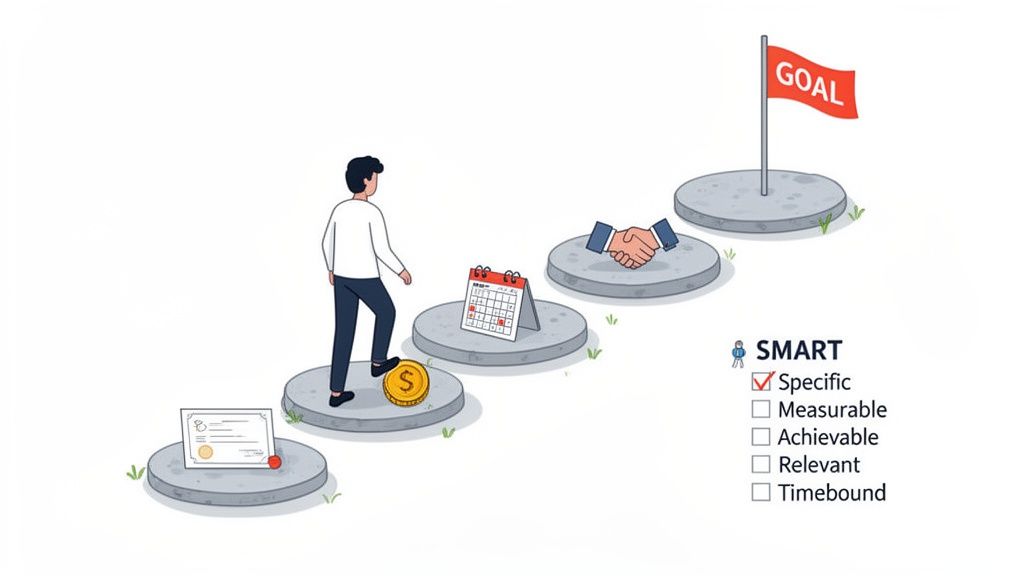
You’ve done the soul-searching, dug into the job market, and figured out what you need to learn. Now for the most important part: turning all those great ideas into a solid, step-by-step plan. Let's be honest, an idea without a plan is just a wish. This is where you build the roadmap that will guide you from where you are now to where you want to be.
Think of this action plan as your personal blueprint. It's designed to break down what feels like a massive, intimidating goal into small, achievable tasks. The whole point is to build momentum, see your progress, and stay motivated so you can move towards your new career without getting overwhelmed.
Set SMART Goals for Your Transition
A goal like "I want to become a project manager" is a decent starting point, but it lacks the punch to get you moving. To give your plan real traction, you need to use the SMART framework. This is a classic for a reason—it forces you to make sure every goal is Specific, Measurable, Achievable, Relevant, and Time-bound.
This simple method turns a fuzzy dream into a clear target with a deadline.
Here’s how it looks in the real world:
- Specific: Instead of "learn new skills," try: "Complete an online Certificate in Project Management to get a solid foundation in Agile methodologies."
- Measurable: How will you know you’re on track? "I will finish one course module each week and aim to pass the final assessment with a distinction."
- Achievable: Can you actually do this right now? "Yes, I can set aside six hours a week for study without it impacting my current job."
- Relevant: Does this fit your bigger picture? "Absolutely. This certificate is a key requirement in almost every entry-level project coordinator role I’ve seen."
- Time-bound: What’s the deadline? "I’ll enrol by the end of this month and aim to have the certificate in hand within six months."
Using a structured approach like this is non-negotiable when you’re figuring out how to choose a career path. It gives you clear milestones to celebrate along the way.
Address Your Skill Gaps and Budget Accordingly
Your plan needs to tackle the skill gaps you identified earlier head-on. List the specific courses or certifications you need and start looking into providers. Flexible online options are often a lifesaver, as they let you learn around your existing work and life commitments.
Of course, upskilling costs money. It’s absolutely crucial to map out a realistic budget for your education.
- Course Fees: What’s the all-in cost of the training?
- Payment Plans: Do they offer flexible payment options to help spread the cost?
- Time Commitment: If you have to cut back on work hours to study, how will that affect your income?
Getting your finances sorted from the get-go removes a huge source of stress. It lets you focus on your learning, confident that you have a sustainable plan to cover the costs.
Creating a solid action plan isn't just about what you'll do; it's about building the confidence to take that first step. By breaking the journey into smaller pieces, you make the entire process feel less daunting and far more achievable.
'Test Drive' Your New Career Path
Before you go all-in, it’s a brilliant idea to get a real feel for the industry. A "test drive" can confirm if this new career is genuinely the right fit, potentially saving you a lot of time and money on something that looked better on paper.
Here are a few low-commitment ways to get some real-world experience:
- Volunteering: Offer your time to a non-profit in your target field. It’s a fantastic way to pick up practical experience and expand your network.
- Short Projects: See if you can pick up a small freelance gig. It’ll give you a genuine taste of the day-to-day work.
- Informational Interviews: Jump on LinkedIn and reach out to professionals in roles you admire. You’d be surprised how many people are happy to share their insights over a quick coffee.
This kind of hands-on experience is gold. As you start pulling your action plan together, it's also a good idea to check out some effective career change resume examples to see how you can best showcase this new experience.
Your 3, 6, and 12-Month Plan
Finally, map everything out on a timeline. This gives your plan a clear structure and holds you accountable.
In the Next 3 Months:
- Finalise your study budget.
- Enrol in your chosen online course.
- Reach out and have two informational interviews with industry pros.
In the Next 6 Months:
- Complete at least 50% of your certification.
- Take on a small volunteer or freelance project to start building experience.
- Update your CV and LinkedIn profile to reflect your new direction.
In the Next 12 Months:
- Complete your training.
- Create a small portfolio showcasing your new skills.
- Start actively applying for roles in your new field.
With a clear, actionable plan like this, you’re no longer just dreaming about a different career—you’re methodically building it, one step at a time.
Have Questions About Choosing a Career?
Figuring out how to choose a career path can bring up a lot of questions. That’s perfectly normal—it’s a big decision, after all. To help you out, we’ve tackled some of the most common worries we hear from Kiwis trying to find their professional footing.
Is It Too Late to Change Careers in My 30s, 40s, or 50s?
Not at all. This is probably the biggest myth holding people back from finding work they actually enjoy. Career changes later in life are becoming the new normal in New Zealand, as more and more of us decide to prioritise well-being and a sense of purpose over just sticking with what’s familiar.
Don't think of your experience as a liability; it's your greatest asset. You’ve built up a huge toolkit of soft skills—like problem-solving, clear communication, and resilience—that employers in any industry are desperate for. The trick is to reframe your experience and focus on how those skills transfer to a new field.
How Can I Be Sure I’ve Made the Right Choice?
While there’s no magic 8-ball, you can get pretty close to certainty through a bit of validation. Before you commit to a full-blown career change, why not 'test drive' it first? You could volunteer, pick up a small freelance project, or even just have a few coffees with people who are already doing the job.
Confidence in your career choice comes from a mix of honest self-assessment, solid market research, and a dose of real-world exposure. If a path lines up with your skills, your values, and the actual reality of the job, you’re on the right track.
This kind of hands-on experience gives you insights that hours of online research just can't match. It’s the best way to see if the day-to-day reality of a job actually fits with what you’ve imagined.
What If I Don’t Have a Specific “Passion”?
Forget what you’ve seen in the movies. The idea that everyone has one single, all-consuming passion they need to turn into a career is mostly a myth. For a lot of people, job satisfaction comes from simply finding a role that’s a good fit for their skills, values, and general interests.
Instead of hunting for a "passion," try following your curiosities. What topics do you find yourself Googling in your spare time? What kinds of problems do you genuinely enjoy trying to solve? Chasing these threads of interest often leads to a career that’s engaging and rewarding, even if it wasn’t some lifelong dream.
How Do I Balance Salary with Job Satisfaction?
This is the classic dilemma, isn't it? Financial security is obviously a big deal, but study after study shows that a massive salary on its own doesn’t guarantee happiness at work. The first step is to figure out your personal “enough” point—the salary you need to live comfortably and hit your financial goals.
Once you have that number, you can look at your career options more clearly. You might find that a role with a slightly smaller paycheque offers far better perks in other areas, like work-life balance, lower stress levels, or more meaningful tasks. A simple self-assessment can help you compare your options properly and make a decision based on the whole picture, not just the salary.
Ready to take the next step towards a career you’ll love? At Get Course New Zealand, we connect you with flexible, 100% online courses designed to give you the job-ready skills you need. Explore your options and find the perfect learning pathway for your goals today.
Find Your Course
Compare courses across every field we write about, and enquire in under a minute.