How to Write a Business Plan That Wins Over Investors
Learn how to write a business plan with our practical guide. We break down every section, from market analysis to financial projections, to help you succeed.
Too many people think a business plan is just a stuffy document you write once to get a loan. That's a huge mistake. Think of it as your strategic blueprint—a living, breathing map that turns a brilliant idea into a real, viable business. It's the process of getting all those thoughts out of your head and onto paper, bringing clarity to your vision and setting actual benchmarks for success.
Why a Business Plan Is Your Strategic Blueprint
I've seen it time and again, especially with exciting side hustles in NZ—entrepreneurs are so keen to get started they jump straight into the action. That enthusiasm is fantastic, but without a plan, it's easy to get lost in the competitive New Zealand market. This isn't just about ticking a box for the bank; it’s about genuinely understanding your own venture, inside and out.
The planning process forces you to be brutally honest with yourself. You have to think critically about every single piece of the puzzle, from pinpointing your ideal customer to mapping out how you’ll handle day-to-day operations. Each section makes you turn abstract ideas into concrete, actionable steps. This foundational work is what separates a fleeting idea from a business that’s built to last.
The Real Value of Planning
A well-crafted business plan does more than just list your goals—it backs them up with solid research and data. It tells a clear, compelling story that proves you’ve done your homework and have a credible path to making money.
Here's where you'll see the real payoff:
- Clarity and Focus: It makes you articulate your vision, mission, and objectives. Suddenly, every decision you make has a purpose that aligns with your long-term goals.
- Securing Funding: For investors or lenders, your plan is everything. It's the main tool they use to judge your business's potential and, just as importantly, your capability as an owner.
- Measuring Success: It sets up your key performance indicators (KPIs) and financial milestones. This gives you a tangible way to track your progress and make smart adjustments along the way.
In New Zealand, we have a bustling small business scene with over 617,330 enterprises. Making your mark here requires strategic thinking. Statistics show that roughly half of new NZ businesses don't survive their first five years, which makes detailed market analysis and financial projections absolutely essential. Interestingly, while only about 28% of businesses prioritise strategic planning, the ones that do tend to experience significantly faster growth.
A business plan is the best insurance you can get against making avoidable mistakes. It’s your chance to stress-test your ideas on paper before you pour your time and money into them.
More Than Just a Document
At the end of the day, the biggest benefit of writing a business plan is the insight you gain. It will challenge your assumptions, expose potential weak spots you hadn't considered, and ultimately build your confidence as a business owner. Whether you're starting small or aiming to build an empire, this document becomes your most trusted guide.
For a deeper dive into the nuts and bolts of putting your strategy on paper, this comprehensive guide on how to write a business plan offers practical steps for every stage.
The Core Components of a Winning Business Plan
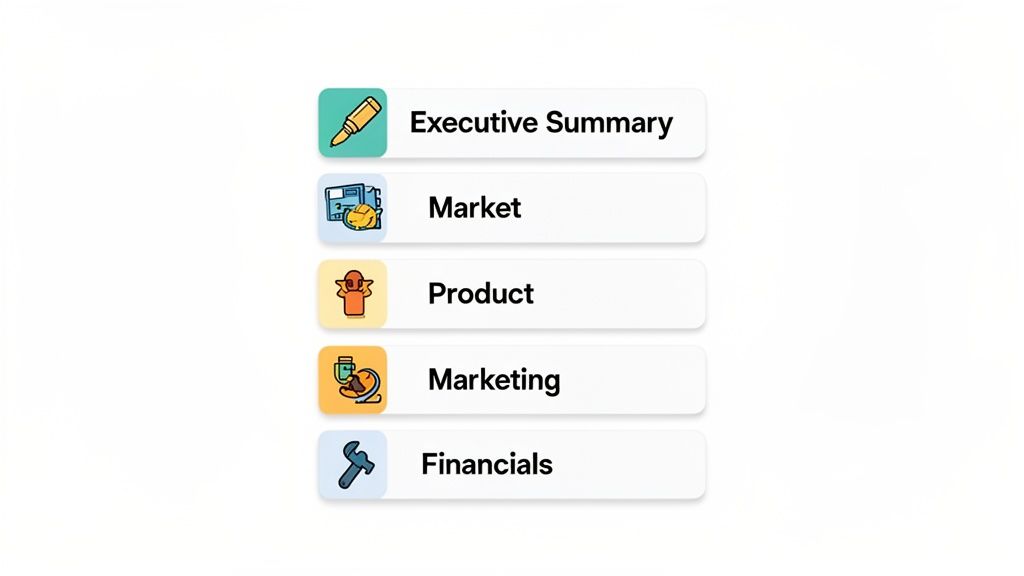
Alright, let's get into the bones of a great business plan. Think of it like building a house – each section is a different room, and they all need to connect logically and support the overall structure. Nail these components, and you’ll turn a spark of an idea into a credible strategy that gets people excited.
Each part of the plan tells a piece of your business story. We'll walk through them one by one, looking at what goes in, why it’s there, and how to make it compelling. This isn't just a checklist; it's the roadmap that will guide your thinking and, ultimately, your business.
The Executive Summary
This is the very first thing anyone will read, but my advice is always to write it last. It's your highlight reel – a punchy, one-page overview of your entire plan. You can’t summarise a story you haven't written yet.
The goal here is to hook your reader, whether that's a bank manager, an investor, or a potential partner, and make them want to know more.
It should briefly cover:
- Your Mission: What's the "why" behind your business?
- Your Product/Service: A quick line on what you actually do.
- Your Target Market: A snapshot of who you're selling to.
- Financial Highlights: A top-level glance at your funding needs and key projections.
This single page is your ultimate elevator pitch. To make it as sharp as possible, check out these tips on how to write executive summaries – it's worth the extra effort.
Company Description
Right after the summary, you get into the nitty-gritty. This is where you formally introduce your business, covering the nuts and bolts of your organisation. It gives the reader a clear picture of who you are.
You’ll want to include details like your legal structure (sole trader, limited liability company), your business mission and vision, and the specific problem you’re solving. For instance, a Kiwi software startup might state its mission as "simplifying payroll for New Zealand's small businesses," which immediately clarifies its purpose and value.
Market Analysis
This is where you prove you’ve done your homework. A strong market analysis shows you have a deep understanding of your industry, customers, and competition. It’s not enough to just say there’s a market; you need to back it up with data and insight.
Get specific about your ideal customer. Don't just say "young people in Auckland." Instead, try "university students aged 18-22 in Auckland's CBD who prioritise sustainable products and have a disposable income of $50-$100 per week." You also need to dissect your competitors – what are their strengths and weaknesses, and where does your business fit in?
A solid market analysis proves you’re not just passionate; you’re realistic. It builds a huge amount of credibility and shows you know the landscape you’re about to enter.
Organisation and Management
Ideas don’t build businesses; people do. This section is all about the team behind the dream. Investors often say they bet on the jockey, not the horse, and this is where you showcase your "jockeys."
Outline the key people on your team, highlighting their relevant experience and what role they’ll play. If you're flying solo, focus on your own background and expertise. It’s also a good idea to mention any key advisors, mentors, or crucial staff you plan to bring on board. This shows you're thinking ahead about the human capital needed to succeed.
Services or Products
Now it's time to get specific about what you’re actually selling. Describe your product or service in detail, but always focus on the benefits to the customer, not just the features. What makes it different or better than what’s already out there?
A local café in Wellington wouldn't just list "coffee and cakes." They’d describe their "ethically sourced, single-origin coffee roasted in-house, paired with a rotating menu of baked goods using locally sourced, seasonal ingredients." See the difference? One is a list; the other tells a story.
Marketing and Sales Strategy
This is your game plan for getting noticed and getting paid. How will people find out about you, and what will convince them to open their wallets? A well-defined strategy is the engine for your growth.
Your plan should cover the essentials:
- Positioning: How will your brand be perceived? Are you the budget-friendly option, the premium choice, or the quirky alternative?
- Pricing: What's your pricing model, and how does it stack up against the value you provide and what the market will bear?
- Promotion: Where will you show up? Think social media, Google Ads, local radio, networking events, or collaborations.
- Sales Process: How do you turn a curious browser into a loyal customer?
Make sure your marketing plan feels tailored to a New Zealand audience. For many entrepreneurs, beefing up their knowledge in this area is a massive advantage. You might find it useful to explore some online business courses that cover modern marketing and sales tactics.
Financial Projections
And finally, the numbers. This can be the most intimidating part for many, but for anyone lending you money, it’s the most important. Your financial projections translate your entire strategy into dollars and cents, proving your business isn't just a great idea, but a financially viable one.
Typically, you'll need to prepare three key statements for the next three to five years:
- Profit and Loss Statement: Shows your projected revenue, expenses, and profit over time.
- Cash Flow Statement: Tracks the actual cash moving in and out of your business, which is critical for staying afloat.
- Balance Sheet: A snapshot of your assets, liabilities, and equity at a specific point in time.
Whatever you do, don't just pluck numbers out of thin air. Clearly state the assumptions behind your figures. Explaining how you arrived at your sales forecasts makes them infinitely more believable.
Conducting Market Analysis That Informs Strategy
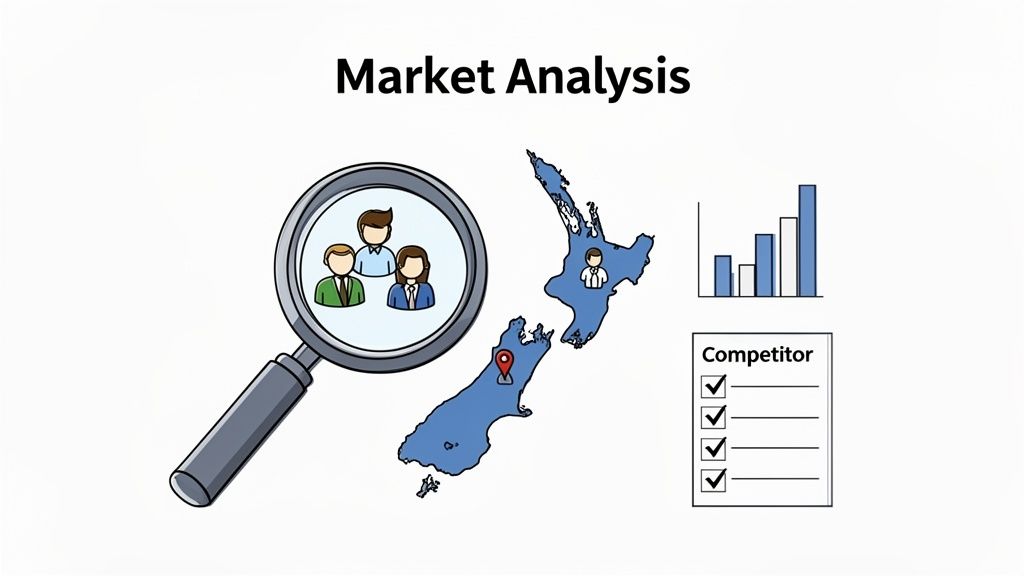
A brilliant idea is only half the battle. Its success really hinges on whether people actually want or need it. This is where your market analysis comes in, proving to investors—and, more importantly, to yourself—that a real, receptive audience exists for what you're planning to offer. It’s all about swapping out your assumptions for solid evidence.
A lot of aspiring Kiwi entrepreneurs get tripped up here, thinking that proper market research costs a fortune. That’s just not true. With the right approach and a bit of focused effort, you can gather incredibly powerful insights using tools that are already at your fingertips. This part of your plan isn't about guesswork; it's about building a rock-solid case for your business's place in the world.
Identifying Your Target Audience
First things first, you need to get crystal clear on who your ideal customer is. Vague descriptions won't cut it. Saying your market is "everyone in Wellington" is the fastest way to connect with no one. The goal is to create a detailed picture of the person most likely to buy from you.
Think about the specifics:
- Demographics: What's their age, income level, job, and where do they live? For example, are they a 25-35 year old professional living in Auckland’s city centre?
- Psychographics: What do they value? What are their hobbies and lifestyle choices? Are they all about sustainability, or is convenience king?
- Behavioural Traits: How do they shop? Are they glued to social media reviews, or do they trust a recommendation from a mate down at the pub?
Getting into these details helps you understand what truly motivates them and what problems they need solved. This is the secret to creating a product and a marketing message that genuinely resonates. Local council websites and Stats NZ are fantastic, free resources for getting a handle on the demographic makeup of your specific area.
Analysing Your Competitors
No business exists in a bubble. Your next job is to get to know your competition. This isn't about copying what they do; it's about spotting the gaps in the market that your business can cleverly fill.
A simple competitor analysis is a great way to keep your research organised. Pick your top three to five direct and indirect competitors and stack them up against each other on the factors that matter most. An exercise like this shines a light on where your competitors are vulnerable and, in doing so, helps you define your unique selling proposition (USP). It’s the proof you need to show exactly how your business will stand out from the crowd.
Understanding Industry Trends
Looking beyond your immediate rivals, you need to have a good feel for the broader trends shaping your industry. Is the market growing, shrinking, or changing direction? Are there new technologies or shifts in customer behaviour you should have on your radar?
For instance, someone opening a new café today absolutely needs to be across the rising demand for plant-based milk alternatives and the shift towards contactless ordering. Staying informed shows you're not just thinking about day one, but are building a business with the future in mind.
Your market analysis is a narrative backed by data. It should tell a clear story that there is a defined group of customers with a specific need, and you have a unique solution that the current competition is failing to provide.
This customer-first thinking is often what separates the businesses that thrive from those that just scrape by. It’s telling that while only 6% of New Zealand businesses focus on truly understanding their market, a massive 49% of high-growth companies credit their success to a deep focus on customer insights. This shows how a strong business plan, built on solid research, is a critical tool for growth. You can explore the 2025 NZ business trends on Probe CX to dig deeper into this.
Ultimately, doing this homework transforms your business plan from a simple wish list into a strategic roadmap. It proves you understand the competitive landscape and have carved out a viable, well-defined space for your venture to succeed.
Right, you've got a killer idea and you know who you're selling to. That's a huge step. But an idea without a plan for execution is just that—an idea. This is the part where you get down to the nuts and bolts of how your business will actually run and, crucially, how you'll make sales.
First up, we'll dive into your operational plan. Think of this as the engine room of your business. Then, we’ll look at your go-to-market strategy, which is how you’ll shout from the rooftops and let New Zealand know you exist.
Outlining Your Day-To-Day Operations
Your operations plan is all about the "how." How will you deliver your product or service consistently and efficiently? It covers the practical, behind-the-scenes work that makes everything else tick. For anyone looking to invest, this section is proof that you’ve moved beyond the exciting ideas and have a solid grasp on logistics.
Getting this right shows you understand the real resources and processes needed to make your business a reality. Your plan should break down the key pillars of your daily workflow.
Your operational essentials include:
- Key Processes: Map out the critical workflows that make your business function. For an online course provider, this would cover everything from content creation and platform management to student enrolment and handling support tickets. A business selling a physical product would need to detail its manufacturing process, quality control, and order fulfilment.
- Supply Chain: Who are your essential suppliers? List them out, along with any backup options you've identified. If you're an e-commerce startup selling merino wool jumpers, this means knowing your wool suppliers, manufacturers, and packaging providers inside and out.
- Technology Stack: What software and tools are essential to run your business? This could be your e-commerce platform like Shopify, accounting software like Xero, or a customer relationship management (CRM) tool to keep track of your customers.
To put it another way, an online course creator's operations are built on a digital foundation—their "supply chain" is a reliable learning management system, video hosting, and secure payment gateways. A physical product seller, on the other hand, is grounded in tangible logistics like warehousing, choosing the right shipping partners within NZ, and having a robust inventory management system.
Crafting Your Marketing and Sales Strategy
With your operations mapped out, it's time to figure out how you'll attract and win over customers. A strong marketing and sales plan is your roadmap for actually generating revenue. This isn't about making vague promises; it’s about a defined strategy tailored specifically for the New Zealand market.
Your strategy needs to be realistic and, most importantly, measurable. It should clearly show how you'll guide a potential customer from hearing about your brand for the first time all the way to clicking "buy."
Your go-to-market strategy is where your brand truly comes to life. It’s how you turn your market research into a tangible plan for building relationships and driving sales.
First, define your brand’s voice. Are you professional and authoritative, or more fun and approachable? Whatever you choose, it needs to be consistent across every channel, from the copy on your website to every single social media post.
Next, you need to pick the right channels to reach your audience here in New Zealand.
- An Online Course Provider would likely lean heavily into digital marketing. This means focusing on search engine optimisation (SEO) so Kiwis searching for specific skills can find them, running targeted ads on platforms like LinkedIn or Facebook, and using content marketing—like blog posts or webinars—to showcase their expertise.
- A Product-Based E-commerce Startup might take a more visual approach. Think Instagram and TikTok campaigns showing their products in action, collaborating with local Kiwi influencers, or even setting up a stall at local markets or trade shows to get in front of people directly.
Finally, you have to set clear and achievable sales goals. The best way to do this is by making them SMART (Specific, Measurable, Achievable, Relevant, and Time-bound). So, instead of a fuzzy goal like "increase sales," a much better goal would be "achieve $15,000 in online sales in the first quarter by converting 3% of website visitors." This gives you a clear target to work towards and a benchmark to measure your success against. Nailing this part of your business plan is absolutely crucial for tracking your progress.
Nailing Your Financial Projections

Let's be honest, this is the part where most people’s eyes glaze over. The numbers. But here’s the thing: your financial projections are the heart of your business plan. They're where you translate all your great ideas, market research, and operational plans into the universal language of money.
This isn't about becoming an accountant overnight. It's about telling a story with numbers. Every figure you put down should be a logical conclusion based on the assumptions you've already made about your customers, pricing, and marketing. It’s how you prove your concept isn't just a passion project—it's a profitable one.
First Things First: Your Start-Up Costs
Before you can dream about future profits, you need an honest, detailed look at what it will cost just to get the doors open. This is your starting block. You need to list every single one-off expense required to launch your business.
Getting granular here is a huge credibility booster. It shows you've really thought through the nuts and bolts of what it takes to get going.
Your start-up cost list should cover everything:
- Essential Gear: Laptops, software, specialised tools, a vehicle, or maybe kitchen equipment.
- Professional Fees: The cost of registering your company, getting a lawyer to check your contracts, or an accountant to set up your books.
- Opening Inventory: The first big order of products you need on the shelf before you can make your first sale.
- Launch Marketing: Your budget for building a website, running those first few social media ad campaigns, or printing flyers.
- Premises Costs: Any bond, initial rent payments, or shop fit-out expenses you need to cover.
Add it all up, and you’ll have the magic number: the exact amount of capital you need to get off the ground.
The Big Three Financial Statements
With your start-up costs sorted, it’s time to look ahead. You'll need to project your financial performance for the next three to five years. This is done using three core statements that, together, give a complete picture of your financial health.
Think of these statements like different camera angles on your business. The Profit and Loss shows your performance, the Cash Flow shows your bank balance reality, and the Balance Sheet is a snapshot of your overall value.
1. Profit and Loss (P&L) Statement
Also called an income statement, this projects your revenue and subtracts your expenses to show your profit or loss. Typically, you'll do this monthly for the first year, then quarterly or annually after that. It answers the most fundamental question: "Are we actually making any money?"
2. Cash Flow Forecast
For a start-up, this might be the most critical document of all. Profit is one thing, but cash in the bank is what pays the bills. This forecast tracks the actual money coming in and going out of your business, helping you see lean months coming so you can plan for them.
3. Balance Sheet
The balance sheet is a snapshot in time. It shows what your business owns (Assets), what it owes (Liabilities), and your stake in it (Equity). It all comes down to a simple formula: Assets = Liabilities + Equity.
Keep Your Numbers Grounded in Reality
The fastest way to lose credibility is to pull numbers out of thin air. Every single figure in your projections must be backed by a clear, logical assumption that you spell out in your plan.
For example, don't just write, "Year 1 revenue will be $100,000."
Instead, show your working: "Based on market data from similar local cafés and our planned marketing activity, we project an average of 20 customers per day, spending an average of $14. This gives us a daily revenue of $280, or approximately $100,000 annually." See the difference? One is a guess; the other is a forecast.
A robust financial section is what gets you across the line for funding. Building these skills can be a game-changer, and exploring some foundational accounting courses online in NZ will give you the confidence to own your numbers. This kind of solid documentation helps businesses overcome barriers to finance, a challenge faced by 35% of New Zealand manufacturers. With 46% of Kiwi private companies looking for third-party funding to grow, a credible financial plan is your most powerful tool. You can read the full KPMG report on NZ business priorities for some more great local insights.
Got Questions About Your Business Plan? We’ve Got Answers.
Even with the best template in hand, you're bound to hit a few roadblocks or have questions pop up as you get into the nitty-gritty of writing your business plan. That’s completely normal.
Let's walk through some of the most common queries we see from entrepreneurs. Getting these sorted will help clear the fog and let you push forward with a bit more confidence.
How Long Should My Business Plan Be?
There’s no magic number, but most solid business plans end up being between 15 and 25 pages long.
The real goal here isn't to hit a certain page count; it's to be concise but thorough. A well-researched 15-page plan that gets straight to the point is infinitely more powerful than a rambling 50-page document that repeats itself.
Think of it this way: can you sell your entire vision in a punchy, one-page executive summary? If you can nail that, you’re on the right track. Focus on quality, not quantity.
Can I Actually Write This Thing Myself?
Absolutely. In fact, you probably should write it yourself. No one else has your passion or your vision, and the process itself is a massive learning curve. It forces you to get intimately familiar with every single cog in your business machine, from who your customer is to how you’ll actually make money.
But writing it yourself doesn't mean you have to go it alone. Getting a second pair of eyes on your draft is non-negotiable.
Find a mentor, a business advisor, or even your accountant (especially for the numbers part) and ask them to read through it. They'll spot the gaps, ask the tough questions you've been avoiding, and give you the honest feedback you need to hear.
Sure, you can hire someone to write your plan, but you'd be robbing yourself of the most valuable part of the exercise. The deep understanding you gain from doing the work yourself is what will make you shine when you're sitting across from a potential investor or bank manager.
What are the Biggest Mistakes People Make?
So many new entrepreneurs fall into the same classic traps. Just by being aware of them, you can give your plan a huge leg up in credibility.
Here are the top three pitfalls to sidestep:
- Financials Based on Hope: This is the big one. Wildly optimistic revenue projections with nothing to back them up are a massive red flag for anyone reading your plan. You need to show your workings. Base your numbers on real market data and sound assumptions, not just wishful thinking.
- "We Have No Competition": Saying this is like a siren blaring "I haven't done my homework." Every business has competitors, whether they're direct or indirect. Acknowledging them and explaining your unique position shows you've actually done the research and understand the world you're about to step into.
- Vague, Fluffy Statements: Avoid generic lines like "we'll use social media to get customers." It means nothing. Get specific. Which platforms? What's your budget? What kind of content? Who are you targeting? Actionable, detailed strategies show you've truly thought things through.
My Plan is Done… What's the Next Step for My Own Learning?
Finishing your business plan is a huge milestone, but it often shines a spotlight on your own knowledge gaps. Maybe you’ve realised your marketing skills are a bit rusty, or perhaps the financial forecasting part felt like you were trying to read another language.
That's a good thing! It shows you where you need to grow.
Being an entrepreneur is all about continuous learning. Now that you know what you don't know, you can do something about it. This is the perfect time to look into flexible online courses that can fill those gaps with practical, real-world skills. Taking that next step is how you turn a document on your computer into a thriving, successful business.
Ready to build the skills that will bring your business plan to life? Get Course New Zealand offers a wide range of flexible, online courses designed to help you succeed. Find the perfect course to match your ambition and start your learning journey today at https://getcourse.co.nz.
Find Your Course
Compare courses across every field we write about, and enquire in under a minute.