A Guide to Community Services Courses Online in Australia
Explore flexible community services courses online to start a rewarding career. Compare qualifications, costs, and career paths in Australia's growing sector.
Ever thought about a career where what you do each day genuinely makes a difference in people's lives? That's the heart of community services—a field built on purpose and human connection. This guide is all about how you can step into this vital sector through flexible online community services courses, giving you the skills to support vulnerable people and build stronger communities right across Australia.
Start a Career That Matters with an Online Community Services Course
Choosing a career in community services isn't just about finding a job. It’s about making a commitment to create real, positive change. It means being the person who provides a steady hand in a crisis, helps someone find the support they desperately need, or stands up for those whose voices aren't being heard. If you're driven by empathy and a passion for social justice, you're in the right place.
The great news is, the need for skilled community services professionals is stronger than ever. As Australia’s communities grow and change, so do the challenges they face. This means the demand for qualified support workers, case managers, and health advocates is on the rise, creating a stable and growing job market for those with the right qualifications.
Why Study Online?
Taking a community services course online is a modern, practical way to get qualified. It breaks down the old barriers to education, letting you fit your studies around your job, family, and everything else life throws at you. You can literally build your new career from your living room, on a schedule that actually works for you.
This kind of flexibility is a game-changer, especially for:
- Career Changers who want to move into a more fulfilling field without having to quit their current job right away.
- Working Professionals who are already in the sector and want to upskill for that next promotion or move into a specialised role.
- Parents and Carers who need to schedule learning around school drop-offs and other family duties.
- People in Rural or Remote Areas who might not have a local TAFE or uni campus just down the road.
When you enrol in an online course, you’re doing more than just gaining a qualification. You're investing in a career that truly reflects your values, one that offers both deep personal satisfaction and genuine professional stability. It’s your chance to turn compassion into a skill set.
What You'll Find in This Guide
Think of this guide as your complete roadmap. We’ll walk you through everything you need to know to get started, so you can make a choice you feel great about. We’ll break down all the different qualification levels—from an entry-level certificate right through to an advanced diploma—to help you find the perfect starting point for your journey.
You’ll also get a clear picture of the core skills you'll learn, the huge range of career doors that will open for you after graduation, and some straight-up advice on how to pick the best online provider. We've got everything covered, from figuring out course costs to navigating work placements. By the time you're done reading, you’ll have a clear, actionable plan to launch a career helping others.
Navigating Community Services Qualification Levels

Trying to figure out the different qualifications in community services can feel a bit like trying to read a map in a new country. But once you know the landmarks, it's actually pretty straightforward.
The best way to think about it is like a career ladder. Each qualification is another rung, taking you higher in skill, responsibility, and the impact you can make. These rungs are all part of the Australian Qualifications Framework (AQF), which is a national system that ensures your qualification is recognised and respected by employers right across the country.
Let's break down what each step on this ladder looks like.
The Foundation: Certificate III
The Certificate III in Community Services is the perfect starting point if you're new to the sector or want to get a formal qualification for the experience you already have. It's the foundational rung that gives you all the core skills for those vital, hands-on roles working directly with people.
With this qualification, you’ll learn the fundamentals of working respectfully with diverse groups, communicating effectively, and providing practical help to individuals. It's really designed to get you job-ready for entry-level positions where you can start making a difference right away. You can find a complete breakdown of what's involved over at our Certificate III in Community Services course page.
Typical roles after a Certificate III include:
- Community Support Worker
- Residential Support Worker
- Family Support Worker
- Intake and Referral Officer
The Next Step: Certificate IV
Climbing to the next rung brings you to the Certificate IV in Community Services. This qualification builds on everything you learned in the Cert III but adds a layer of specialisation and extra responsibility. Think of it as moving from providing general support to delivering more targeted, specific kinds of help.
A Certificate IV often lets you focus on an area you're passionate about, like youth work, mental health, or alcohol and other drugs. The coursework gets you ready to work with more independence, handle more complex client situations, and even supervise other support staff.
This level is ideal for people who have some experience and want to deepen their expertise. It’s all about becoming a specialist who can manage specific programs or provide advanced support to clients with more complex needs.
The Leadership Level: Diploma
At the top of this particular ladder is the Diploma of Community Services. This is a big step up, preparing you for roles that involve case management, coordinating programs, and leadership. A Diploma takes you beyond direct support to focus on the bigger picture: assessing client needs, developing and implementing support plans, and managing small teams.
This qualification gives you the skills to take a high-level view of service delivery. You'll learn how to advocate for clients, navigate complex service systems, and play a role in managing a community organisation. It opens doors to more senior roles with higher earning potential and greater influence.
Australia's community services industry is booming. Employment is projected to hit 1.9 million workers by 2025, driven by an ageing population and changing social needs. This is why qualifications like the Certificate IV and Diploma are so important—they build the operational and leadership expertise the sector is crying out for. These nationally recognised courses often include work placements, making sure graduates are ready for the 88,500 new jobs expected by 2026.
Choosing Your Starting Point
So, which rung is the right one for you? It really comes down to your personal and professional goals.
- Want to start a new career? A Certificate III is your gateway.
- Ready to specialise and advance? A Certificate IV is your next logical step.
- Aiming to lead and manage? A Diploma is what you should be working towards.
The great thing about the AQF is its flexibility. You don't have to climb the whole ladder at once. You can start with a Certificate III, get some valuable work experience under your belt, and then come back to study a Certificate IV or Diploma when you're ready to take that next step. Each qualification you earn is a solid building block for your future.
Developing Core Skills for Real-World Impact
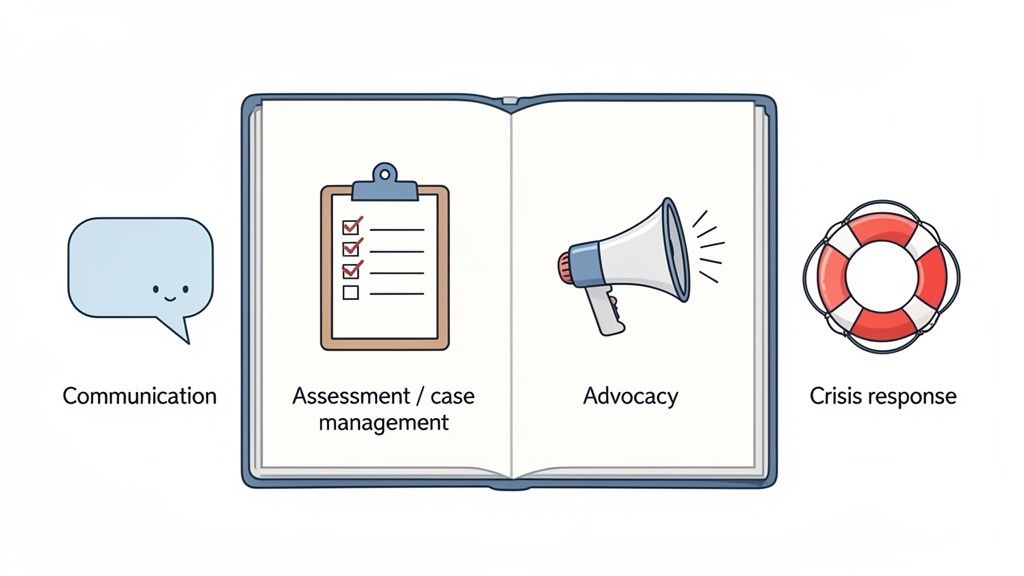
A qualification in community services is so much more than a piece of paper. Think of it as your professional toolkit, one that’s carefully packed with the practical, job-ready skills you’ll need to walk into a role with confidence and start making a real difference from day one.
These skills are what connect your desire to help people with the ability to actually do it—effectively, ethically, and compassionately. Your online course is designed to build that bridge, turning theory into the tangible capabilities you’ll rely on every single day in the field.
From Theory to Practice: The Core Competencies
When you dive into community services courses online, you start building a set of core competencies that are the lifeblood of the sector. These aren't just abstract ideas; they're the foundational skills that drive professional, effective support work.
You’ll get a solid grounding in:
- Ethical Practice: This is all about understanding professional boundaries, confidentiality, and the legal frameworks that protect everyone involved. It’s the bedrock of building trust with the people you support.
- Client Advocacy: You'll learn how to stand up for an individual's rights and needs, making sure their voice is heard in complex systems like Centrelink, healthcare, or housing.
- Effective Communication: It's about mastering active listening, showing genuine empathy, and communicating clearly to build rapport with people from all walks of life, especially those in distress.
- Assessment and Planning: This is the skill of accurately sizing up a person’s situation, identifying their needs, and working with them to create a clear, goal-oriented support plan.
These competencies are woven into every part of your coursework, so you don't just learn about them—you learn how to apply them. Of course, putting plans into action often means rallying community support, which is why your training also touches on effective community engagement strategies.
Bringing Skills to Life with Real-World Scenarios
The best courses know that theory only gets you so far. That’s why they use practical scenarios that reflect the real challenges you'll face. It's this approach that takes you from knowing a skill on paper to being able to execute it under pressure.
Let’s walk through a situation you might encounter in your training:
- The Scenario: A 17-year-old comes to your service. They're visibly distressed and have been sleeping rough for a couple of nights after a major family conflict. They have no idea what to do next.
Your training is what gives you the roadmap to respond calmly and professionally. You’d start drawing on specific skills from key units of study to manage this situation from beginning to end.
This is where your qualification really proves its worth. It gives you a professional framework for responding to a crisis, turning a chaotic and overwhelming situation into a structured, supportive process.
Key Units and Their Practical Application
So, how does the theory actually help in that scenario with the teenager? Let's break down how specific units from a typical community services course give you the tools you need.
CHCCCS019 - Recognise and respond to crisis situations: Your first job is to bring the temperature down. This unit teaches you how to de-escalate, create a safe space, and offer immediate psychological first aid to help the young person feel secure.
CHCCCS004 - Assess co-existing needs: Next, you need to see the whole picture. Using the assessment techniques from this unit, you'd look beyond the immediate need for shelter. Are there health issues? Is there ongoing family conflict? What about their schooling?
CHCDEV001 - Confirm client developmental status: A 17-year-old isn't a child, but they aren't quite an adult either. This unit gives you the insight to communicate appropriately and understand the unique vulnerabilities and strengths of someone at this critical life stage.
CHCLEG001 - Work legally and ethically: Finally, everything you do is guided by a strict ethical and legal code. This unit makes sure you understand things like mandatory reporting, privacy laws, and your duty of care. It’s about protecting both the client and your organisation.
With this structured approach, a crisis becomes a series of manageable steps. That's the power of a great qualification—it gives you the process, the tools, and the confidence to handle complex human challenges and be truly ready for a career in community services.
Mapping Your Career Path After Graduation
Finishing your course is a massive milestone, but it's really just the beginning. Think of it as opening the door to a career where you can finally put all those new skills into practice and make a real difference. Graduating from a community services course online unlocks a huge range of meaningful jobs right across Australia.
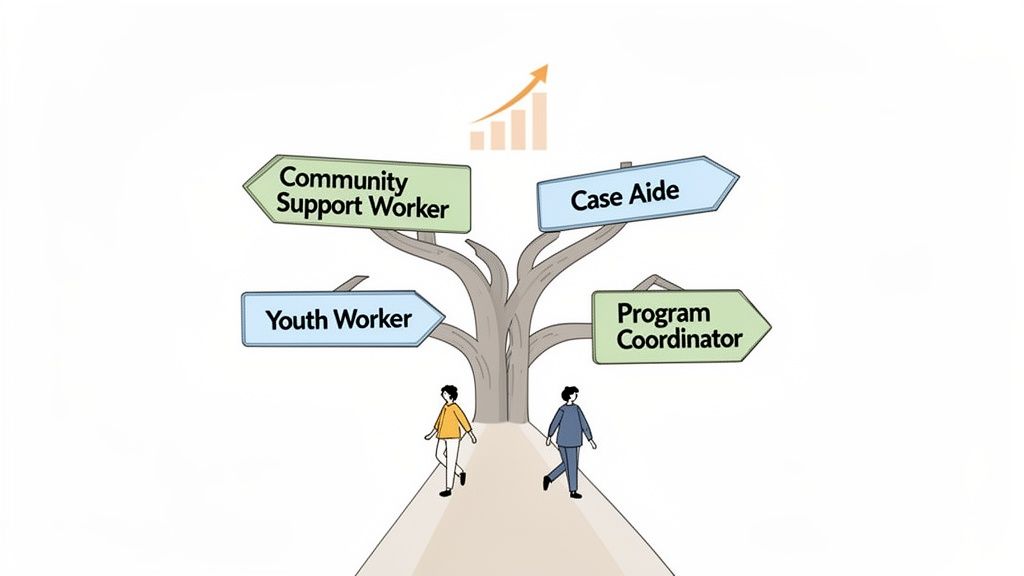
This isn't just about finding a job; it's about stepping into a sector that's the backbone of our communities. The roles are so varied that you can find a niche that truly clicks with your personality and passions, whether that’s working with young people, supporting the elderly, or helping those with disabilities.
A Sector with Strong Job Prospects
One of the best things about starting a career in community services is its stability and growth. The demand for qualified people isn't just steady; it's booming. This gives you a level of job security that’s hard to come by in other industries, offering real peace of mind for the future.
Right now, more than 967,000 people work in the community services sector in Australia, and that number is expected to climb past one million by the end of 2025. That’s a powerful sign that skilled workers are desperately needed.
The sector has been growing at an average of 7.1% each year between 2019 and 2024. With skills like case management and client support, you’ll be in high demand. In fact, the industry is predicted to grow by another 15.8% over the next five years, which means we’ll need around 88,500 new professionals by 2026.
These aren't just statistics; they're opportunities. It means your new qualification is a golden ticket in a job market that is actively looking for the exact skills you've worked so hard to gain.
Finding Your Specialisation
The community services field is incredibly broad, which is great because it means you can specialise in an area you genuinely care about. Your online course gives you the foundational skills, and from there, you can steer your career toward a specific group or need in the community.
Some of the most common specialisations include:
- Aged Care: Offering vital support to older Australians, helping them live with independence, dignity, and a better quality of life.
- Disability Services: Working alongside people with disabilities to help them hit their personal goals and be active members of the community.
- Mental Health: Providing non-clinical support for people facing mental health challenges and linking them with the services they need.
- Youth Work: Mentoring and guiding young people through tough times to help them build a positive future for themselves.
- Child Protection: Playing a crucial role in keeping vulnerable children and families safe and supported.
Choosing an area to focus on lets you build deeper expertise and make an even bigger impact. If you have your sights set on a management role, you might find our guide on the Diploma of Community Services and its career pathways really helpful.
Matching Qualifications to Job Titles and Salaries
Of course, one of the biggest questions on anyone's mind is, "What job can I get, and what will I earn?" To make things clear, we've put together a table that maps each qualification level to the kinds of jobs you can expect and the typical salary ranges in Australia.
This should give you a good visual of how your career can progress. It shows how studying further can lead to more senior roles with more responsibility and, naturally, a higher salary.
Community Services Qualifications and Career Pathways
Note: Salary ranges are estimates and can vary based on experience, location, and the specific organisation.
As you can see, there's a clear and achievable career ladder here. You can start with a Certificate III to get your foot in the door, gain some invaluable hands-on experience, and then jump back into your studies online for a Certificate IV or Diploma when you're ready to take the next step. Your journey is flexible and can be shaped to fit your life and career goals.
How to Choose the Right Online Course and Provider
With so many community services courses online, picking the one that’s perfect for you can feel like a big decision. It's not just about enrolling in a course; it's about making a real investment in your future. To make a confident choice, you need a clear checklist to help you compare your options and find a provider that truly sets you up for success.
Think of it like choosing the right guide for a long hike. You want someone experienced, who knows the terrain inside and out, and has the right tools to support you if you stumble. In the same way, a quality course provider will guide you through your studies, connect theory to the real world, and make sure you reach your career destination.
Here’s a quick look at some of the courses available through Get Course, showing how different providers structure their programs.
This gives you a snapshot of the variety in providers, qualification levels, and pricing. It really drives home the point that you need to look closer at the details of each program to find the right fit.
Your Essential Checklist for Choosing a Course
To cut through the noise, it helps to focus on a few non-negotiable factors. These are the hallmarks of a high-quality online course that will be respected by employers and give you the practical skills you actually need on the job.
- National Recognition: This is the absolute first thing you should check. Make sure the course is nationally recognised under the Australian Qualifications Framework (AQF). This is your guarantee that the qualification is legitimate and valued by employers right across the country.
- Provider Reputation and Support: Dig into what past students are saying. Look for providers with strong reviews and a clear system for student support. Will you have a dedicated tutor? Is there a simple way to ask questions and get help when you need it?
- Flexible Learning Format: Does the course offer a self-paced structure that fits around your life, or are there rigid deadlines and scheduled classes you must attend? Be honest about your own commitments and learning style, and choose the model that works for you.
Understanding Work Placement Requirements
A huge part of any community services qualification is the work placement. This is where you step out from behind the screen and apply your skills in a real-world community organisation. It’s the bridge between what you learn and what you do.
Before you even think about enrolling, get clear answers on these key questions:
- How many hours are required? This can vary significantly, often from 100 to 400 hours, depending on the qualification.
- What support does the provider offer? The best providers won't just leave you to it. They'll actively assist you in finding and securing a suitable placement, using their industry connections to help you get your foot in the door.
- Are there any location restrictions? Make sure they can support placements in your local area.
A provider’s approach to work placement speaks volumes about their commitment to your career success. Strong support in this area is a sign of a high-quality program focused on producing job-ready graduates.
The demand for community services professionals in Australia has never been higher. Online courses are helping to bridge this gap, with platforms bringing together flexible, nationally recognised programs from providers like Open Colleges, Upskilled, and Hader Institute. The Diploma of Community Services, for example, often requires 400 hours of accredited placements, blending online learning with hands-on assessments like role-plays. The best online models are all about real-world application, mentorship from sector veterans, and flexible payment options to make it all possible.
By carefully checking these key factors—accreditation, provider support, and placement assistance—you can confidently pick the course that’s right for you. For more guidance on this journey, check out our detailed article on how to get qualified in community services and help people.
Got Questions About Studying Community Services Online? We've Got Answers
Starting a new course is a big decision, and it’s completely normal to have a bunch of questions. To help you get the clarity you need, we’ve put together some straight-up answers to the things our students ask most.
This is all about the practical stuff—the details you want to know before you dive into an online community services course.
What Do I Need to Get Into a Certificate III Course?
Good news. For most Certificate III courses, you don't need any previous qualifications. They are built to be the perfect starting point for people from all walks of life.
The main things you’ll need are to be at least 18 years old and have some basic language, literacy, and numeracy skills. That’s it. This makes a Certificate III a brilliant launchpad if you're new to the sector or making a complete career change. It’s all about opening doors for anyone who has the heart to help others.
Think of a Certificate III as the open gate to a new career path. It’s not a test of what you already know. Instead, it’s designed to give you the foundational skills for the journey ahead, no matter what your work or study history looks like.
How Does Work Placement Work When I’m Studying Online?
This is a fantastic and super important question. While you’ll do all your theory and assignments online at your own pace, the work placement is where you get to roll up your sleeves and apply what you've learned in the real world.
It's a hands-on, in-person part of your course that’s mandatory. You'll spend time at an approved community services organisation, which is where the learning really clicks into place. It’s your chance to work alongside seasoned professionals, support real clients, and build the kind of practical confidence that employers value so highly.
Don’t worry, you won’t be on your own. A good online provider will have your back. They’ll have a dedicated team to help you find and lock in a suitable placement in your local area, making sure the whole experience is valuable and ties directly back to your studies.
What Are My Options for Paying for the Course?
Making study affordable is a huge plus of learning online. Most providers get that you’re probably juggling study with work and family, so they offer different ways to pay.
The most popular choice is an interest-free payment plan. This breaks the total cost down into smaller, more manageable weekly, fortnightly, or monthly payments. You can spread the cost over the length of your course without any extra fees piling up.
For higher-level courses like a Diploma, you may also be able to access government funding, such as a VET Student Loan. This lets you study now and pay the loan back through the tax system once you’re earning over a certain amount. It’s always best to check the specific course page to see exactly what payment and funding options are on the table.
Can I Genuinely Study Around My Work and Family Life?
Yes, you absolutely can. In fact, it’s the number one reason people choose to study community services courses online. The whole model is built for people with busy lives.
These courses are self-paced, giving you 24/7 access to all your learning materials through an online portal. There are no strict timetables telling you when to log on or live lectures you have to show up for at set times.
This puts you in complete control. You can study after the kids are in bed, on your lunch break, or during a quiet weekend. It’s a learning style designed for real life, letting you earn your qualification in a way that works for you, not the other way around.
Ready to find a course that fits your life and career goals? At Get Course, we make it simple to compare nationally recognised community services courses from Australia's leading online providers. Explore your options and take the first step toward a rewarding new career today at https://getcourse.com.au.
Find Your Course
Compare courses across every field we write about, and enquire in under a minute.