%20(1).png)

Thinking about becoming a social worker? If you’re driven by a deep desire to help people and be a part of real, meaningful change, then you’re looking at one of the most rewarding career paths out there.
The journey to becoming a social worker in Aotearoa New Zealand is clear-cut, but it takes commitment. It all boils down to getting the right qualification from a recognised provider, gaining hands-on experience in the field, and then officially getting registered so you can practise.
Deciding to pursue a career in social work is a big step. It’s a profession that calls for more than just academic smarts; it demands genuine empathy, a whole lot of resilience, and a powerful sense of social justice. Knowing the roadmap from the get-go can make the whole process feel less overwhelming and help you plan your next moves.

For a lot of people, the idea of diving straight into a four-year university degree feels like a huge leap. That’s where foundational learning can be a game-changer. Dipping your toes in with an introductory course in a related area, like community services, is a brilliant way to test the waters.
This approach gives you a solid grounding and helps you figure out if this field is truly where your passion lies before you commit to the full degree. It’s a great way to build confidence and make sure you walk into your social work programme with a real sense of purpose.
The path to becoming a registered social worker in New Zealand is structured and requires real dedication. While everyone's journey looks a little different, the core milestones are the same for everyone. Here’s a quick overview of what you can expect as you work towards making a lasting impact.
Think of this table as your high-level guide. Each stage is a crucial building block, taking you from initial interest to fully qualified professional, ready to support individuals, whānau, and communities across the country.
Before you start looking at degree programmes and application forms, it pays to get a real sense of what you’re stepping into. Becoming a social worker is so much more than just earning a qualification; it means joining a dynamic, challenging, and absolutely essential sector that touches every corner of Aotearoa.
Understanding this landscape—its opportunities, its pressures, and its people—is the first practical step on your journey.
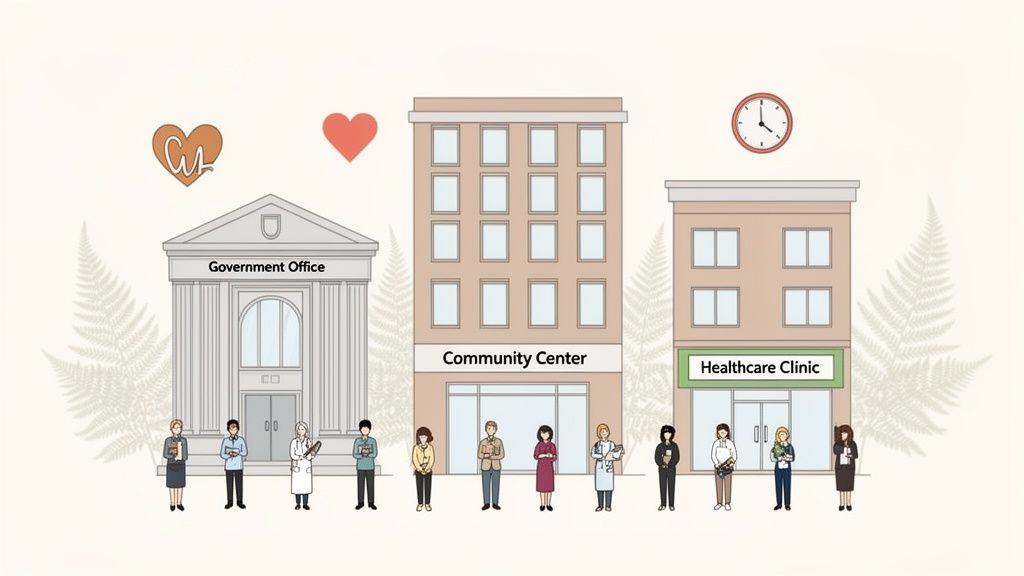
Social workers are the backbone of community support in New Zealand. You’ll find them in settings as diverse as the people they help—a bustling government agency, a grassroots non-profit, a hospital ward, a school, or a mental health facility. Each setting comes with its own unique challenges and, equally, its own unique rewards.
A career in social work is definitely not a monolith. The day-to-day mahi can change dramatically depending on where you're based. This diversity is fantastic because it lets you find a niche that truly aligns with your passions, whether that’s child protection, addiction services, elder care, or community development.
Data from the Social Workers Registration Board (SWRB) workforce survey really highlights this variety. The two biggest employers are non-governmental organisations (NGOs), making up 28% of the workforce, and Oranga Tamariki, which employs 26% of practising social workers. The health sector is the next major employer, showing just how critical social workers are alongside doctors and nurses.
Crucially, the survey reveals that an overwhelming 86% of practitioners qualify through a New Zealand-based pathway. This really underscores how important it is to choose a locally recognised programme. You can check out all the details in the full SWRB workforce survey.
This variety of roles is one of the most appealing things about the profession. For a deeper dive into what a social work career path can look like, you might be interested in our guide on exploring your social worker career options.
Social work is about working alongside people, their families, and communities in a holistic way to meet their needs, as well as advocate for wider societal change. It’s a profession that operates on both an individual and a systemic level.
Let’s be honest about the challenges. Social work is not an easy job. High caseloads, emotionally demanding situations, and complex systemic issues are part of the daily reality for many. The field demands immense resilience, empathy, and a strong personal support system to thrive.
A huge part of navigating this is developing rock-solid communication. Learning how to improve active listening skills isn't just a 'nice to have'—it's essential for building rapport and genuinely understanding what your clients need. It’s a foundational skill for managing the pressures of the job.
But alongside these challenges are incredible opportunities. Right now, New Zealand has a significant need for qualified, passionate social workers. This demand is really being driven by two key factors:
This situation creates a powerful dynamic. Yes, the work is demanding, but the need for new social workers has never been greater. For anyone entering the field, this means you aren’t just choosing a job; you’re stepping into a profession where your skills are desperately needed and where you can make an immediate, tangible impact.
Your decision to become a social worker is a commitment to supporting vulnerable people during their most difficult times. It requires a clear-eyed view of the challenges, but also a firm belief in your capacity to create positive change. This is the reality—and the reward—of social work in Aotearoa today.
Your formal education is the bedrock of your social work career. This is where a passion for helping people gets sharpened into the professional knowledge, ethical framework, and practical skills you’ll need to make a real, lasting difference. The path to becoming a social worker in Aotearoa isn’t just about any degree; it’s paved with specific, recognised qualifications.

The most direct routes involve degrees approved by the Social Workers Registration Board (SWRB), the official governing body for the profession here in New Zealand. Put simply, without an SWRB-recognised qualification, you can’t become a registered social worker. Let’s break down what those main pathways look like.
To legally call yourself a social worker in New Zealand, you need to complete a specific tertiary qualification from an accredited institution. The two main options are designed for different starting points, whether you're fresh out of school or already have a degree under your belt.
Both of these qualifications are demanding, and for good reason—they prepare you for the real-world complexities of the job. You'll cover a massive range of topics, from human development and social policy to counselling theories and bicultural practice, all firmly grounded in the unique context of Aotearoa.
The idea of committing to a multi-year degree can feel pretty full-on, especially if you’re thinking about a career change or haven't hit the books in a while. It's natural to ask, "Is this really the right move for me?" This is where taking a foundational step can be a brilliant strategy.
Starting with a shorter, more focused course in a related field like community services lets you build core knowledge and get a genuine feel for the sector's demands. It’s a chance to confirm your passion without the immediate pressure and financial commitment of a full university degree.
Think of it as a stepping stone. A foundational course builds your confidence and gives you a solid base of understanding, making sure you walk into your degree programme informed, prepared, and certain about your career choice.
This approach lets you test the waters and pick up practical insights that will put you ahead when you do start your degree. If this sounds like a smart move, exploring what community services courses are available online can give you a clearer picture of how to get your journey off to a strong start.
A social work degree is so much more than just lectures and late-night essay writing. It’s an immersive experience designed to build both your competence and your resilience. The curriculum is a careful mix of theory and practice, ensuring you’re ready to hit the ground running when you graduate.
You’ll likely find yourself studying key areas like:
Throughout your studies, you'll be constantly challenged to think critically, reflect on your own values, and develop the self-awareness that is so essential for effective practice. As you manage the demands of your degree, you might look for ways to streamline your study process, perhaps even exploring resources for effective AI homework help to support your academic workload.
The practical component, which we'll dive into next, is where all this theory comes to life. These mandatory placements are non-negotiable, and they’re where you’ll finally connect classroom learning to real-world situations, building the skills that will define your career.
Theory is essential, but social work is a profession you learn by doing. That’s where practical placements come in. They’re a non-negotiable part of any SWRB-recognised degree and the bridge that connects what you learn in the classroom to the real world.
Landing that first placement can feel like a massive hurdle. It’s often your first real taste of the professional social services world, and the pressure to make a good impression is definitely on. But take a breath. Placement providers aren’t looking for a fully-formed expert; they’re looking for someone with passion, potential, and a willingness to learn.
While your university or polytechnic will have a dedicated team to help you find a placement, the ball is still in your court to stand out. It’s on you to put your best foot forward, and that preparation starts long before you even think about writing your CV.
The best way to impress a placement agency is to show you’re already walking the talk. You need to demonstrate that you’re genuinely engaged with the core principles of social work, and you can do this by getting some proactive experience under your belt.
Think about taking these steps to build up your profile:
These activities give you solid, real-world examples to talk about in your application and interview, proving your interest is more than just academic.
Your CV and cover letter are your handshake before you even meet. They need to do more than just list your qualifications; they need to tell a compelling story about who you are and why you are so committed to becoming a social worker. Generic, copy-paste applications are easy to spot and even easier to ignore.
When you're writing, focus on your transferable skills. And don't just state them—prove them with a quick example. Instead of a bland line like, "I have good communication skills," try describing a time you had to calm down a tricky situation or explain something complex in a simple way.
Your lived experience is one of your greatest assets. Whether it's from previous jobs, volunteering, or personal challenges you've overcome, these experiences have built resilience and empathy—two of the most critical qualities in a social worker.
If you’re looking to build experience from the ground up, it helps to understand the roles that feed into social work. For instance, learning what a support worker does can give you incredibly valuable context and skills that translate directly to a social work placement.
The interview is your chance to let your personality and passion shine through. Placement coordinators will be looking for self-awareness, genuine empathy, and a solid grasp of professional boundaries. Be ready to talk openly about what’s driving you to become a social worker.
They’ll almost certainly throw some scenario-based questions at you to see how you think on your feet. For example, they might ask, "What would you do if a client told you something that made you worry about their safety?" Your answer needs to show that you can think critically and are committed to ethical practice.
Common Anxieties and How to Manage Them
It's completely normal to feel nervous. Here are two common worries and how to approach them:
Securing your placement is a huge milestone on your journey. It’s your first proper step into the profession, and it will teach you invaluable lessons that no textbook ever could. By preparing thoughtfully, you can turn this requirement into a powerful learning experience that builds your confidence and shapes the kind of social worker you want to be.
Finishing your social work degree is a massive achievement, but the journey isn't quite over. There are two crucial final steps before you can truly step into your new career: getting officially registered and then turning everything you’ve learned into a job offer. This is where all that hard work finally starts to pay off.

This final stage is all about making your new status official and then proving your value in a competitive job market. The good news? You're about to enter a sector with a clear and urgent need for new talent. Let's walk through exactly how to make this transition a smooth one.
Once that qualification is in your hands, your very next move is to apply for registration with the Social Workers Registration Board (SWRB). This isn't just a suggestion; it’s a legal requirement to practise social work and even call yourself a social worker here in Aotearoa New Zealand.
The registration process is designed to ensure every practitioner meets the professional standards for competence, ethics, and safety. You'll need to provide proof of your qualification, pass a 'fit and proper person' check, and show how you meet the SWRB's core standards. It’s a thorough process, so it pays to start early and give yourself plenty of time to get all the documents together.
Your CV is the first thing a potential employer will see. It needs to do more than just list your degree—it has to tell the story of a capable, empathetic professional who's ready to hit the ground running. The trick is to directly connect your academic learning and placement experiences to what the job ad is asking for.
Instead of simply listing your duties on placement, focus on what you actually achieved and the skills you built. Think action verbs and specific, tangible examples.
Remember to tailor your CV for every single application. Read the job description carefully and mirror its language, highlighting the specific skills and experiences the employer is looking for. A generic CV is a missed opportunity.
The interview is where you bring that CV to life. Employers will want to hear how you handle real-world scenarios, and the best way to structure your answers is by using the STAR method. It’s a simple technique that helps you give clear, concise, and evidence-based responses.
Here’s how it works:
Using this structure stops you from rambling and shows that you can think clearly and logically, even under pressure.
You are stepping into a profession with significant, well-documented demand. The road to becoming a social worker in NZ is set against a backdrop of serious workforce challenges, which actually creates urgent opportunities for new graduates like you.
The SWRB’s Workforce Report paints a stark picture: 85% of social workers are affected by heavy workloads and burnout, an aging workforce is heading towards retirement, and part-time work has jumped from 12% to 25%. More alarmingly, 16% of the current workforce plans to leave the profession within five years—that’s a loss of over 700 experienced practitioners.
While this climate is challenging for the sector, it means your skills are needed more than ever. Employers are actively searching for passionate new graduates to fill these critical roles across the country, putting you in a strong position as you kick off your job hunt.
Thinking about a career in social work? You probably have a few questions. It’s a big commitment, and it’s smart to get the details sorted before you dive in. To give you a bit of clarity, we’ve tackled some of the most common queries we hear from aspiring social workers across New Zealand.
Let’s get you some answers so you can make the best decision for your future.
The timeline really depends on where you're starting from academically.
For most people coming straight from school or another career, the standard path is the four-year full-time Bachelor of Social Work (BSW). This degree is your all-in-one ticket, blending solid academic theory with the practical, on-the-ground experience you’ll need.
Already have a degree? Great! If it's in a related field like sociology, psychology, or even criminology, you might be able to fast-track. The typical route here is a two-year full-time Master of Social Work (MSW). Both of these SWRB-recognised qualifications include mandatory clinical placements—they're a non-negotiable part of the training.
Not quite. While you can certainly get a head start with foundational courses online, like those in community services, you can't complete a recognised social work qualification 100% online. There's one very important reason for this: the mandatory in-person placements.
These placements are where the real learning happens. They're your chance to apply classroom theory in supervised, real-world settings, developing the hands-on skills needed to work safely and ethically with clients. Some universities offer a lot of flexibility for the theory side of things, but that practical component is an absolute must for registration.
Your degree gets you in the door, but your personal qualities are what will make you a truly great social worker. Technical knowledge is one thing, but employers are looking for people who can genuinely connect with others on a human level.
A few skills are absolutely essential:
Social work is about working alongside people, their families, and communities in a holistic way to meet their needs, as well as advocate for wider societal change. It’s a profession that requires you to operate on both an individual and a systemic level.
Yes, it is—and this is a huge step forward for the profession. Since 2021, social work has been a legally regulated profession here in Aotearoa.
This means you must be registered with the Social Workers Registration Board (SWRB) to legally call yourself a social worker and to practise. This isn't just red tape; it's a critical measure to protect the public and ensure every practitioner meets high professional and ethical standards. It safeguards the integrity of the profession and gives clients confidence they’re getting support from a qualified, accountable professional.
Ready to take your first step into a rewarding career in community services? At Get Course, we make it easy to find flexible, online courses that fit your life. Explore foundational programmes that can build your confidence and prepare you for your social work journey. Start learning today at https://getcourse.co.nz.


