%20(1).png)

Thinking about a career that genuinely helps people through life's ups and downs? If that sounds like you, then becoming a counsellor in New Zealand might be the most rewarding move you ever make. This isn't just another job; it's a response to a real, growing need for mental health support right across the country.

The demand for skilled, empathetic counsellors is more than just a headline—it's a reflection of our society's growing awareness of mental wellbeing and the everyday struggles Kiwis face.
We're not just talking about abstract statistics here. This is about the real experiences of our friends, whānau, and workmates. From managing anxiety and navigating tricky relationships to coping with grief, the need for professional, compassionate support is impossible to ignore. As a counsellor, you step into that space, offering a safe place for people to heal, grow, and build resilience.
One of the biggest drivers behind this demand is the rising tide of workplace stress and burnout. Let's be honest, modern work can be incredibly demanding, and a lot of New Zealanders are feeling the pressure. This has created a clear and urgent need for mental health support, both inside and outside our organisations.
The numbers really tell the story. A recent analysis found that only about one in four Kiwi workers is truly flourishing. That leaves the vast majority grappling with some level of stress or burnout. This isn't just an individual problem; it has a massive knock-on effect on our national productivity and economy.
In 2020 alone, New Zealand lost a staggering 7.3 million working days to absences linked to mental health issues. That cost the economy an estimated $1.85 billion. You can find more of these eye-opening stats on the Mental Health Foundation of New Zealand's website.
It's becoming crystal clear that investing in mental health pays off. For every dollar spent on early intervention and wellbeing initiatives, organisations see a return of $4.70. This signals a huge shift in thinking—businesses now realise that supporting their people isn't just the right thing to do, it's also smart business.
This growing need creates a powerful opportunity for anyone looking for a truly meaningful career change. The path to becoming a counsellor is an achievable and deeply rewarding journey, giving you the chance to contribute directly to the wellbeing of your community.
It’s a profession that calls for empathy, resilience, and a genuine desire to connect with and help others. The skills you develop aren't just for a job; they're life skills that enrich your own understanding of human connection. By choosing this path, you are answering a national call for more support systems. It's about:
The journey involves education and hands-on experience, but it all starts with recognising the significant role you can play. By exploring how to become a counsellor in NZ, you're taking the first step towards a career that truly matters—one that helps in breaking barriers and overcoming the stigma around counselling.
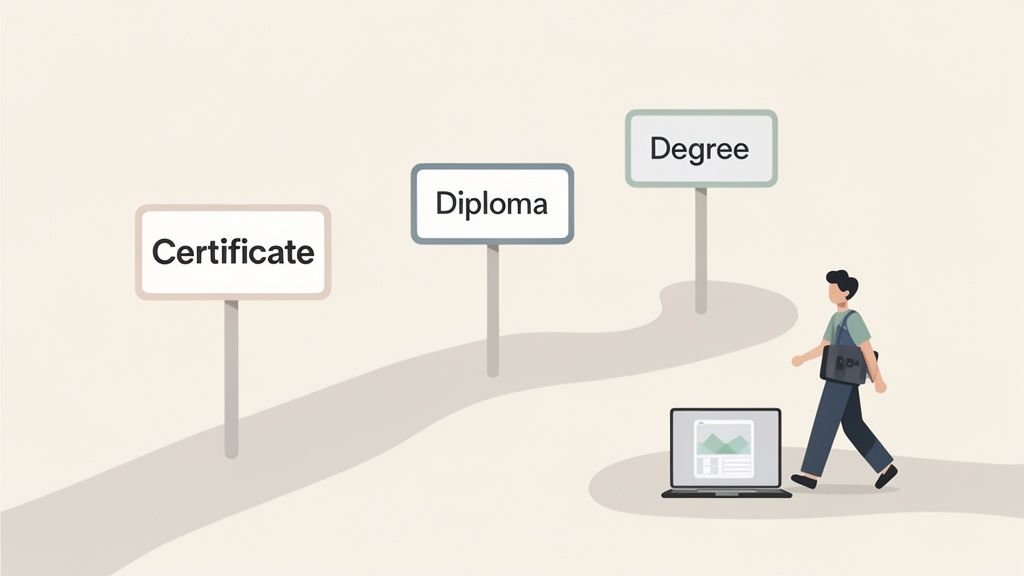
Starting your journey to become a counsellor in Aotearoa means figuring out which educational path is right for you. It can feel like a maze at first, but once you understand the main routes, you can take that first step with confidence.
The path you pick will likely hinge on where you're at right now—your current qualifications, life experience, and what you hope to achieve. Whether you're starting from scratch or looking to build on what you've already learned, there’s a pathway that will fit.
First things first, it's crucial to get your head around the difference between foundational learning and the formal qualifications you'll need for professional registration. Introductory courses, many of which are flexible and online, are a brilliant way to dip your toes in. They give you a solid feel for core concepts in mental health without the big commitment of a multi-year degree.
These courses are perfect for confirming this is really the field for you and building a base of knowledge. However, to actually practise as a registered counsellor and join a professional body like the New Zealand Association of Counsellors (NZAC), you’ll need to complete a formal, NZQA-accredited qualification.
Think of it like this: foundational courses are your runway, giving you the momentum and confidence to take off. The NZQA-accredited diploma or degree is the aircraft that will actually get you to your destination as a professional counsellor.
It is important to understand that the introductory courses available through our service can be a valuable stepping stone. They are designed to prepare you for potential entry into the formal programmes offered by NZQA-registered universities and polytechnics that lead to professional registration. For a good look at what's out there, exploring a range of online counselling courses can give you a comprehensive overview.
Once you’re ready to commit to formal study, you'll find a few well-trodden paths. The most common routes include diplomas and bachelor's degrees in counselling, which typically sit at NZQA Level 6 or 7.
To give you a clearer picture, here’s a quick comparison of the main educational routes.
This table breaks down the common qualification pathways, helping you see which one might be the best fit for your goals and circumstances.
As you can see, the right choice really depends on your learning style, previous experience, and long-term ambitions.
To get a better sense of where a counselling qualification fits into the bigger picture, it can be helpful to explore what career cluster a therapist belongs to. This gives you context on the different specialisations and pathways within the broader health and community services sector.
The New Zealand Qualifications Authority (NZQA) framework is the national standard for all qualifications. When you’re looking at counselling courses, these are the levels you really need to know:
Ultimately, your educational pathway is the foundation your entire career will be built on. Starting with an introductory course is a smart way to confirm your interest, but choosing the right NZQA-accredited programme is the critical step toward becoming a trusted, registered professional.
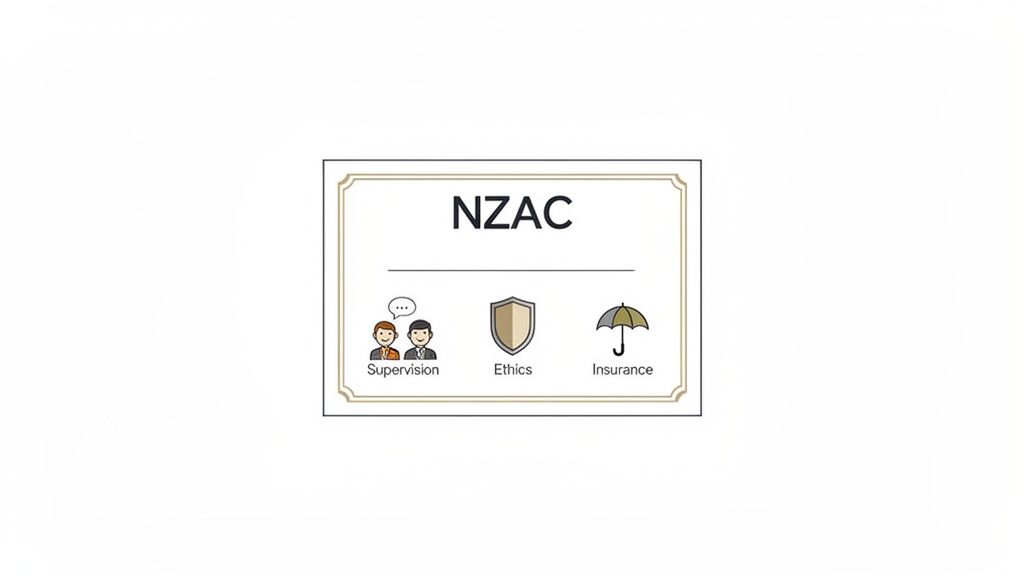
Finishing your qualification is a huge milestone, but it’s what comes next—professional registration—that really kicks off your career. This isn't just about getting a piece of paper; it’s your public commitment to practicing safely, ethically, and competently.
For most aspiring counsellors here in New Zealand, the main goal is getting registered with the New Zealand Association of Counsellors (NZAC). The NZAC is our leading professional body, and being a member is a mark of credibility that both employers and clients look for.
Achieving this status tells everyone you meet the nationally recognised standards. It’s a clear sign that you’re not just qualified in theory but are actively committed to upholding the highest professional conduct.
Getting your provisional membership with the NZAC involves more than just handing over your degree. The association needs to see that you're truly ready for the responsibilities of practice. You can think of these requirements as the essential pillars holding up your professional identity.
Here's what you'll need to have sorted:
This structured process ensures every registered counsellor has a solid footing in both theory and real-world application, which is absolutely vital for building trust with the people you’ll be helping.
One of the most critical—and often misunderstood—parts of becoming a counsellor is supervision. Forget any ideas about a manager watching over your shoulder. It’s actually a supportive and collaborative professional relationship.
In supervision, you meet regularly with an experienced, accredited counsellor to talk through your client work in a completely confidential space. It’s a dedicated time to reflect on your practice, get a second opinion on tricky ethical dilemmas, and receive guidance on your own professional growth. This is mandatory to keep your registration and is a cornerstone of ethical practice in New Zealand.
Supervision is your professional safety net. It protects both you and your clients by ensuring you have a confidential space to process challenges, gain new perspectives, and maintain your own wellbeing while supporting others.
It’s a true investment in your career and your resilience, helping you avoid burnout and constantly sharpen your skills.
While NZAC membership is a key goal, other credentials can really broaden your career options. One of the most valuable is becoming an ACC-registered counsellor.
This registration lets you provide fully funded therapy to clients who need support due to an injury or trauma covered by the Accident Compensation Corporation (ACC). To get on their books as a provider, you generally need:
This pathway opens up a crucial area of practice, putting you in a position to support some of the most vulnerable people in our communities.
Lastly, and this is a big one: before you see a single client, you must have professional indemnity insurance. This is a non-negotiable for practicing in New Zealand and a requirement for membership with any professional body.
This insurance protects you from legal costs or claims that might pop up from an act, omission, or breach of professional duty in your work. It gives you peace of mind, making sure that in the unlikely event of a complaint, you're financially covered. Think of it as essential protection for your career, your finances, and your reputation.

Theoretical knowledge lays the groundwork, but it's the hands-on experience where you truly forge your skills as a counsellor. This practical application is an essential part of your training, bridging the gap between classroom concepts and the complexities of real human interaction.
Securing these practical placements is a key requirement for any NZQA-approved qualification and for your eventual professional registration. This is where you'll start to see your learning come to life, working with clients under the safety net of professional supervision.
Finding the right placement can feel like a big task, but many organisations across New Zealand are eager to support emerging counsellors. Formal training providers often have established relationships with community agencies and will help you find a suitable spot.
Don't be afraid to be proactive in your search, though. Reaching out to different types of organisations is a great way to get a feel for where your passion lies.
As you consider where to gain real-world experience and specialise, it's beneficial to explore the mental health therapy practice industry to see the full scope of opportunities.
Your supervisor is more than just a mentor; they are a critical guide throughout your early career. This professional relationship is built on trust and is absolutely essential for developing an ethical, competent, and reflective practice.
When looking for a supervisor, it’s about finding the right fit. You need someone whose approach resonates with you and who has experience in an area you're interested in. A good supervisor will challenge you, support your growth, and provide a safe space to discuss your client work without judgement.
The supervision process is fundamental to your development. It’s a dedicated space to unpack complex cases, manage ethical dilemmas, and reflect on your own emotional responses to client work, ensuring both your wellbeing and the safety of your clients.
As you gain experience, you'll naturally start to gravitate towards certain areas of counselling. This is the exciting process of finding your niche—the specialisation where you feel most effective and passionate.
Your practical placements are the perfect testing ground for this. For example, a placement at a youth centre might reveal a talent for connecting with teenagers, while volunteering at a grief support service could uncover a deep capacity for helping people navigate loss.
Your niche could be defined by:
For those drawn to helping people within community-focused roles, exploring the variety of community services courses online can provide a wider perspective on potential specialisations. This process of discovery is ongoing and shapes a career that is not only successful but also deeply fulfilling.
You’ve done the hard yards, completed your qualification, and are on the path to registration. That’s a massive achievement. So, what’s next? Let's get a clear, motivating picture of where your skills can take you and the kind of stability you can expect.
The great news is that the demand for skilled counsellors in New Zealand is strong, and it’s only growing. This isn’t just a feeling; it’s backed by serious national investment in mental health and a genuine shift in how much our communities value what counsellors do.
New Zealand's commitment to bolstering its mental health workforce is creating real, tangible opportunities. This national focus means more roles are popping up in all sorts of sectors as organisations finally start prioritising wellbeing.
And this is happening at a significant scale. In 2023 alone, Te Whatu Ora (Health New Zealand) increased its mental health and addiction staff by 630 full-time equivalents. The wider health sector, which includes counselling, is also set to expand, needing thousands more skilled professionals every year. You can dig into the full workforce plan to see the national strategy for yourself.
This isn't just about filling gaps—it's a fundamental change. Employers across public health, community services, and even corporate HR are actively looking for people who can support the mental and emotional wellbeing of Kiwis. This creates a stable and genuinely promising job market for newly qualified counsellors.
One of the best things about a career in counselling is the sheer variety. Your qualification doesn't pigeonhole you. Instead, it unlocks doors to so many different environments, letting you find a role that really clicks with your skills and passions.
You could find your calling in places like:
Of course, passion has to be paired with practicality. While counselling is driven by a desire to help, it’s also a profession that can provide a stable and rewarding income.
Naturally, your earning potential will grow as you gain more experience, find your specialisation, and establish yourself in the field.
Here’s a general idea of what you can expect to earn at different stages of your counselling career in New Zealand.
These figures, based on data from various career sources, show a clear path for financial growth. At the start, your focus will be on building up that crucial experience, but as your skills deepen and your reputation grows, so will your income. This makes becoming a counsellor in NZ a sustainable and financially sound career choice for the long run.
It’s completely normal to have a lot of questions when you’re thinking about a big career change. To give you some clarity and confidence, we've put together answers to the most common queries we get from people just like you, wondering how to get started as a counsellor in NZ.
This is usually the first thing people want to know, and the answer depends on the path you choose and whether you can study full-time.
Becoming a qualified counsellor isn't a quick process. It requires a serious commitment to both academic learning and hands-on practice to make sure you're ready for the role's responsibilities. Generally, you’re looking at three to four years of full-time study to complete an NZAC-accredited qualification, like a Bachelor of Counselling or a Level 7 diploma.
If you need to fit your studies around work or family, a part-time pathway is a great option, though it will naturally take longer—often six years or more. Remember, this timeline includes your supervised clinical hours, which are a non-negotiable part of your training.
This is a really common point of confusion, but the distinction is important. While both counsellors and psychologists are dedicated to helping people with their mental health, their training, focus, and the way they work are quite different.
Here’s a simple way to think about it:
Each profession has its own training pathway and is governed by a different professional body in New Zealand. They both play crucial, distinct roles in our mental health system.
Yes, you absolutely can. This is great news for many people who have valuable life experience and empathy but don't have a traditional academic background.
A Bachelor of Counselling is a well-respected route, but it’s definitely not the only one. Many programmes approved by the NZAC for professional registration are diplomas offered by polytechnics and private training providers. These are usually at NZQA Level 6 or 7.
The key thing to know is that entry into these diploma programmes can be much more flexible. Providers often put a lot of weight on your life experience, personal character, and genuine passion for helping others—not just your previous academic record.
Starting with a foundational certificate can be a smart move. It lets you get a feel for the field, build essential knowledge, and create a stronger application for a diploma programme, all without committing to a full degree right away.
The financial side of things is a practical and important part of your planning. The cost of becoming a counsellor in New Zealand can vary quite a bit, so it really pays to do your homework.
Several things will influence the total cost:
You’ll need to check the specific tuition fees for any provider you’re interested in. But the course fees are only part of the picture. Once you start practising, there are ongoing professional costs you'll need to budget for.
These are standard for any practising counsellor and usually include:
Thinking about these costs from the very beginning helps make your journey financially sustainable and sets you up for long-term success in this incredibly rewarding field.
Ready to take that first step? At Get Course, we make it easy to find flexible, self-paced online courses to build your foundational knowledge and get you ready for the next stage. Discover your options today and start your journey.


