%20(1).png)
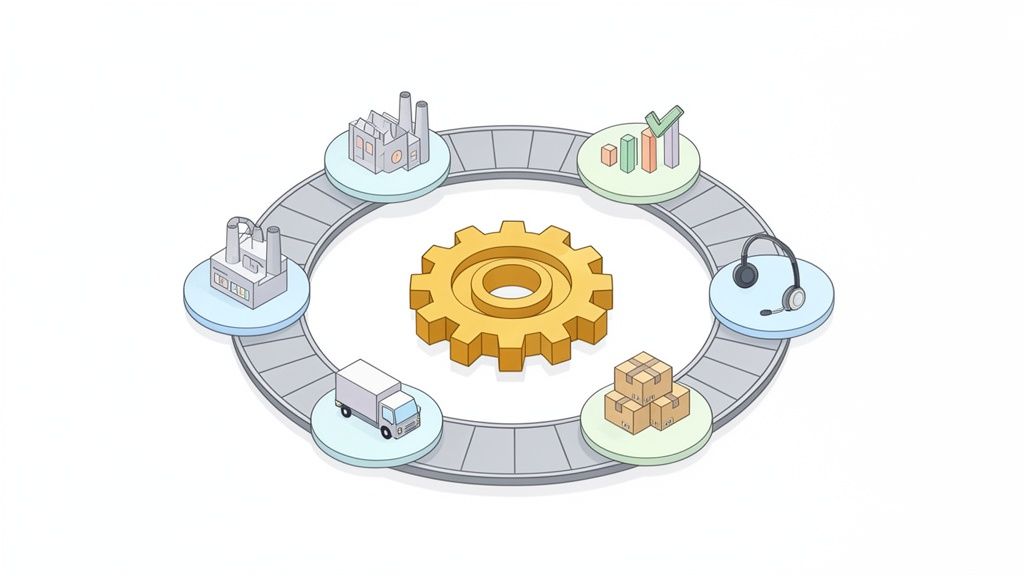
In the simplest terms, operations management is the engine room of any business. It’s the behind-the-scenes work of planning, organising, and overseeing how products get made or services get delivered. Think of it as the "how" behind everything a company does—turning inputs like raw materials, people, and energy into something valuable for customers.

So, what is operations management really about at its heart? It’s all about creating the most efficient and effective ways to do business. The goal is to convert materials and labour into goods and services as smoothly as possible, which in turn maximises the company's bottom line.
Picture a busy Auckland café during the morning rush. Operations management is the invisible force making sure the coffee beans were ordered on time, the right number of baristas are on shift, and the process from taking an order to handing over a perfect flat white is seamless. Without it, you’d have chaos—long waits, wrong orders, and frustrated customers.
This same idea applies everywhere, not just in your local coffee shop. It's just as crucial for a construction company in Christchurch managing building supplies and contractors, or an IT firm in Wellington delivering reliable software support. Even a nationwide retailer needs it to keep its shelves stocked.
No matter the industry, the fundamental goals are always the same:
You could say operations management is the art and science of getting things done. It’s all about building systems and processes that are not only effective but also repeatable and scalable, so a business can keep delivering value as it grows.
In any business, operations managers are the ultimate problem-solvers. They look at the entire journey—from the very first raw material to the final delivery—and constantly ask, "How can we make this better?" This relentless drive for improvement is what keeps a business competitive and profitable.
Ultimately, strong operations management helps a business continuously find ways to improve operational efficiency across every single function. By getting these principles right, companies build a solid foundation for growth, allowing them to adapt to market changes and keep their customers happy. That’s what makes it such a vital skill set in any modern career.
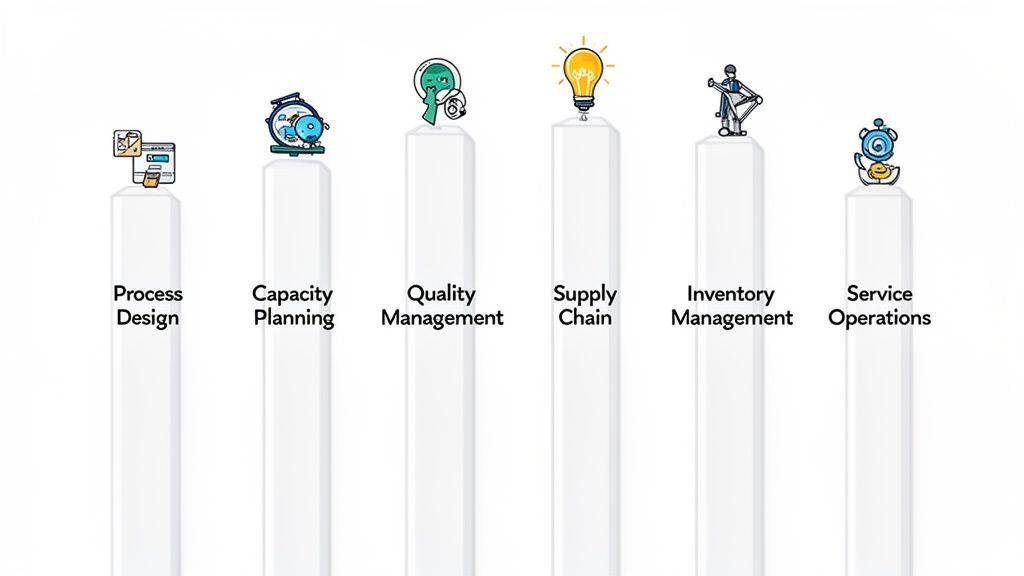
To really get what operations management is all about, we need to look at its core components. Think of a well-built house; it needs strong, separate pillars to hold it up. In the same way, solid operations management is built on six essential pillars that work together to create a powerful, efficient, and customer-focused business.
These pillars aren't independent silos. They're all interconnected, and a change in one directly affects the others. A disruption in the supply chain, for instance, will ripple through to inventory levels, which in turn impacts how you serve your customers. Let’s break down each of these six pillars.
The first pillar, process design, is essentially the blueprint for how work gets done. It’s about mapping out every single step needed to turn inputs into outputs—whether that's assembling a product, building software, or helping a customer. The goal here is to create a workflow that is logical, repeatable, and as lean as possible.
Picture a busy café during the morning rush. The process design dictates where the coffee machine is, how the milk is stored, and the exact sequence of steps a barista takes to make a flat white. A good process means less running around, shorter wait times, and a consistently great coffee every time. Bad process design? That leads to bottlenecks, mistakes, and wasted effort.
Once you have your process sorted, you need to figure out how much you can actually produce. This is capacity planning, our second pillar. It’s the constant juggling act of balancing your company’s ability to deliver with what your customers are asking for. It involves forecasting demand and making sure you have the right amount of equipment, people, and materials to meet it without overspending.
A classic example is an airline figuring out how many flights to run between Auckland and Queenstown during the ski season versus the middle of summer. Too few flights, and they miss out on revenue and leave customers frustrated. Too many, and they're flying half-empty planes, burning fuel and money. Capacity planning is all about hitting that profitable sweet spot. You can learn more about how capacity planning helps manage uncertainty by reading our guide on what is risk management.
The third pillar is quality management, which is about embedding a commitment to excellence in everything you do. It’s not just about a final inspection before a product goes out the door; it's about building quality into the process from the very beginning to stop defects from ever happening.
Quality management ensures that what you produce consistently meets or exceeds customer expectations. It’s the difference between a business that just gets by and one that builds a rock-solid reputation for reliability, turning customers into loyal fans.
This pillar covers everything from setting quality benchmarks and training your team to using data to track performance and find ways to get better. A car manufacturer, for example, runs thousands of checks throughout its assembly line to make sure every single part fits perfectly, creating a vehicle that's both safe and dependable.
The fourth pillar, supply chain management, is the art and science of getting goods and information from the original supplier all the way to the final customer. It involves sourcing materials, handling logistics, coordinating with partners, and making sure products are exactly where they need to be, right when they need to be there.
For a company like Fonterra, the supply chain is a massive global puzzle. It starts with collecting milk from thousands of farms across New Zealand, processing it in factories, and then shipping dairy products to markets all around the world. This incredibly complex network needs meticulous coordination to keep costs down, meet delivery times, and maintain product quality.
Tied closely to the supply chain is our fifth pillar, inventory management. This is the delicate balancing act of holding enough stock to meet demand without tying up too much cash. Get it right, and you avoid stockouts (and lost sales). Get it wrong, and you're stuck with high storage costs and potentially obsolete products.
A local retail shop is a perfect example. They need enough of a popular item on the shelves to last until the next delivery arrives, but not so much that it crowds out other products or goes out of style. Modern inventory systems use sales data to predict demand and automate reordering, finding that perfect equilibrium.
Finally, the sixth pillar is service operations. While the other pillars apply to both product and service businesses, this one is laser-focused on designing and managing an outstanding customer experience. It involves managing customer interactions, mapping out service encounters, and ensuring staff have the training and tools they need to provide fantastic support.
This is particularly crucial in sectors like facilities management, where the "service" is the ongoing maintenance of a building. In New Zealand, operations management in this field has been a key driver of efficiency. Hard services—like structural, electrical, and fire-safety maintenance—make up 60.88% of the market, a trend heavily influenced by the country's seismic risks and mandatory building upgrades.
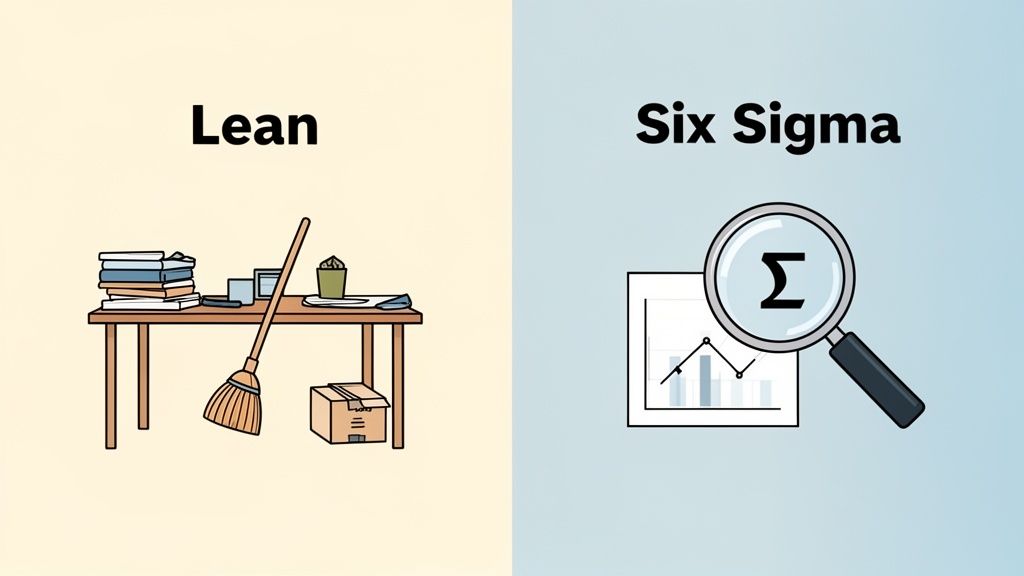
To get the most out of every resource, leading companies don't just work harder; they work smarter using proven systems. Two of the most powerful and widely used frameworks in modern operations management are Lean and Six Sigma. While often mentioned together, they solve different problems in unique ways.
Think of these frameworks as specialised toolkits. You wouldn't use a hammer to fix a delicate watch, and you wouldn't use tweezers to build a house. Similarly, knowing which operational framework to apply is key to achieving outstanding efficiency and quality.
The Lean methodology is all about maximising customer value while minimising waste. It’s a relentless pursuit of identifying and removing anything in a process that doesn't add value from the customer's perspective. It’s like tidying up your business processes, keeping only what is essential for a great result.
This concept originated in manufacturing but is now applied everywhere, from healthcare to software development. Lean identifies several types of waste that can slow a business down:
By systematically targeting and reducing these wastes, a business becomes faster, more agile, and more cost-effective. This principle is fundamental to understanding what operations management aims to achieve.
If Lean is about speed and eliminating waste, Six Sigma is about precision and eliminating defects. It is a highly disciplined, data-driven methodology that uses statistical analysis to find and remove the root causes of errors. The ultimate goal is to get as close to perfection as possible.
The term "Six Sigma" refers to a statistical goal of having no more than 3.4 defects per million opportunities. It’s a detective's toolkit for business, using data as clues to solve problems and prevent them from recurring.
This approach is perfect for complex processes where consistency is critical. A hospital might use Six Sigma to reduce medication errors, while a bank could apply it to minimise mistakes in processing loan applications. It’s all about making outcomes predictable and reliable, which builds customer trust.
Many organisations now combine these two approaches into a single methodology called Lean Six Sigma. This hybrid framework gives them the best of both worlds: Lean’s focus on speed and waste reduction, plus Six Sigma’s focus on quality and defect prevention. For many businesses, effective operations management also provides powerful frameworks for Scaling With Systems to achieve sustainable growth.
The core idea shared by both is Kaizen, or continuous improvement. It’s the belief that small, ongoing positive changes can lead to major improvements over time. By empowering teams to constantly look for better ways of working, businesses create a culture of excellence.
Understanding these frameworks is essential, just as it's crucial to grasp how a well-managed supply chain functions. If you're interested, you can learn more about what is supply chain management in our detailed guide.
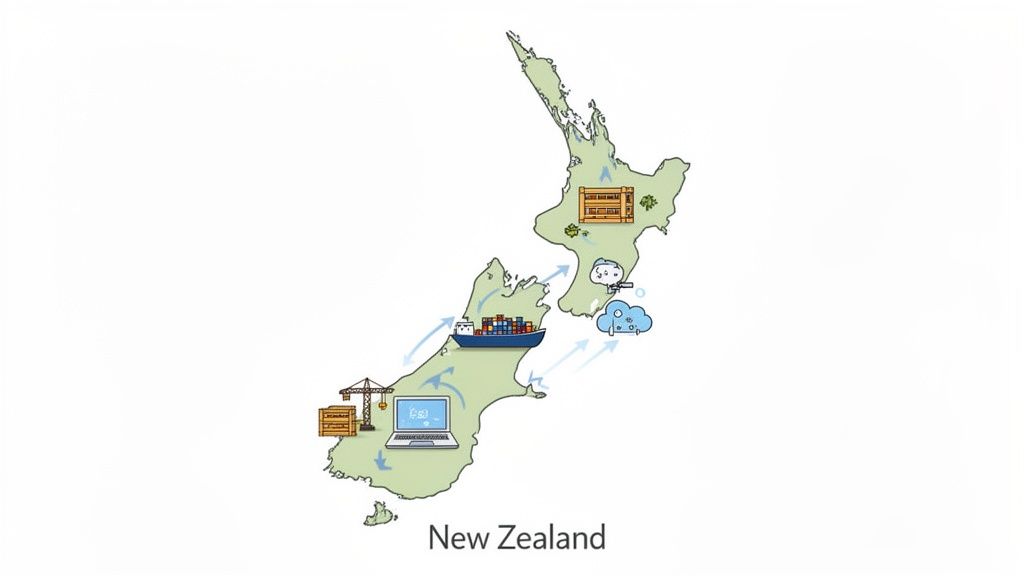
Operations management isn't just a business school theory—it's the engine that keeps New Zealand's economy humming. For a country built on global trade and sharp thinking, the principles of running things smoothly are woven into the very fabric of our biggest industries, from the farm gate to the international marketplace.
To really get what operations management is in a Kiwi context, you have to see it in action. It’s the smart planning that lands fresh Zespri kiwifruit on shelves in Europe. It's the tight project coordination that gets new houses built in our growing cities. And it's the nimble processes that help our tech start-ups go head-to-head with global giants.
The link between operational know-how and our economic health is crucial. The services sector, for example, ballooned from $69 billion to $126 billion in just five years, yet as a nation, our overall productivity still has some catching up to do. This gap often comes down to things that strong operations can fix, like tightening up processes in smaller firms and finding clever ways to work more efficiently. If you want to dive deeper, you can explore a full analysis in this long-term insights briefing on NZ's productivity.
To show you what this looks like on the ground, let's look at how OM plays out across some of our key sectors.
The following table breaks down how operations management tackles different challenges across New Zealand's diverse industries, showing just how adaptable these skills really are.
As you can see, while the problems are different, the goal is always the same: create a smarter, more efficient way of getting things done.
New Zealand's primary industries are a masterclass in operations management. Take our dairy or kiwifruit sectors. Their global success hinges on an incredibly fine-tuned supply chain that connects thousands of individual farms with consumers on the other side of the world.
This isn't just about putting things on a boat. It involves tackling some serious operational puzzles:
Frankly, without world-class operations, our agricultural exports wouldn't stand a chance. It’s this operational backbone that turns our natural advantages into real economic muscle.
The building industry in New Zealand is grappling with its own set of operational headaches, from skill shortages to the sheer complexity of major projects. This is where project operations management becomes absolutely critical for delivering the roads, hospitals, and houses we need—on time and on budget.
An operations manager in construction is like an orchestra conductor. They're in charge of resource allocation, making sure the right people, machinery, and materials are on-site exactly when they're needed. They also manage supplier relationships to sidestep delays from material shortages, a problem that can bring a whole site to a standstill.
In construction, effective operations management isn't just about speed. It’s about managing risk and making sure a project is finished safely and to a high standard. It’s what separates a successful development from one that gets stuck in a cycle of delays and cost overruns.
As New Zealand’s economy shifts, the rules of operations management are proving just as vital in our booming tech and service industries. For a software company in Wellington or a tourism operator in Queenstown, the "product" might not be something you can hold, but the need for a seamless process is exactly the same.
In these fields, operations management is all about:
At the end of the day, strong operational skills are non-negotiable for the small and medium-sized businesses that are the heart of our economy. They provide the practical tools needed to handle challenges, jump on opportunities, and build businesses that last.
Understanding the theory behind operations management is a great start, but the real goal is turning that knowledge into a fulfilling career. This field is packed with diverse professional paths for anyone who loves strategic problem-solving. At its core, it’s a career built on making businesses run better, faster, and smarter.
Most people start in foundational roles to learn the ropes. From there, the opportunities to climb into senior leadership are huge. It's a career track that really values hands-on experience and a sharp, analytical mind.
The career ladder in operations management is pretty clear and progressive. You’ll usually start in a specialised or analyst role before making your way into management.
Here are some of the typical entry-level and senior positions you'll see:
To really succeed in operations, you need a balanced toolkit of technical know-how and solid people skills. This mix is what separates a good manager from a great one. The best professionals can crunch the numbers and lead a team with equal confidence.
Here in New Zealand, the demand for these skills is crystal clear. The country has 617,330 enterprises, but with total employee numbers recently dipping 2.2% to 2.4 million, the pressure is on. Businesses—especially the small firms that are the backbone of our economy—have to operate with maximum efficiency. If you want to dive deeper into the data, you can find more insights into NZ's business demography here.
Hard skills are the technical abilities you’ll need to dissect problems and build effective solutions.
Don't underestimate the soft skills—they're just as important. They dictate how well you work with others to actually get things done.
Operations management is as much about people as it is about processes. You can design the perfect system, but it will fail without effective communication, leadership, and collaboration.
Thinking about a career in operations management? The good news is, it’s more accessible than you might think. You don't need a specialised degree to get your foot in the door. What really counts with employers is a knack for problem-solving, practical skills, and a genuine drive to make things run better.
This career path is wide open to people from all sorts of backgrounds. Whether you're a super-organised planner, an analytical thinker, or a natural leader, there’s a spot for you. The trick is to build a solid base of knowledge you can actually use in the real world.
Getting started is all about taking small, smart steps to build up your expertise. Flexible online study is a brilliant way to gain formal knowledge without hitting pause on your life. You can dive into the core principles of business, procurement, or project management whenever it suits you.
This approach helps you pick up the exact skills that are in demand for operations roles. Building this foundation shows potential employers you’re serious and have the theory to back up your practical smarts. It's a fantastic way to fill any gaps in your experience.
The best operations professionals never stop learning. They’re always on the lookout for new methods and fresh ideas to boost efficiency, which is why ongoing education is a cornerstone of a successful career.
As you begin, aim to develop a healthy mix of practical know-how and people skills. This balanced toolkit will make you a strong contender for entry-level roles and pave the way for future leadership positions.
Here are a few areas to focus on:
By concentrating on these areas, you build a direct pathway into a dynamic and genuinely rewarding field. The skills you develop aren't just for one job; they're the building blocks for a long-term career that can take you across countless industries. Your journey starts with that first step toward learning.
To wrap things up, let's tackle a few common questions that pop up when people first dive into operations management. Getting these sorted will help you see the bigger picture—from career paths to how it all fits together in the business world.
Not necessarily. While a degree in business or supply chain management is a great starting point, it’s far from the only path. Many of the best operations professionals I’ve met came from completely different fields.
What really matters to employers is a knack for problem-solving, a head for numbers, and the ability to lead a team. Focussing on building those practical skills often speaks louder than the title on your degree. It shows you can walk the walk, not just talk the talk.
That’s a classic misconception, but the simple answer is no. While the principles of operations management were first ironed out on the factory floor, they’re now used in practically every industry imaginable.
The goal is always the same: deliver value as efficiently as possible. And that’s a universal need.
Any organisation that has a process—and that’s all of them—relies on operations management to keep things running well.
Great question. These two fields are often intertwined, but they have very different jobs. The easiest way to think about it is ongoing processes versus one-off initiatives.
Operations management is all about the day-to-day grind—the continuous functions that create the same product or service again and again. Project management is about steering a unique, temporary project with a clear beginning and end, a specific goal, and a final result.
Imagine a car factory. The operations manager is in charge of the assembly line that runs every single day. A project manager would be called in to lead the special, one-time project of installing a new robotic arm on that line. One manages the routine; the other manages the change.


