How to Start a Small Business in Australia from Scratch
Learn how to start a small business in Australia with our complete guide. Get actionable advice on your ABN, business plan, funding, and marketing.
So, you're thinking about starting a small business in Australia. It all boils down to a few core stages: testing your idea to make sure it has legs, sketching out a lean business plan, getting your legal ducks in a row with things like an ABN, sorting out your finances, and figuring out how you’ll actually find customers. It's the journey from a spark of an idea to a real, trading business.
Your Australian Small Business Launchpad

If you're looking to launch your own thing, you're in great company. The entrepreneurial spirit in Australia is absolutely buzzing right now, which makes it a fantastic environment for new founders. You can ditch the old-school image of needing a huge office or a massive bank loan to get started; today’s most exciting businesses are being built by people just like you.
The path from a brilliant idea to a profitable business can feel like a maze of jargon and red tape. But when you break it down, it’s really just a series of manageable steps. Think of this guide as your roadmap. We’re here to demystify the entire process, from that first "what if?" moment right through to making your first sale, giving you a clear, actionable plan to build your confidence for the road ahead.
A Thriving Ecosystem for Founders
The numbers don't lie—the opportunity is real. As of mid-2025, Australia was home to over 2.7 million actively trading businesses, a jump of 2.5% from the year before.
And here's the kicker: a massive 97.3% of these are small businesses. The 4.9% growth in non-employing businesses shows that sole traders and tiny ventures are the true engine of the Aussie economy. You don't need a huge team to make a go of it. In fact, most business owners are starting small, with 91.5% turning over less than $2 million a year.
The most powerful insight? A staggering 61% of small business owners are first-time founders. This highlights that passion and a solid plan—not just prior experience—are the key ingredients for success in today's market.
Planning Your Path Forward
A great idea is the spark, but a plan is the fuel that turns it into a bonfire. Having a plan forces you to think through the critical parts of your business—operations, marketing, and money—before you sink in your time and cash.
To really lay a solid foundation, using a structured guide like an ecommerce business plan template can be a game-changer, even if you’re not selling products online. It prompts you to answer the tough questions early and creates a practical playbook for your launch and first few months of growth.
Your 7-Step Small Business Launch Checklist
To give you a bird's-eye view of the journey ahead, we've broken it down into seven core stages. This checklist summarises the entire process, from that initial lightbulb moment to officially opening for business.
This table maps out the key milestones. By focusing on one stage at a time and building the right skills along the way, you can turn your vision into a successful Aussie business.
Testing Your Business Idea in the Real World

Every great business starts with that "aha!" moment—an idea for a product or service that just feels right. But an idea, no matter how brilliant it seems in your head, is really just a starting point. The absolute most crucial thing you can do next is to see if it holds up in the real world before you pour your heart, soul, and savings into it.
One of the most common—and heartbreaking—mistakes I see is people jumping straight from idea to launch. The hard truth is that many ideas that sound amazing don't survive first contact with actual customers. This is where market validation becomes your secret weapon. It’s all about gathering cold, hard evidence that people not only like your idea but are willing to pay for it.
And this isn't about asking your mum or your mates what they think. They love you, and they'll likely tell you what you want to hear. Real validation means getting out there and getting honest, unfiltered feedback from the very people you hope will become your customers.
Who Are You Actually Selling To?
Before you can test anything, you need to be crystal clear on who you're testing it with. Aiming for "everyone" is a surefire way to connect with no one. What you need is a detailed buyer persona—think of it as a profile of your perfect customer.
Give this person a name, a job, and some real-life details. Ask yourself:
- What are their biggest frustrations that keep them up at night?
- Where do they hang out online? Are they in specific Facebook groups, industry forums, or scrolling through Reddit?
- What are they trying to achieve, and how can your idea help them get there?
For example, if you want to launch a meal-prep service for busy professionals in Sydney, your persona might be "David." He’s a 35-year-old lawyer, works insane hours, wants to eat healthy but just doesn't have the time to cook, and listens to business podcasts on his commute. See how specific that is? This detail makes it so much easier to find and talk to real-life "Davids."
How to Test Your Idea on a Shoestring Budget
Once you know who you’re looking for, you can start testing your idea without needing a huge budget. Forget about fancy market research firms for now; some of the best insights come from simple, direct approaches. Remember, your goal right now is to learn, not to sell.
Just have a chat: Find people who fit your persona and ask for a 15-minute chat. Don't pitch them. Frame it as you seeking their expert advice on a problem they face. Ask open-ended questions about their challenges and listen carefully to see if your solution even registers as something they need.
Put up a "Coming Soon" page: A simple one-page website explaining what you're offering is an incredibly powerful tool. Describe the main benefit, add an email sign-up form, and see what happens. If you can get 50-100 subscribers who are keen to know when you launch, that's a massive green light.
Build a Minimum Viable Product (MVP): An MVP is the most stripped-back version of your product that actually works. It could be a simple booking system, a basic spreadsheet template, or a tiny batch of a physical product. This lets you get real feedback and, most importantly, see if people will actually pay for it. Looking at a list of low-cost small business ideas can also get the wheels turning on what a simple MVP could look like for you.
So many first-time founders make the mistake of building their entire product in secret, waiting for a "big reveal." A much smarter way is to test a simplified version first. This cycle of building, measuring what happens, and learning from it is the heart and soul of the lean start-up method.
The Power of a One-Page Plan
Forget those dusty, 50-page business plans you learned about in school. For a new venture, a one-page lean business plan is a far more practical and powerful tool. It’s a living, breathing document that focuses on the absolute essentials: your value proposition, who your customers are, how you'll make money, and what it will cost.
This simple format forces you to be clear and concise. Best of all, it makes it easy to adjust your strategy as you get feedback from your testing. Think of it as your strategic snapshot—a guide that keeps you focused on the most critical assumptions you need to prove right.
Getting Your Legal and Financial Ducks in a Row
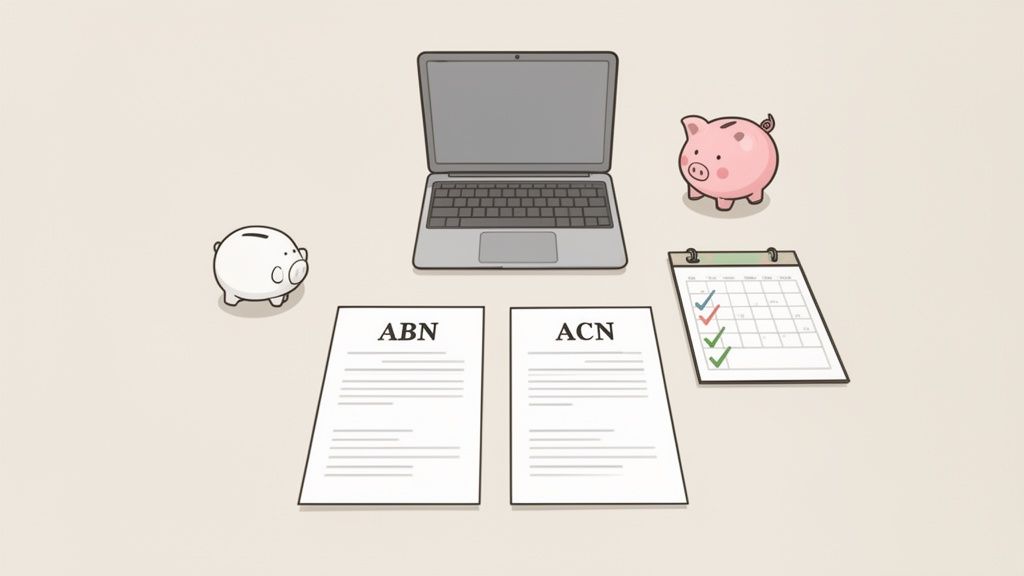
Alright, you’ve got a solid idea and a rough plan sketched out. Now for the part that can feel a bit daunting: making it all official. The admin side of starting a business—think paperwork, registrations, and legal jargon—is the foundation for everything that comes next. Getting your legal and financial house in order right from the start saves you a world of headaches later on.
This isn't just about ticking boxes for the government. It's about building a framework that protects you personally and aligns with where you want to take your business. These early decisions about structure and tax will shape how you operate for years to come. Let's break down exactly what you need to do here in Australia.
Choosing Your Business Structure
First up, you need to decide what your business actually is in the eyes of the law. This choice has a huge impact on your tax, your personal risk, and how much paperwork you'll be doing. For most people starting out, it usually boils down to one of these options.
- Sole Trader: This is the simplest and most popular path. You are the business. You trade under your own name (or a registered business name), you have full control, and the profits are all yours. The catch? Unlimited liability. This means if the business gets into debt, your personal assets could be on the line.
- Partnership: This is essentially two or more sole traders working together. You and your partners share control and profits. Just like a sole trader, you're looking at unlimited liability, which means you're personally responsible for business debts—even those your partner racks up.
- Company (Pty Ltd): A company is a whole separate legal entity. This is the key difference. It provides limited liability, creating a protective wall between the business's finances and your personal assets. It’s a safer option but comes with higher setup costs and more complex reporting requirements to keep it running.
Honestly, a lot of this comes down to your personal risk tolerance. If you're a freelance consultant working from home with low overheads, being a sole trader is probably a perfect fit. But if you’re signing a commercial lease or taking on significant debt, setting up a company could be the smartest move you make.
Getting Your Essential Registrations Sorted
Once you know your structure, it's time to get the official numbers that let you operate legally in Australia.
You'll need an Australian Business Number (ABN), which is your unique 11-digit identifier for dealing with the government and other businesses. It's non-negotiable for things like invoicing. If you decide to form a company, you’ll first get an Australian Company Number (ACN) when you register it, and then you use that to get your ABN.
A common point of confusion is GST. Just because you get an ABN doesn't mean you automatically have to register for GST. You are only required to register if your business turnover is expected to be $75,000 or more in a financial year.
Nailing these registrations is crucial. For a really clear walkthrough of the official process, this guide on how to register a business in Australia is a great resource to have bookmarked.
Setting Up Your Financial Foundations
I can't stress this enough: do not mix your personal and business finances. It’s a surefire recipe for chaos, making it impossible to see if you're actually making a profit and turning tax time into a nightmare.
Your very first move should be to open a dedicated business bank account. Simple. All business income goes in, and all business expenses come out. This one habit will make your bookkeeping a thousand times easier.
Next, think about your accounting system. A spreadsheet might get you through the first few weeks, but investing in proper accounting software is a game-changer. Tools like Xero, MYOB, or QuickBooks are built for people like us and help you:
- Track every dollar in and out.
- Send professional-looking invoices.
- Get ready for your BAS and tax returns.
- See your real-time cash flow with a click.
Building good money habits from day one is everything. If the idea of managing the books makes you nervous, getting your head around the basics with something like a Xero bookkeeping course can give you the confidence to keep your finances organised and stress-free from the get-go.
Funding Your Venture and Managing Cash Flow
Alright, let's talk about money. It’s often the biggest roadblock—or at least it feels that way—when you’re starting out. You’ve got this brilliant idea, but turning it into a real, functioning business takes capital. This is the part where the rubber truly hits the road, where you secure the funds you need and, just as crucially, learn how to keep them flowing.
Getting that initial injection of cash is one thing, but the real secret to staying in business is mastering your cash flow. It’s all about understanding the rhythm of money coming in and money going out. You need enough on hand to pay your suppliers, cover your rent, and ride out the inevitable quiet patches every new business faces.
So, let's break down where you can find the money and how to manage it like a pro from day one.
Exploring Your Funding Options
First things first: not every business needs a massive bank loan or a cheque from a venture capitalist. The funding scene in Australia is pretty diverse, with a path for almost every type of business, big or small. The best fit for you really depends on your business model, how much risk you're comfortable with, and how much control you want to hang onto.
Here are a few of the most well-trodden paths:
- Bootstrapping: This is the classic DIY route—funding the business yourself with your own savings. The huge upside is you keep 100% ownership and control. The downside? It’s your own money on the line.
- Small Business Loans: The big banks, credit unions, and a growing number of online lenders offer loans specifically for small businesses. You'll need a convincing business plan and a decent credit history to get your application over the line.
- Government Grants: It's worth checking what grants are available from federal and state governments. They're often aimed at specific industries (like tech or manufacturing) or initiatives like regional development. They are incredibly competitive, but the big advantage is you don't have to pay them back.
- Crowdfunding: Platforms like Kickstarter or the Aussie-born Pozible let you raise smaller amounts of cash from a lot of people. It’s a fantastic way to test if people actually want your product and build a loyal following before you’ve even launched.
Mastering Your Day-to-Day Finances
Getting funded is just the start of the race. How you manage that money day-to-day is what will get you across the finish line. It’s a harsh reality, but poor cash flow management sinks more small businesses than just about anything else. Building good financial habits from the get-go isn't just a good idea; it's non-negotiable.
Think of cash flow as the heartbeat of your business. It's the constant cycle of cash moving in (customer payments) and out (rent, wages, stock). You can be profitable on paper, but if all your money is tied up in unpaid invoices while bills are piling up, you’re in serious trouble.
A sale isn't really a sale until the money is in your bank account. The goal isn’t just to make sales; it’s to get paid for them quickly enough to cover your next round of expenses.
To keep your finger on the pulse, you just need a few simple but powerful tools.
Essential Habits for Healthy Cash Flow
First, you need a budget. It doesn’t have to be a 50-page masterpiece. A simple spreadsheet listing your expected monthly income against all your costs (both fixed and variable) is perfect. This forces you to be honest about your spending and helps you see a cash crunch coming before it hits.
Next, get a system for tracking every dollar. This is where accounting software like Xero or MYOB becomes your best friend. It gives you a clear, real-time picture of your financial health and shows you exactly where the money is going.
Finally, you need to get good at invoicing. It’s an art form.
- Invoice Immediately: Don't wait. Send the invoice the second the job is done or the product is shipped.
- Make Terms Obvious: Put your payment terms (e.g., "Payment due in 14 days") front and centre. Don't make people hunt for it.
- Follow Up: There's no shame in it. A polite reminder a day or two before an invoice is due can make all the difference.
Combine a smart funding plan with disciplined money management, and you're not just starting a business—you're building one that's designed to last.
Marketing Your Business to Find Your First Customers

You’ve done the hard yards—you've validated the idea, sorted your ABN, and have your finances in order. But a business without customers is just a very well-organised hobby. This is where the real fun begins: connecting with people who need what you offer and turning all that hard work into actual revenue.
This is the point where many new founders get overwhelmed, picturing massive advertising budgets and complex campaigns. The good news? Finding your first customers doesn't have to be expensive or complicated. With a smart, focused approach, you can start making sales and build a solid online presence without breaking the bank.
The trick is to lean into a few powerful, low-cost strategies that punch well above their weight. We're talking about building a simple but effective home for your brand online and using digital tools to reach the right people when they're ready to listen.
Build Your Digital Storefront
Think of your online presence as your modern-day shop window. It's where potential customers will find you, get a feel for what you're about, and decide whether they want to walk through the door. You don't need a huge, all-singing, all-dancing website to get started.
Instead, nail the essentials first:
- A Simple Website or Landing Page: This is your central hub. It needs to clearly explain what you do, who you help, and how people can buy from you or get in touch. Platforms like Squarespace or Wix are fantastic for beginners because they make it easy to create something professional without needing to code.
- Claim Your Google Business Profile: This is completely non-negotiable, especially for any business with a local presence. It's a free listing that gets you on Google Maps and into local search results, complete with your hours, contact details, and those all-important customer reviews.
- Choose One or Two Social Media Channels: Don't spread yourself thin trying to be everywhere at once. Figure out where your ideal customers actually spend their time online. If you're a visual brand (like a cafe or a clothing designer), Instagram is a natural fit. If you're selling to other businesses, LinkedIn is probably your best bet.
The goal isn't just to exist online; it's to create a cohesive and professional first impression that builds trust from the very first click.
Find Your People with Smart Marketing
Once your digital home is set up, you need to invite people over. Rather than just shouting into the void, you'll get much better results by focusing on tactics that attract customers who are already looking for solutions like yours.
This is where basic Search Engine Optimisation (SEO) becomes your best friend. It’s simply the art of helping Google understand what your business is all about so it can show you to the right people. Start by putting yourself in your customer’s shoes—what phrases would they type into Google? If you’re a plumber in Ballarat, it's likely "emergency plumber Ballarat" or "fix leaking tap." Weaving these kinds of natural phrases into your website content is a simple but powerful way to get found.
Social media is your tool for building a community. It’s less about hard selling and more about sharing your story, offering real value, and starting conversations. Post behind-the-scenes glimpses, share helpful tips related to your industry, and don't be afraid to celebrate your first customer wins.
The most powerful shift in thinking is to see marketing not as a sales pitch, but as an act of service. When you genuinely help and educate your audience, you build trust and authority. The sales will follow.
Turning Clicks into Customers
Getting people's attention is the first step, but turning that interest into a sale is what really matters. This is your sales process, and just like everything else, it can start simple.
For a service business, it might look like this:
- Lead: Someone finds you on Google and fills out your contact form.
- Connect: You follow up with a friendly email or phone call to understand their needs.
- Propose: You send a clear quote or proposal outlining the work and the cost.
- Close: They give the green light, and you book in the work.
For a product-based business, the "close" happens the moment they hit that "buy now" button. In both scenarios, the journey doesn't end there. Following up to make sure they're happy and asking for a review is critical for building a base of loyal customers and generating powerful social proof that will attract the next one.
This cycle of attracting, converting, and delighting customers is the engine that will drive your early growth. You can explore some of these effective online marketing methods to get more ideas.
Let's look at a few channels you can use right away.
Low-Cost Marketing Channels for New Businesses
Starting out, you need channels that deliver results without needing a huge budget. The key is to pick one or two that align with your skills and your audience, and then focus on doing them well.
The data backs this up. The 2025 State of Small Business Report found that tech-enabled small businesses process 94% more sales volume than their counterparts. This just goes to show how adopting even basic digital systems for your sales and marketing can give your revenue a massive boost right from the start. You can read the full report on small business digitisation from COSBOA and Square.
Your First 90 Days: A Practical Launch Plan
Those first three months are where the rubber really hits the road. All your planning and preparation meet the cold, hard light of day. Forget perfection; this period is all about action, learning on the fly, and adapting—fast. A solid 90-day plan is your secret weapon against the initial chaos, keeping you focused on what actually builds momentum and brings in that critical early feedback.
Think of it as a series of sprints. Each month has a distinct purpose, moving you from the final pre-launch scramble to getting in front of your first customers and figuring out what’s actually working. This stops you from getting overwhelmed and makes sure you're building a business based on reality, not just the assumptions in your business plan.
Month 1: The Final Checks and Liftoff
The first 30 days are all about flicking the switch from 'planning' to 'doing'. It's time to put the finishing touches on your product or service so it's ready for those first paying customers. The main goal here? Get your digital doors open and make that very first official sale.
Here's what to focus on:
- Get your website live: Even a clean, professional one-pager is enough to plant your flag online.
- Fire up your social media: Pick one or two platforms where your ideal customers actually hang out and start posting consistently.
- Run a small, focused launch campaign: This could be a special deal for your first 10 customers or a "founder's offer" you send out to your email list.
Month 2: Gathering Feedback and Building Momentum
Okay, you’re live. Now, the game shifts to listening. What do your first customers really think? This month is dedicated to gathering feedback, encouraging reviews, and using that intel to make quick improvements. This is how you start turning curious buyers into loyal fans.
Don't shy away from negative feedback. Early criticism is a gift that shows you exactly where the cracks are in your offering before they become massive problems. A happy customer might tell a friend, but an unhappy one gives you a direct roadmap for what to fix.
Month 3: Reviewing the Damage and Planning Your Next Move
After 60 days in the trenches, you'll finally have some real data to work with. It's time to take a breath and look at the numbers. Dive into your initial sales, website traffic, and how people are engaging with you online. Are you hitting those small financial goals you set for yourself?
Use this analysis to pinpoint what's bringing in the business. If one marketing channel is clearly outperforming the others, double down on it. This review isn't just about looking back; it sets the stage for the next quarter, helping you make smarter decisions to fuel real, sustainable growth for your new small business.
Got Questions About Kicking Off Your Aussie Business? We’ve Got Answers.
Diving into a new business venture can feel like you're collecting more questions than answers. It's totally normal to get bogged down in the details. To help clear the fog, we’ve put together answers to the most common queries we hear from founders just starting their journey.
How Much Cash Do I Actually Need to Get Started?
This really is the classic "how long is a piece of string?" question. Honestly, your startup costs could be anything from less than $500 to tens of thousands of dollars. A freelance copywriter, for instance, might only need to cover a business name registration and a website domain. On the flip side, someone opening a café has to think about rent, commercial coffee machines, and a whole lot of inventory.
Your biggest initial outlays will almost always come from a few key areas:
- Legal & Registration: Registering a business name is pretty cheap, but setting yourself up as a company will cost a bit more.
- Tools & Equipment: This covers everything from the laptop you're working on to specialised trade machinery.
- Website & Marketing: You can get a basic website off the ground without breaking the bank, but remember to budget for ongoing marketing to actually bring in customers.
- Stock or Inventory: If you’re in the business of selling physical goods, this will be a major upfront investment.
Can I Just Use My Own Name for the Business?
Yep, you absolutely can. In fact, it's the most straightforward way to get up and running. If you're set up as a sole trader and you use your legal name (for example, "Ben Jones"), you don't even need to register a separate business name.
But, the second you want to trade as something different—say, "Ben's Lawn Mowing"—you’ll need to register that as an official business name with the Australian Securities and Investments Commission (ASIC). This connects your trading name to your ABN, making it clear to everyone who's behind the business.
Picking a business name is a huge decision. Before you commit and register it, do a thorough search on Google, all the social media platforms, and the official business names register. You want to be sure it’s not already taken. A unique name is far easier to build a brand around and protect later on.
Do I Really Need Business Insurance from Day One?
For the vast majority of new businesses, the answer is a hard yes. It might feel like just another bill to pay when money is tight, but think of insurance as your financial safety net. It’s what protects you, your personal assets, and your customers when things inevitably go sideways.
The specific insurance you'll need comes down to what your business actually does. Public liability insurance is a non-negotiable for almost everyone—it covers you if a customer gets injured or you damage their property. If you’re giving out professional advice (like a consultant or an accountant), you’ll also need professional indemnity insurance. The golden rule is to figure out your risks and get your cover sorted before you make your first sale.
Ready to build the practical skills you need to launch and grow your venture? At Get Course Australia, we connect you with flexible, nationally recognised online courses in business, marketing, and more. Find the perfect qualification to turn your business idea into a success story. Explore your options today at https://getcourse.com.au.
Find Your Course
Compare courses across every field we write about, and enquire in under a minute.