%20(1).png)
A quick search for online courses nz throws open a door to a whole new way of learning. All across the country, Kiwis are tapping into online study to pick up new skills, make a career change, or finally dive into a long-held passion—all without putting their lives on hold. It’s education that fits into your world, not the other way around.

Let's be honest, juggling work, family, and your own goals is the reality for most of us. The old-school model of sitting in a lecture hall at set times just doesn't work for everyone anymore. This is exactly where online learning comes in, offering a genuinely practical way to upskill or reskill on your own terms.
Think of it as education that bends to your life. Whether you're a professional chasing that next promotion, a parent looking to get back into the workforce, or someone taking that first exciting step into a brand-new industry, online courses deliver the knowledge you need, when you need it.
The real game-changer here is flexibility. Most online courses are asynchronous, which is just a fancy way of saying you can access lectures, readings, and assignments whenever it works for you. This self-paced approach puts you firmly in the driver's seat.
This is a massive advantage for anyone balancing different hats. You can get your study done after the kids are asleep, on your lunch break, or over the weekend. It completely removes the old barriers of location and rigid timetables that once made further education feel out of reach for so many.
The core idea is simple but powerful: quality education should be accessible to everyone, regardless of their location or daily schedule. It’s about creating pathways to success that work for real life.
This guide is your roadmap to navigating the world of online courses nz. We'll break everything down for you, covering the essential stuff like:
Our aim is to give you the clarity and confidence to choose the right path for your future.
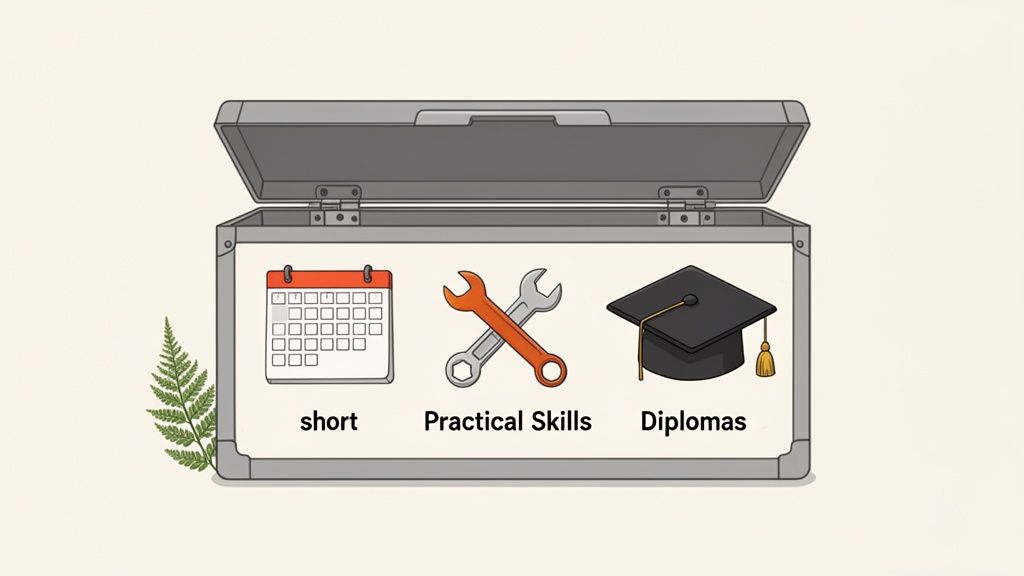
The term ‘online course’ covers a lot of ground here in New Zealand, and figuring out what’s right for you can feel like trying to solve a puzzle. It helps to think of the options as a well-stocked toolbox. Some tools are perfect for a quick fix, while others are designed for a major construction project.
Knowing the difference is the first step toward making a smart choice.
On one side, you have short, sharp courses focused on a single skill, like getting your head around a new piece of software. On the other end of the spectrum, you’ll find comprehensive university degrees delivered online, which involve deep academic study over several years. Both have their place, but they serve completely different purposes.
Somewhere in the middle is where you’ll find the real powerhouse: vocational training. This is the sweet spot where many of the best online courses in NZ thrive. Their entire focus is on teaching you practical, job-ready skills that employers are actively looking for right now.
Vocational courses, like the certificates and diplomas available through Get Course, are built with one thing in mind: getting you into the workforce. They’re designed to be efficient, cutting out dense theory to focus on the exact skills you need to land a specific role, whether that’s in healthcare, IT, or the trades.
A formal university degree, by contrast, is generally more theoretical and research-heavy. While incredibly valuable, that path is often much longer and less directly tied to immediate job functions. It’s also important to know that while universities are NZQA-registered, many brilliant vocational providers focus on industry recognition rather than formal NZQA qualifications.
The key is to match your learning path to your objective. If your goal is to quickly gain skills for a new job or a promotion, practical vocational training is often the most direct and effective route.
The demand for this kind of flexible learning has shot up. Distance learning among secondary students in New Zealand jumped by 26.7% between 2019 and 2023, a trend that the pandemic certainly accelerated. Even so, with only about one in 12 secondary students taking a distance course, there’s still massive potential for growth as more Kiwis discover the perks of studying online.
To help you weigh up the options, this table breaks down the main differences.
Ultimately, the right choice depends entirely on where you want to go. Whether you need a full diploma to launch a new career or just a quick course to get ahead, understanding the landscape is the first step. You can explore more about the different types of online courses available to see what aligns with your career path. A good online course platforms comparison can also offer valuable insights as you make your decision.
When you’re putting your time and money on the line for an online course, there’s one question that matters more than any other: is this legit, and will it actually help my career? The answer isn’t always as simple as looking for a formal qualification.
While some career paths absolutely require specific credentials, many New Zealand employers are shifting their focus. They're increasingly interested in what you can do, not just the bit of paper you hold.
This is where the idea of industry recognition becomes so important. It’s all about a course's reputation within a specific field. Does it teach the practical, real-world skills that hiring managers are desperate for? An industry-recognised certificate shows you’ve got the up-to-date knowledge to step into a role and contribute from day one.
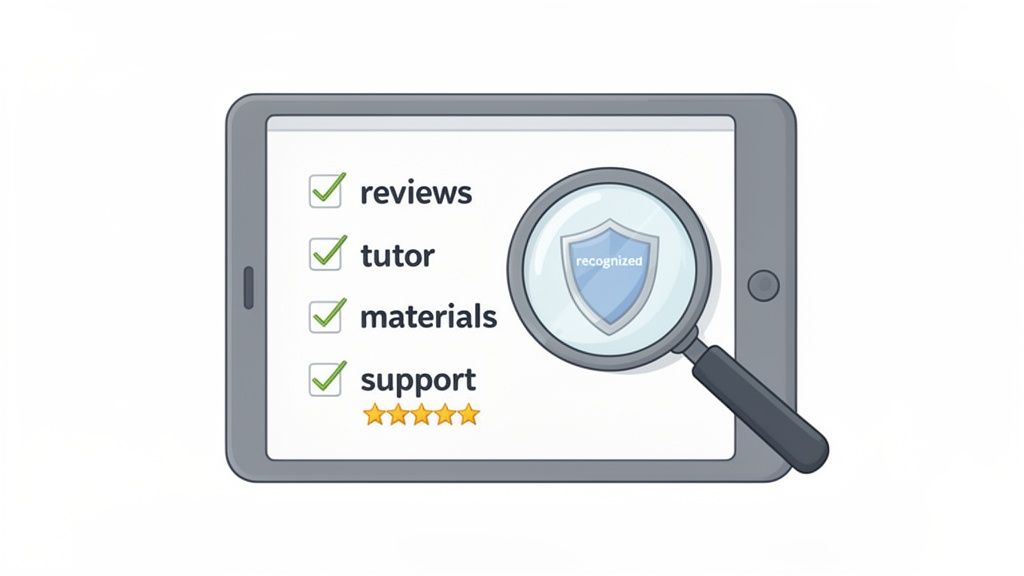
So, how do you spot the high-value courses and steer clear of the duds? You need a solid checklist to vet any provider you’re considering.
Before you click "enrol" on any online course in NZ, run through these essential checks. Think of it as doing your homework to make sure your educational investment pays off. A bit of research now can make a massive difference to where you end up.
A great place to start is with unfiltered feedback from the people who’ve been there before you: past students.
Authentic Student Reviews: Jump on independent platforms like Trustpilot. Are the reviews detailed? Do they talk about specific things, like the quality of the course materials or how helpful the tutors were? A consistent pattern of positive, specific feedback is a brilliant sign.
Tutor Expertise: Who’s actually teaching you? Look for tutors who aren’t just academics but have real, hands-on experience in the field. Their practical insights and war stories are often the most valuable part of the entire learning journey.
Course Materials and Platform: The learning content should be well-structured, current, and genuinely engaging. A good provider invests in a user-friendly online platform that makes it simple to access lectures, submit assignments, and find resources without any fuss.
Responsive Student Support: What happens when you hit a roadblock? A huge indicator of quality is solid student support. You should be able to easily reach out for help with your coursework or technical glitches and get a prompt, genuinely helpful response.
Ultimately, the best online course is one that delivers tangible value. It equips you with job-ready skills, is respected by employers in your chosen industry, and provides the support you need to succeed.
By carefully weighing up these factors, you can confidently pick a course that gives you a real return on your investment and sets you up for success in the New Zealand job market.
Let's talk money. Figuring out the financial side of an online course here in NZ is a big part of the decision, and it’s important to know exactly what you’re paying for before you commit.
The price tag on a course isn't just a random number. It reflects the depth of the material, how long you'll be studying, and the level of one-on-one support you get from tutors. A full-blown diploma that sets you up for a brand-new career is naturally going to be a bigger investment than a short course designed to teach you a single new skill. It's less of a one-off purchase and more of an investment in your own professional future.
One of the best things about modern online education is the financial flexibility. Gone are the days of needing a huge lump sum of cash right at the start. Instead, most reputable providers offer simple, manageable payment plans.
These plans break the total cost into smaller, regular chunks—often weekly or fortnightly. This approach makes top-tier education so much more accessible, allowing you to budget properly and spread the cost out while you study. It takes the stress out of the equation so you can focus on what actually matters: learning.
The bottom line is that quality education doesn't have to break the bank. Flexible payment options are designed to fit around your life, not the other way around.
Beyond the payment plans offered by the provider, it's always worth looking into other ways to fund your studies. You might be surprised by the support that's already out there.
Employer Sponsorship: Lots of Kiwi businesses are more than happy to invest in their people. If the course you’re eyeing will add real value to your current job, it’s worth putting together a business case for your manager. Think of it as a win-win: you get new skills, and the company gets a more capable, motivated employee.
Government Initiatives: It pays to keep an eye out for any government-backed programmes or subsidies. These are often aimed at upskilling the workforce, particularly in high-demand industries, and can sometimes help cover a good chunk of your training costs.
While many vocational courses are self-funded, a bit of research can go a long way. And if you're looking for a no-cost way to get started, our guide to the best free online courses NZ has some great options for building foundational skills without spending a cent.
Let's be honest, an online course isn't just about gaining knowledge for its own sake. It’s a strategic move. For most of us, that end goal is landing a better job, securing a well-deserved promotion, or making a complete career pivot.
The true measure of any course is how well it bridges the gap between where you are today and where you want to be professionally. The right qualification acts as a direct stepping stone into the workforce.
Think of it this way: a certificate in digital marketing doesn't just teach you the theory behind social media and SEO. It gives you the practical, in-demand skills a Kiwi business needs right now to grow its online presence. That makes you a valuable candidate from day one.
In the same way, finishing a project management course could be the very thing that takes you from being a team member to a leadership role. It shows initiative and hands you a structured framework for managing projects—a skill that's needed everywhere.
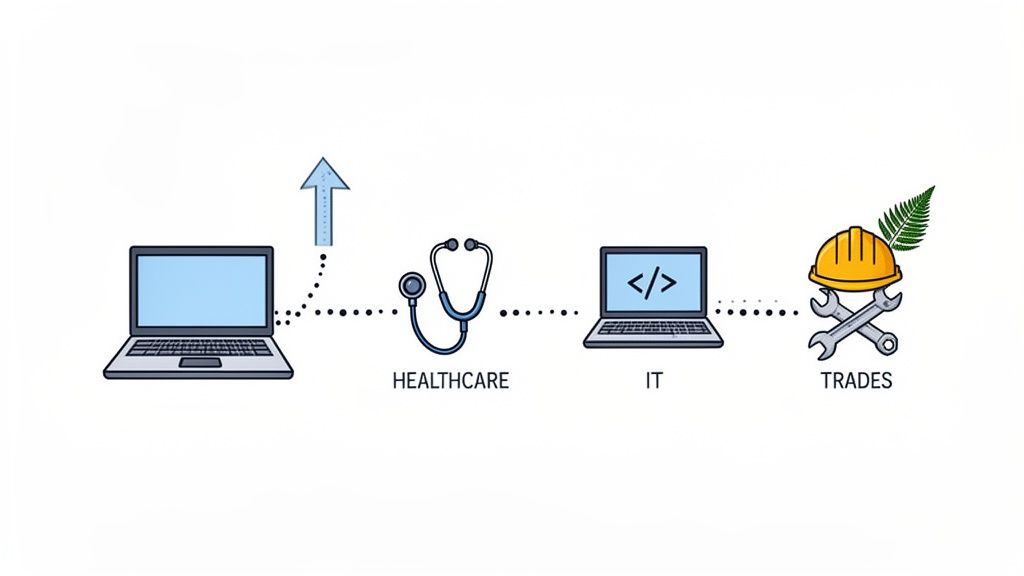
The smartest study choices are the ones that line up perfectly with what the job market is crying out for. In New Zealand, some industries are constantly on the lookout for skilled people, which is why course providers focus on offering qualifications in these high-growth areas.
When you choose a course in a booming field, you're doing more than just learning. You're positioning yourself right in the middle of high demand, which massively boosts the return on your investment of time and money.
Key growth areas in the NZ job market include:
This alignment is everything. It ensures the skills you work so hard to learn are the same ones employers are actively searching for across the country. It turns your certificate or diploma into a powerful tool for your career. You can read more about how bite-sized learning can boost your career in our related article.
Your education should be a direct pathway to opportunity. Choosing a course in a high-demand industry ensures your new skills translate into tangible career rewards and long-term security.
The drive for lifelong learning is changing how Kiwis build their careers. Research shows that flexibility is key, with thousands of study sessions happening between midday and midnight. Amazingly, there are even 3,600 sessions logged between midnight and 6 am, which just goes to show how busy adults are fitting study around their lives to get ahead.
Here’s how you get started, step-by-step.
Thinking about starting a new course can feel like a massive undertaking. But if you break it down into smaller, manageable chunks, it's actually quite straightforward—and even exciting. This simple checklist will walk you through everything, from that first spark of an idea right through to your first day of study.
Before you even glance at any online courses nz, take a step back and ask yourself one simple question: why?
Are you chasing a promotion at your current job? Maybe you’re looking to jump into a completely new industry. Or perhaps you just want to learn something new for the pure joy of it. Knowing your "why" acts as your compass, guiding every decision you make and making sure the course you end up with is a perfect fit for what you actually want to achieve.
Once you’ve got your goal locked in, it’s time for the fun part: exploring what’s out there. This is where platforms like Get Course really come in handy, letting you easily line up different study paths side-by-side.
Dive into the course outlines, check the estimated completion times, and see what kind of industry recognition they offer. This is your chance to connect the dots between a qualification and the career you’re aiming for.
Starting your learning journey is about making a series of smart, small decisions. By following a clear process, you transform an overwhelming task into an achievable set of steps, moving you closer to your goal with confidence.
Okay, now it’s time to get into the nitty-gritty. The small details are often what separates a good experience from a great one.
Look for genuine student reviews on independent sites—not just the glowing testimonials on the provider's page. Check out the professional backgrounds of the tutors. Are they just academics, or have they actually worked in the field? Get a feel for the student support on offer. A quality provider won’t hide this information; they’ll make it easy to find.
The actual sign-up process should be painless. Most providers have a simple online form, and there are usually course advisors on hand to answer any last-minute questions.
Once you’re in, the final piece of the puzzle is setting yourself up for success. Carve out a dedicated study space, block out time in your calendar like you would for any other important appointment, and get your head in the game. You're investing in your future, after all.
And it’s an investment more and more Kiwis are making. The demand for quality education in New Zealand is booming, with recent data showing a 14% jump in student numbers from January to August 2023 compared to the year before. This trend shows you're making a smart move at the right time. You can dive deeper into the stats on New Zealand's expanding education sector on ICEF Monitor.
Thinking about diving into online study? It's natural to have a few questions buzzing around your head. Getting the answers sorted is the best way to feel confident you're making the right move for your future.
Let's unpack some of the most common queries we hear from students just like you.
This is easily the number one question we get asked, and the answer is one of the biggest perks of online learning: it’s entirely up to you. The beauty of self-paced study is that it fits around your life, not the other way around. Forget about rigid lecture schedules or stressing about getting to campus on time.
As a rule of thumb, most of our students find that dedicating 10 to 15 hours per week is a great sweet spot. It allows you to make consistent, solid progress without feeling swamped. But if you've got a tight deadline or you’re just keen to power through, you can always ramp it up. Equally, if life gets busy, you can ease back. You're in control.
Absolutely. It’s a common concern, but the answer is a definite yes. While some providers are not NZQA-registered, many vocational courses are built from the ground up with direct input from industry experts. This collaboration ensures that what you learn isn’t just theory—it’s practical, current, and precisely what New Zealand employers are searching for right now.
These days, employers are increasingly focused on what you can do. When you add an industry-recognised certificate to your CV, you're sending a clear signal: you have the job-ready skills to hit the ground running. It’s a brilliant way to show your initiative and prove you’re ready to contribute from day one.
The real measure of any qualification is its power to open doors. Industry-focused training gives you the practical, hands-on skills that Kiwi workplaces need, making you a much stronger candidate.
Just because your learning is flexible doesn't mean you're left to figure it all out alone. Far from it. A great online course is always backed by a solid support system, there to help you cross the finish line.
You can almost always count on having access to:
This support network is designed to make sure you have all the resources and encouragement you need to succeed.
Ready to find the perfect course to launch your career? Get Course New Zealand makes it simple to discover flexible, industry-recognised qualifications that work for you. Check out our huge range of online courses and take your next step today at https://getcourse.co.nz.


