What Is Micro Credentialing and How Can It Boost Your Career
Discover what is micro credentialing with this clear guide. Learn how targeted online courses can help you gain in-demand skills and accelerate your career.
Micro-credentialing is a smarter way to gain specific, job-ready skills through short, focused courses. Think of them as small, targeted qualifications that prove what you can do in a particular area, like digital marketing or data analysis, without the huge time and cost commitment of a full degree.
Demystifying Micro-Credentialing
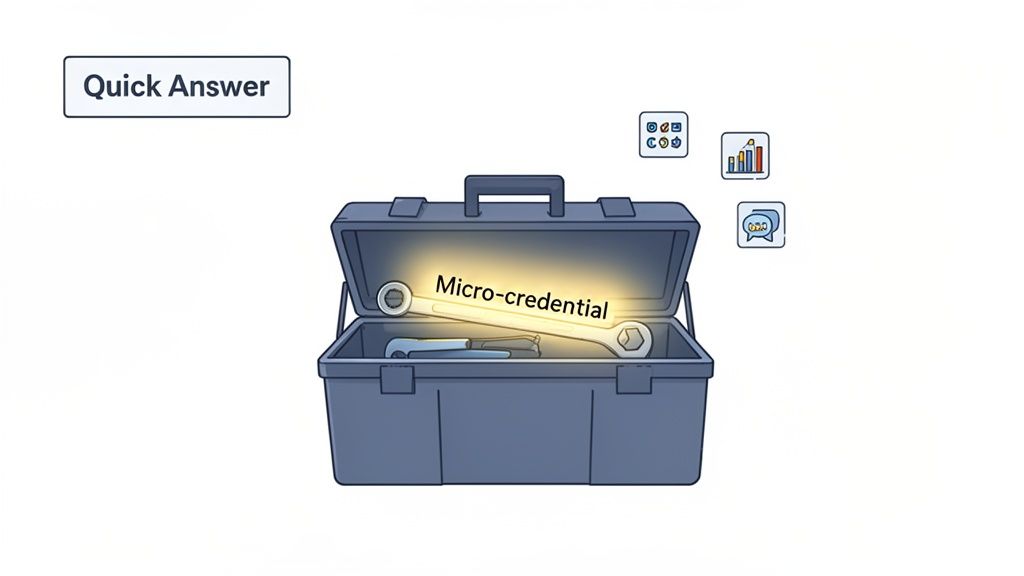
Let's imagine your professional skillset is a toolkit. A traditional degree is like building the whole workshop from scratch—a massive, foundational project that takes years to complete.
A micro-credential, on the other hand, is like adding a specialised, high-performance power tool to your kit. It’s designed to do one job exceptionally well and deliver immediate results. This nimble approach to learning is becoming essential for career growth in New Zealand's fast-moving job market.
What Makes Them Different
Unlike broad, theory-heavy university programmes, micro-credentials are all about practical application. They’re built to address a specific skill gap that employers have identified, ensuring what you learn is relevant right now.
This laser focus on targeted, useful learning is what truly sets them apart. They are often assessed based on competency, meaning you have to prove you can apply the skill, not just understand the theory behind it. For an employer, that’s verifiable proof of your abilities.
The Core Components
So, what is micro-credentialing at its heart? It’s a modern learning model built on a few key ideas:
- Skill-Specific: Each course targets a single, clearly defined competency, such as "Social Media Advertising" or "Python for Beginners."
- Time-Efficient: They are much shorter than traditional qualifications, often taking just weeks or a few months to finish, not years.
- Industry-Aligned: The content is developed to meet current industry demands, giving you the exact skills that employers are actively looking for.
- Flexible Delivery: Most are offered online, letting you learn at your own pace and fit your study around work and life.
A micro-credential acts as a verified testament to a specific skill or competency. It provides a quick, credible way for professionals to demonstrate their capabilities and for employers to identify qualified candidates for specific roles.
Micro-Credentials at a Glance
To put it simply, here’s a quick comparison of how micro-credentials stack up against traditional degrees.
This table shows why they've become such a powerful tool for career development.
This makes them a brilliant tool for both upskilling in your current role and reskilling for a completely new career path. Platforms like Get Course help simplify this journey by making it easy to discover and compare a wide variety of online micro-courses. We connect you with these opportunities so you can find the perfect tool to add to your professional toolkit, whenever you need it.
How Micro-credentials Compare to Traditional Degrees
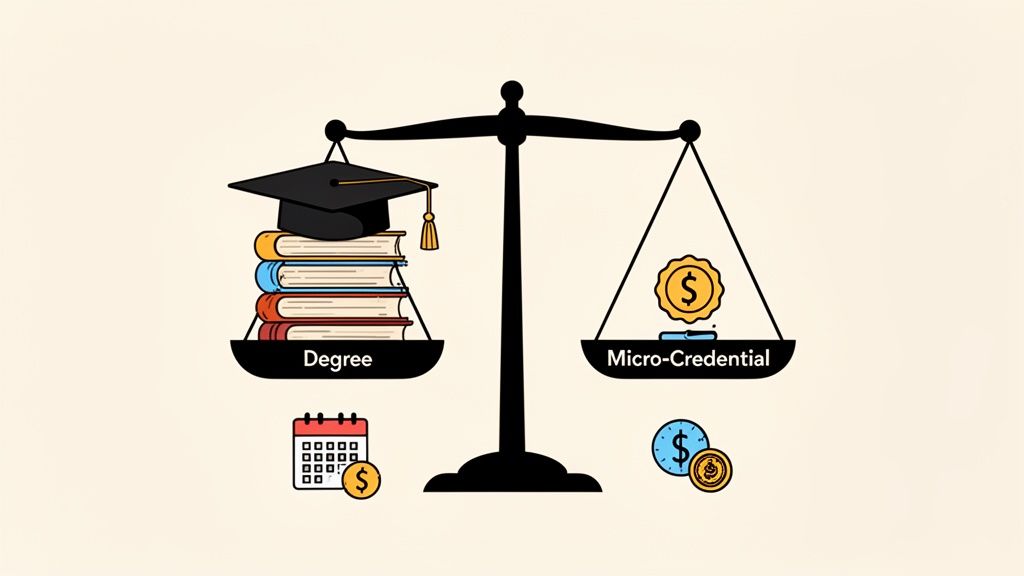
Trying to choose between a micro-credential and a traditional degree can feel a bit like picking between a speedboat and a cruise ship. Both will get you moving, but they’re built for completely different journeys, speeds, and destinations. Nailing down these differences is the key to picking the right educational path for where you are now and where you want to go.
Think of a university degree as the cruise ship of your education. It's a comprehensive, multi-year voyage designed to give you a broad, foundational understanding of an entire field. This journey builds a deep base of theory and critical thinking, helping you forge a wide network and preparing you for a huge range of potential careers.
A micro-credential, on the other hand, is the speedboat. It’s all about speed and precision, designed to zip you to a specific destination—a new skill or competency—as fast as possible. You get targeted, job-ready expertise in just weeks or months, with a laser focus on skills you can apply immediately.
Time Commitment and Flexibility
The most obvious difference is the time you need to invest. A standard bachelor's degree in New Zealand requires at least three years of full-time study. It’s a huge commitment, perfectly suited for someone just starting their career journey and ready for a deep dive.
Micro-credentials, however, are built for agility. They’re designed to slot into the lives of busy professionals who can’t just hit pause on their careers. Because most are self-paced and online, you can knock them over in a fraction of the time—often in just a few months. This makes them perfect for getting up to speed, fast.
A degree is a marathon, building endurance and broad knowledge over years. A micro-credential is a sprint, focused on achieving a specific, measurable skill goal in the shortest time possible.
Skill Focus and Career Impact
Degrees and micro-credentials are also chasing different learning outcomes. One delivers a holistic education; the other delivers a specific, practical skill.
It's about breadth versus depth.
- Traditional Degree: A Bachelor of Business, for instance, covers the full spectrum—marketing, finance, management, and economics. You graduate as a well-rounded professional ready for a variety of business roles, but you might not have deep, hands-on expertise in a specialised tool like Google Analytics from day one.
- Micro-credential: A course focused on "Advanced Google Analytics" gives you immediate, actionable skills. When a hiring manager sees that on your CV, they know you can step in and start delivering value on specific tasks straight away.
This immediate impact is a massive advantage. While a degree signals long-term potential, a micro-credential signals present-day capability. For many professionals, the winning combination is the broad foundation of a degree stacked with targeted micro-credentials.
Cost and Accessibility
The financial side of things is also worlds apart. A university degree is a major financial decision, involving hefty tuition fees, expensive textbooks, and often, the opportunity cost of working less.
Micro-credentials offer a much more accessible entry point for professional development. Their lower cost breaks down the financial barriers to learning, allowing you to invest in your career one skill at a time. This model makes lifelong learning a genuine reality for everyone, empowering you to constantly adapt without taking on a huge financial burden.
The Growth of Micro Credentials in New Zealand
In New Zealand, micro-credentials are far more than just a passing educational trend. They’re a formally recognised and fast-growing part of the country's skills and training landscape. For learners and employers alike, this gives powerful assurance that these focused qualifications hold genuine, measurable value.
This isn’t just about a new way to learn—it’s about a structured, credible pathway for professional development. New Zealand has proactively embraced this model, positioning itself as a leader in flexible education that meets the real-world demands of its industries and workforce.
A Landmark Shift in National Education
The big moment for micro-credentialing came in 2018. In a significant move, the New Zealand Qualifications Authority (NZQA) officially brought micro-credentials into the New Zealand Qualifications and Credentials Framework (NZQCF). This decision cemented their status, taking them from a niche concept to a legitimate form of qualification, right alongside certificates, diplomas, and degrees.
By formally recognising them, the NZQA sent a clear signal. It confirmed that quality-assured micro-credentials meet national standards, giving learners confidence that their new skills are credible and portable. It was a game-changer that paved the way for widespread adoption.
This official thumbs-up has fuelled incredible growth. In less than a decade, micro-credentials have gone from a novel idea to a major part of our national qualifications system. By the 2023–24 reporting year, the NZQA recorded 795 deemed micro-credentials and 398 approved micro-credentials. Together, these now make up well over a third of all distinct credentials available on the NZQCF. You can learn more about the growth of NZ's micro-credentials on the NZQA website.
What This Means For You As a Learner
The formalisation and rapid expansion of micro-credentials in New Zealand have direct benefits for anyone looking to build their career. It’s created a trusted system where you can confidently invest your time and money.
Here’s what this structured growth means for you:
- Assured Quality: An NZQA-approved micro-credential has been rigorously checked against national standards. You know you're getting a qualification that actually means something.
- Employer Recognition: Because these qualifications are part of the official framework, employers can easily understand their value. It makes it much simpler to showcase your new skills on your CV or in a job interview.
- Clear Pathways: The growing number of micro-credentials means you can find highly specific courses to fill precise skill gaps, helping you move up in your current role or pivot to a new one.
The integration of micro-credentials into the NZQCF provides a clear, government-backed framework for quality. This ensures learners are gaining legitimate skills and employers can trust the qualifications candidates present.
How Get Course Fits Into This Picture
It helps to understand the different players in this educational space. While organisations like NZQA set the standards and tertiary providers create and deliver the courses, Get Course acts as a vital connection point.
We are a course discovery platform, not a college. Our mission is simple: to make your search for the right learning opportunity as easy as possible. We partner with a wide range of education providers to bring their courses—including a huge array of micro-credentials—into one easy-to-use place.
Think of us as your guide to the world of online learning. We help you explore what’s out there, compare your options, and find a flexible, online course that lines up perfectly with your career goals. We give you the tools and info you need to connect with reputable providers and start your skill-building journey with confidence.
Unlocking Your Career Potential
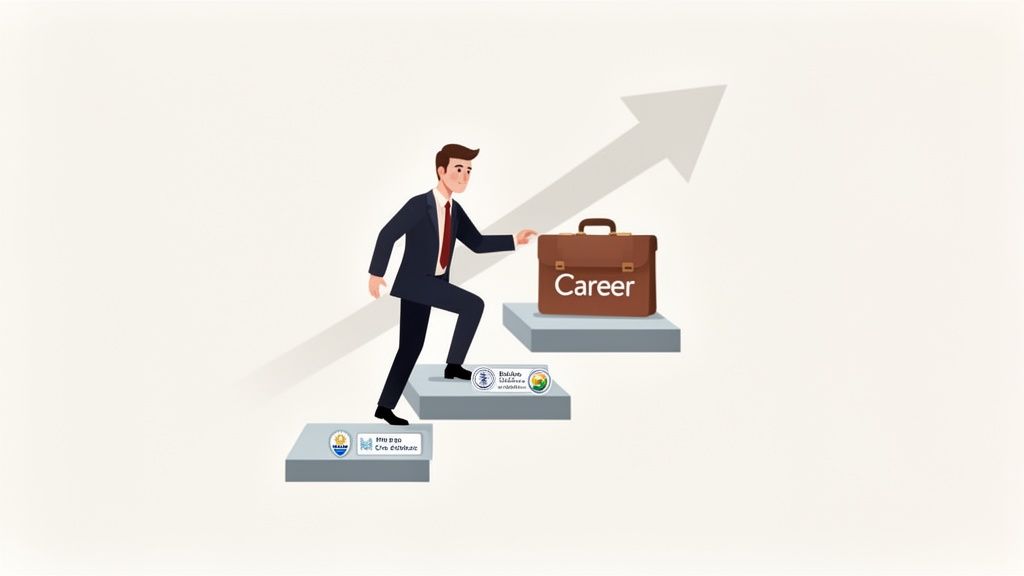
So, we’ve covered what micro-credentials are and how they’re recognised. That's the first step. Now, let’s get into the practical, real-world advantages they deliver for ambitious professionals and forward-thinking businesses alike.
For individuals, micro-credentials are a powerful way to take back control of your professional development. They offer a direct, efficient path to gaining valuable new skills, making career progression feel far more achievable and a lot less overwhelming.
From an employer's point of view, this approach to learning is just as compelling. Businesses are constantly trying to build a more agile and skilled workforce. Micro-credentials give them a targeted solution for closing internal skill gaps and quickly verifying a candidate's specific expertise.
Advantages for the Individual Learner
Let's be realistic. For professionals juggling work, family, and everything else, the traditional multi-year degree can feel completely out of reach. Micro-credentials were designed for the realities of modern life, offering a much more manageable way to invest in your future.
The benefits for you are clear and immediate:
- Exceptional Flexibility: The vast majority are delivered 100% online and are self-paced. This means you can fit learning around your existing schedule—studying when and where it suits you without having to put your life on hold.
- Faster Skill Acquisition: Instead of waiting years to graduate, you can pick up a new, in-demand skill and start applying it in just a matter of weeks or months. This speed lets you respond quickly to new opportunities or changing job requirements.
- Cost-Effective Development: Let’s face it, degrees are expensive. Micro-credentials are a far more affordable way to learn, lowering the financial barrier so you can continuously upskill and stay relevant without taking on significant debt.
- Targeted Career Growth: You can strategically pick courses that fill the exact skill gaps on your CV. This makes you a much stronger candidate for that promotion you’re after or a completely new role you've been eyeing up.
Micro-credentials empower you to build your career one skill at a time. It’s a strategic, bite-sized approach to professional growth that delivers immediate value and keeps you competitive in the job market.
Think of a marketing coordinator who wants to move into a digital strategy role. Instead of enrolling in a three-year marketing degree, they could complete a micro-credential in "SEO and Content Strategy" in just a few months. This focused qualification gives them the specific, verifiable skill their manager is looking for, putting them on the fast track to a promotion.
Benefits for Employers and Businesses
In today's competitive market, organisations need their teams to be adaptable and highly skilled. Micro-credentials offer a powerful tool for building a more resilient and capable workforce from the inside out.
For businesses, the advantages are all about building agility and verifying talent:
- Rapidly Closing Skill Gaps: When a new technology or process emerges, companies can use micro-credentials to quickly upskill their existing teams. It's far more efficient than trying to hire new staff for every new requirement.
- Verifying Candidate Expertise: A micro-credential on a CV is clear, tangible proof that a candidate possesses a specific, practical skill. It removes the guesswork for hiring managers, helping them find the right person for the job, faster.
- Boosting Employee Retention: Investing in professional development shows a company values its people. Offering upskilling opportunities through micro-credentials can improve morale and loyalty, as employees see a clear path for growth within the organisation.
- Creating an Agile Workforce: A team that continuously learns new skills is simply better equipped to handle market changes and new challenges. This culture of ongoing learning creates a more dynamic and future-proof business.
This really creates a win-win scenario. Professionals get the skills they need to advance, and businesses build the talented, adaptable teams they need to succeed. It's a modern solution for professional development that aligns the goals of the individual with the needs of the industry.
How to Find, Stack and Showcase Your Credentials
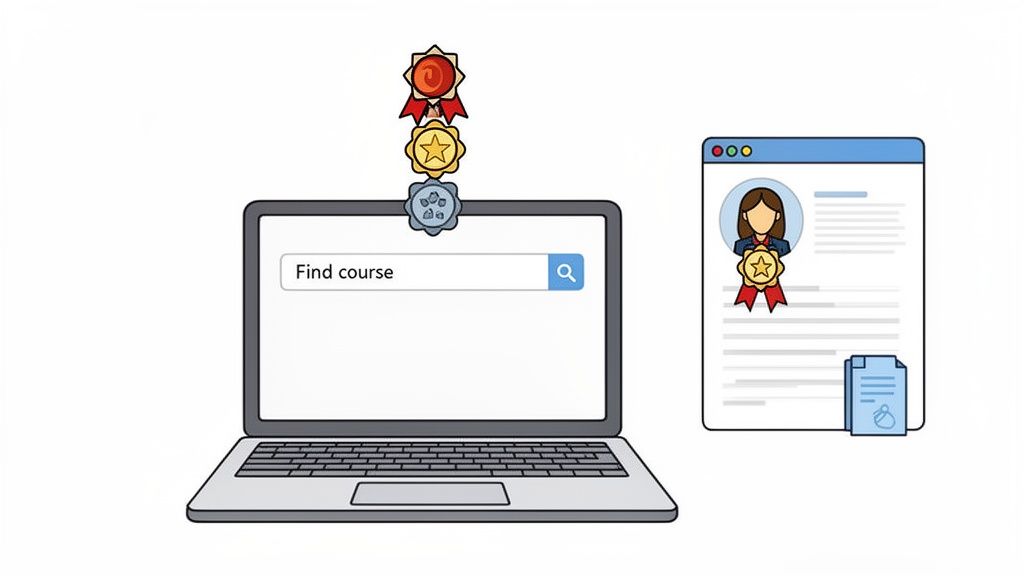
Earning micro-credentials is just the start. The real magic happens when you strategically choose, combine, and display them to build momentum in your career. Let's walk through how to find the right courses, build a unique skill profile, and make your achievements impossible for employers to ignore.
The first step is finding courses that actually line up with your professional goals. Platforms like Get Course are built for this, gathering a huge range of options from different providers all in one place. Keep an eye out for courses with a 100% online, self-paced format. This gives you the control to fit learning around your life, not the other way around. To get a better handle on this style of learning, check out our guide on the benefits of studying online in NZ.
This flexibility is becoming the norm. A 2021 survey of Australasian education providers found that 71% had a dedicated online shopfront for their micro-credentials, and another 71% had a digital credentialing platform. For you, this means the skills you earn online are recognised, portable, and simple to manage. You can explore the full findings to understand more about the technical maturity of micro-credential delivery.
The Power of Stacking Your Skills
Once you've got your first micro-credential under your belt, you can start using a powerful strategy called stacking. This is simply the process of combining several related micro-credentials over time to build a deeper, more versatile skill set.
Think of it like building with LEGOs. One brick is useful, but snap a few together and you can create something far more impressive and specialised. For instance, a marketing professional might stack their credentials like this:
- Foundation: A micro-credential in "Digital Marketing Fundamentals."
- Specialisation: A second one in "Advanced SEO Techniques."
- Application: A third in "Data Analytics for Marketers."
Together, these stacked credentials tell a compelling story. They show an employer you have more than a passing interest; you're committed to mastering a specific area. This layered expertise makes you a much more adaptable and valuable candidate than someone with just a single, isolated skill.
Making Your Achievements Visible
New skills are great, but they won't do much for your career if no one knows you have them. The final, crucial step is to showcase your micro-credentials where employers and recruiters will actually see them. Most are issued as verifiable digital badges or certificates, which are incredibly easy to share.
Here’s how to put your new skills on display:
- Update Your LinkedIn Profile: This is your professional storefront. Add your new credentials to the "Licenses & Certifications" section—it's often the first place a recruiter looks to verify skills.
- Enhance Your Resume: Create a dedicated "Professional Development" or "Certifications" section on your CV. Listing your micro-credentials here immediately highlights your commitment to staying current.
- Build a Professional Portfolio: If you're in a creative or technical field, add your credential to your online portfolio. Even better, link it directly to projects where you put those new skills to work.
By prominently displaying your micro-credentials, you turn learning achievements into real career leverage. You're not just telling employers what you know—you're showing them verifiable proof of what you can do.
Alright, you've got the lowdown on micro-credentials. You know what they are, how they're officially recognised here in New Zealand, and the serious punch they pack for your career. The only thing left to do is put that knowledge into action.
Taking the reins of your own professional development starts with finding the right learning opportunities—the ones that actually line up with where you want to go.
Your Gateway to Online Learning
That’s where Get Course fits in. Think of us as your launchpad for discovering online education. We’ve partnered with a huge range of providers to bring all their courses into one easy-to-use spot. No more juggling a dozen different websites to find what you're looking for.
Our whole focus is on connecting you with learning that works for your life. We specifically hunt down and feature courses that are:
- 100% Online: You can study from anywhere in New Zealand. Forget about commuting to a campus.
- Self-Paced: You’re in the driver's seat. Fit your study around work, family, and everything else life throws at you.
- Career-Focused: These aren’t just courses for the sake of it. They're built to deliver practical, job-ready skills you can use straight away.
Find Your Path Forward
It doesn’t matter what industry you’re in or how much experience you have under your belt. In today’s world, continuous learning is the only way to stay relevant and keep new doors opening up. Get Course gives you access to a massive catalogue of courses to help you build the skills that employers are actually hiring for right now.
The best professional development is targeted, flexible, and easy to access. By embracing micro-credentials, you can build a skillset that directly answers what your industry needs and proves you’re serious about your growth.
You can explore pathways in high-growth fields and find something that genuinely clicks with you. We make it simple to discover options in areas like:
- Business and Management
- Information Technology
- Trades and Construction
- Healthcare and Community Services
Just to be clear, we're not a college. Our role is to be your guide on this journey. We're the platform that pulls together all the info and connections you need to make a smart decision about your education.
So, the next move is yours. Dive in, explore the huge range of online courses available through Get Course, and start building those specific, in-demand skills you need to get ahead. Your journey to upskilling and levelling up your career can begin today, one powerful credential at a time.
Got Questions? We’ve Got Answers
Stepping into the world of micro-credentials can spark a few questions. It’s a newer way of learning, after all. Here are some straightforward answers to the queries we hear most often, helping you see exactly how they can fit into your career plans.
Are Micro-credentials Actually Recognised by Employers?
Yes, absolutely. In fact, employers are increasingly seeking them out. Think of it from a hiring manager’s perspective: a micro-credential acts as direct, verified proof that you have a specific, practical skill they need right now.
When they see "Advanced SEO Techniques" or "Python for Data Analysis" on your CV, it removes the guesswork. It tells them you have the exact, job-ready expertise they’re looking for, making their hiring decision that much easier.
How Long Does It Take to Earn One?
This is one of their biggest drawcards. Unlike degrees that take years to complete, most micro-credentials are designed to be finished in a matter of weeks or a few short months.
Because so many are self-paced and online, you can move as quickly or as steadily as your schedule allows. It’s a seriously efficient way to add a new skill to your toolkit without putting your life on hold.
Can Micro-credentials Replace a Degree?
Not really—they serve different purposes, and that’s their strength. A degree gives you a broad, foundational education over several years, which is fantastic for building a comprehensive knowledge base and critical thinking skills.
A micro-credential, on the other hand, is all about precision. It delivers a targeted, specific skill quickly and affordably.
Many professionals are discovering the most powerful combination is a foundational degree boosted by a stack of specialised micro-credentials. This approach pairs broad knowledge with sharp, in-demand expertise, creating a professional profile that truly stands out.
How Are Micro-credentials Assessed?
Assessment is all about practical application, not just theory. Forget cramming for a traditional final exam. Instead, you’ll likely be asked to complete a project, solve a real-world problem, or demonstrate your new skill in a hands-on way.
This competency-based approach is a key reason employers trust them—it proves you can actually do the work.
What’s the Difference Between a Micro-credential and a Badge?
The terms are often used together, but there's a subtle distinction. A digital badge is the visual proof of your achievement—it’s the icon you can share on your LinkedIn profile or add to your CV.
The micro-credential is the qualification itself. It represents the entire learning, assessment, and verification process you went through to earn that badge. In short, you complete the micro-credential to earn the digital badge, which then acts as your verifiable proof of skill.
Ready to find a course that lines up with your career ambitions? At Get Course, we make it easy to discover flexible, online learning opportunities from a huge range of providers across New Zealand. Start exploring today and take the next step in your professional journey.
Find Your Course
Compare courses across every field we write about, and enquire in under a minute.