What Is Supply Chain Management A Guide to Modern Operations
Discover what is supply chain management through real-world examples. Learn the core functions, key roles, and essential skills for a thriving career.
Ever wondered how that perfect flat white ends up in your hands every morning? It's not magic. It's the result of a complex, globe-spanning dance called supply chain management.
Think of it as the invisible nervous system behind every product you buy. It’s the active management of the entire flow of a good or service, starting from the tiniest raw materials and ending with the final product delivered right to you. This system coordinates every single step to make sure things happen efficiently, on time, and without a hitch.
The Journey from Bean to Cup
Let’s stick with that morning coffee. The journey of those beans from a distant farm to your favourite local cafe is a perfect real-world example of a supply chain in action.
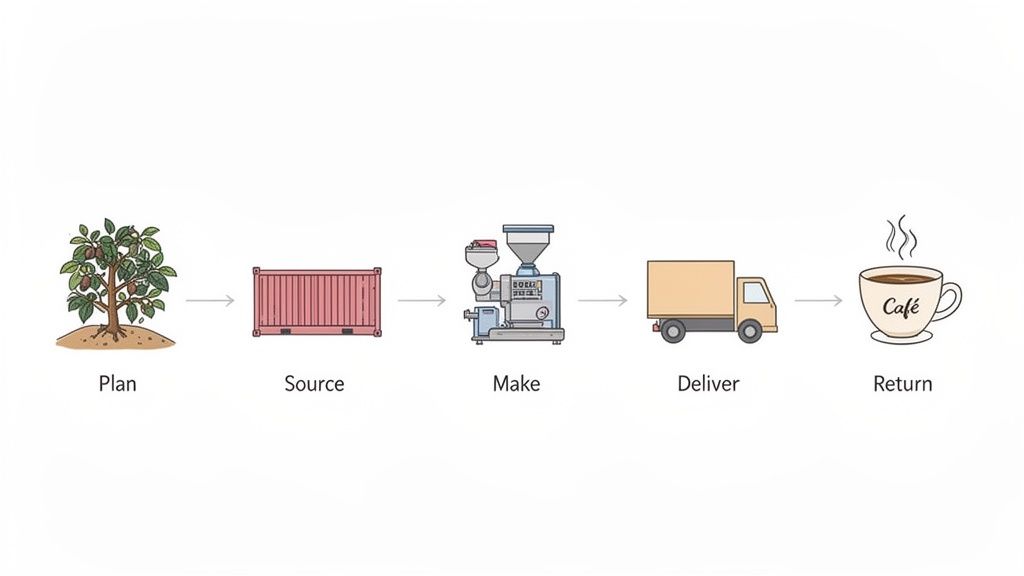
This entire sequence—involving a vast network of people, companies, information, and resources—is the supply chain. It’s the complete lifecycle, from creation to consumption. From your smartphone to your running shoes, every single item has its own unique supply chain story.
Breaking Down the Coffee Journey
At its heart, supply chain management (SCM) is about orchestrating this entire journey. It’s far more than just moving boxes from A to B. It’s about making smart, strategic decisions to keep the whole process running smoothly, cost-effectively, and reliably.
Without great SCM, that coffee could be way too expensive, show up late, or worse, not be available at all.
It's also important to distinguish SCM from logistics. People often use the terms interchangeably, but logistics is really just one piece of the much larger SCM puzzle. You can get a better sense of how logistics with supply chain management work together to understand the full picture.
Ultimately, the goal is to perfectly sync up supply with demand, giving the best possible value to both the customer and the business. This is managed across five core functions:
- Plan: Figuring out how much coffee the world will want to drink.
- Source: Finding and choosing the best farms to buy the beans from.
- Make: The art of roasting, grinding, and packaging the coffee.
- Deliver: Getting the finished product to warehouses, distributors, and finally, your cafe.
- Return: Dealing with any issues, like a damaged shipment or recycling used packaging.
A supply chain is essentially a series of linked activities that must be performed to move a product from a raw material stage to the hands of the end customer. Supply chain management is the orchestration of these activities to maximise customer value and achieve a sustainable competitive advantage.
The Journey of Your Morning Coffee: A Supply Chain Snapshot
To bring this to life, let’s map out your coffee’s journey through these distinct stages. Each step is connected and requires careful planning and coordination, right down to making sure the cafe has enough milk and lids.
This simple snapshot shows just how interconnected everything is. A small delay at the farm can send ripples all the way through the chain, eventually affecting the person waiting for their morning brew. Effective supply chain management is the art and science of keeping this incredibly complex system humming along perfectly, day in and day out.
The Five Core Functions of Supply Chain Management
At the heart of every effective supply chain are five interconnected functions. Think of them as the essential gears in a complex machine; if one falters, the whole system can grind to a halt.
These five pillars—Plan, Source, Make, Deliver, and Return—form a continuous loop that lets businesses meet customer demand efficiently and profitably. Each function has its own distinct responsibilities, yet they're all deeply intertwined, relying on shared information and constant communication to succeed. Understanding these stages is fundamental to grasping what supply chain management truly is.
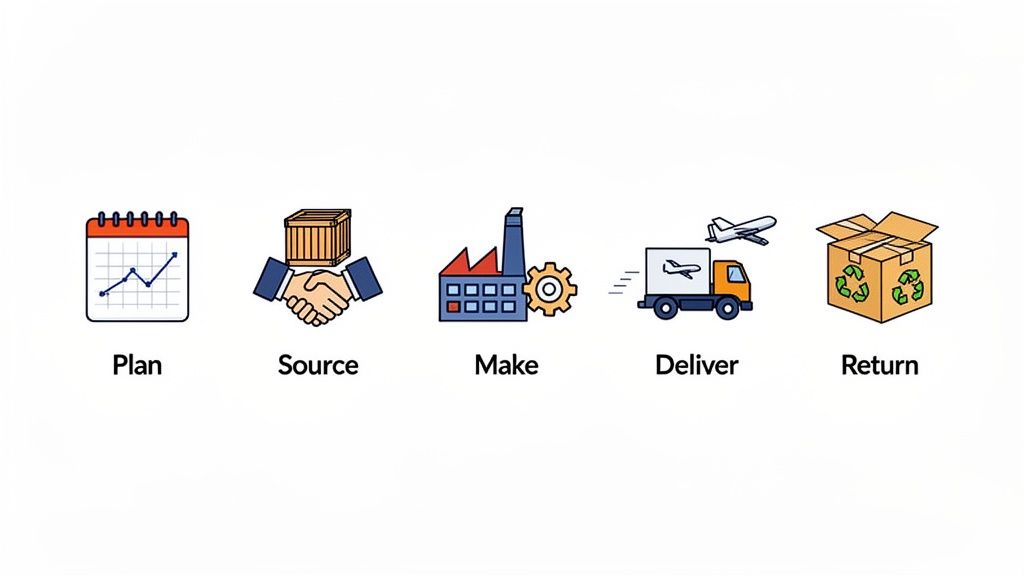
1. Plan: The Strategic Foundation
Everything starts with a plan. This is the strategic brain of the operation, where a company maps out how it will meet customer demand and align its supply activities with its broader business goals. It’s all about looking ahead to anticipate what customers will want, how much they'll want, and when they'll want it.
But this isn’t just guesswork. The best plans are built on a deep analysis of historical sales data, market trends, and even seasonal patterns. For instance, a retailer in New Zealand needs to forecast how many winter jackets to stock months before the first cold snap arrives. Getting it wrong—ordering too many or too few—can lead to costly unsold stock or frustrating empty shelves for customers.
2. Source: Finding the Right Partners
Once the plan is in place, the next step is sourcing the raw materials and components needed for production. This function is far more than just finding the cheapest supplier; it’s about building strong, reliable partnerships that can stand the test of time.
Professionals in this area identify, evaluate, and select vendors who can provide high-quality goods at a fair price, consistently and on time. Key activities include:
- Supplier Vetting: Checking a potential supplier’s quality standards, ethical practices, and financial stability.
- Price Negotiation: Securing fair terms and contracts that create a win-win for both parties.
- Inventory Management: Ordering and managing the raw materials needed for production without creating a wasteful surplus.
Imagine a furniture maker sourcing sustainable timber. They must ensure their supplier not only provides quality wood but also sticks to responsible forestry practices. This kind of strategic sourcing protects both the product quality and the brand's reputation.
3. Make: Transforming Materials into Products
The "Make" function is where the product finally comes to life. This stage covers everything involved in manufacturing, assembling, testing, and packaging the final goods. Here, efficiency and quality are everything.
This process involves choreographing the use of machinery, labour, and raw materials to transform inputs into market-ready outputs. For a tech company, this could mean assembling complex circuit boards for smartphones. For a food producer, it might involve mixing ingredients, cooking, and packaging snacks according to strict safety standards.
The goal of the 'Make' stage is to produce the right quantity of products to the right quality standard, all while minimising waste and production costs. Effective production scheduling ensures the factory operates smoothly, avoiding bottlenecks and delays.
4. Deliver: The Logistics of Movement
With the product made and packaged, the "Deliver" stage takes over. This is often the most visible part of the supply chain, covering all the logistics required to get the product into the hands of the end consumer.
This function, often just called logistics, includes a whole range of activities:
- Order Management: Receiving and processing customer orders accurately.
- Warehousing: Storing products safely and organising them for efficient dispatch.
- Transportation: Choosing and managing how goods will move—by truck, ship, or plane—from warehouses to distributors, retailers, or directly to customers.
For a Kiwi business exporting wool overseas, the "Deliver" phase involves a complex dance of land freight to the port, international shipping, customs clearance, and final delivery in a foreign country. Getting this right is absolutely crucial for keeping customers happy.
5. Return: Managing the Reverse Flow
The supply chain doesn’t always end when a product is delivered. The "Return" function, also known as reverse logistics, is a critical component that handles everything flowing back from the customer.
This process is essential for managing customer satisfaction and sustainability. It covers product returns due to damage, handling repairs under warranty, and managing the recycling or responsible disposal of old products. A well-organised returns process can turn a potentially negative experience into a positive one, building loyalty and trust. For example, a clothing brand that offers easy, free returns is far more likely to keep its customers coming back.
The People Who Power the Supply Chain
Processes and tech are important, but it's the people who are the real engine of any supply chain. This field is driven by sharp, skilled professionals who think on their feet, solve complex puzzles, and collaborate across departments—and continents—to keep goods moving. They’re the ones who turn a plan on a spreadsheet into a product in a customer's hands.
A supply chain isn't just a set of automated steps. It’s a living, breathing network that depends on human expertise to handle constant change, unexpected roadblocks, and new opportunities. The roles demand a unique blend of analytical thinking, clear communication, and a knack for creative problem-solving.
Key Roles in Supply Chain Management
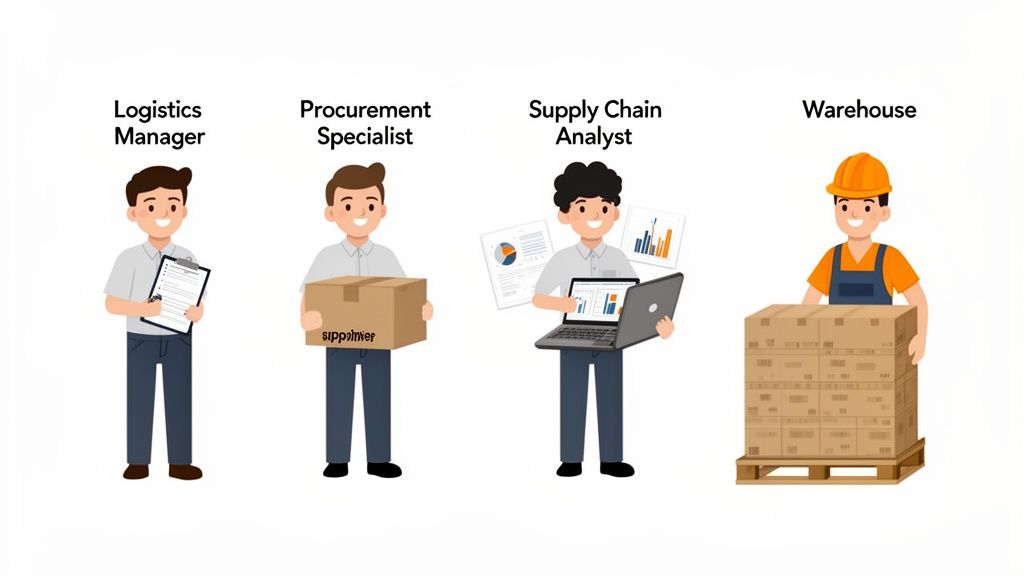
Several key roles form the backbone of a successful supply chain operation. Each one has a distinct focus, but they all share the same goal: getting value to the customer efficiently.
Here are a few of the most critical positions you'll find:
- Procurement Specialist: These are the master negotiators and relationship builders. They source and buy the raw materials, goods, and services a company needs, constantly balancing cost, quality, and supplier reliability.
- Logistics Manager: Logistics managers have their eyes on the entire journey of a product. They coordinate everything from warehousing and inventory to transport, making sure goods get where they need to be safely, on time, and on budget.
- Supply Chain Analyst: As the data gurus, analysts use information to make things better. They track key metrics, spot trends, hunt down inefficiencies, and recommend strategies to make the whole supply chain faster and more cost-effective.
- Warehouse Manager: This role is all about the day-to-day hustle of a distribution centre. They manage staff, oversee the flow of goods in and out, and keep a laser focus on workplace safety and inventory accuracy.
How These Roles Work Together
In supply chain management, teamwork isn't just a buzzword; it’s essential. These professionals are in constant communication, tackling daily challenges and heading off disruptions before they can cause real damage.
Picture this: a key supplier's factory shuts down without warning. The Procurement Specialist immediately scrambles to find and vet an alternative. At the same time, the Supply Chain Analyst is crunching the numbers to figure out the impact on production schedules and costs. They feed that data to the Logistics Manager, who then has to reroute trucks and adjust transport plans for the new supplier.
This seamless teamwork is the human element that makes a supply chain resilient. It’s about anticipating problems and having the right people with the right skills ready to execute a coordinated response.
The importance of this human factor is massive. New Zealand's Supply Chain Resilience Market is valued at a hefty USD 5.5 billion, a number that underscores just how vital these professionals are to our economy. That figure covers everything from freight and warehousing to the advanced risk management tools these teams rely on. You can dive deeper into these market dynamics in this detailed report from Ken Research.
Building a Career in the Industry
A career in supply chain management offers a huge range of pathways, from hands-on operational roles to strategic, data-heavy positions. It's a field that rewards quick thinking, adaptability, and a genuine talent for organisation. Managing teams, coordinating schedules, and fostering collaboration are skills that cross over into many other management disciplines.
In fact, core competencies like workforce planning and performance management are quite similar to those you’d explore when learning what is human resource management. By understanding how these skills connect, aspiring professionals can see how experience in one area can pave the way for success in another, opening up a world of opportunity in this crucial industry.
Navigating Modern Supply Chain Challenges
Today’s supply chains are under constant pressure. The smooth, predictable flow of goods we once took for granted is now constantly being tested by global disruptions, making a deep understanding of what is supply chain management more important than ever. The last few years have shown us all just how fragile these complex networks can be.
Events like the worldwide pandemic sent shockwaves through every single link in the chain. All of a sudden, businesses were facing skyrocketing shipping costs, unexpected material shortages, and wild price swings. For everyday people, this meant empty shelves and long waits for everything from new cars to building supplies.
These global issues hit New Zealand particularly hard. As an island nation at the bottom of the world, we lean heavily on international trade, making our supply lines especially vulnerable when things go wrong with global shipping or manufacturing.
New Zealand's Unique Position
Our geographic isolation creates a unique set of logistical hurdles. When a major international port gets jammed up, Kiwi businesses feel the ripple effect almost immediately. This dependency means local industries have to be exceptionally good at planning and managing risk just to stay competitive and keep their doors open.
Think about the local construction sector during the recent disruptions. Builders were hit with massive delays and budget blowouts as they struggled to get their hands on essential materials like Gib board and timber. This one example makes it crystal clear: good supply chain management is no longer just about being efficient; it’s now a fundamental requirement for our economic stability.
Mastering supply chain principles has shifted from a competitive advantage to a critical necessity. In a world of constant change, the ability to anticipate, adapt to, and recover from disruptions defines business success and failure.
The Rise of Resilience
In response to these pressures, the industry’s focus has shifted dramatically towards resilience. This isn't just a buzzword; it means building supply chains that are not only efficient but also flexible and tough enough to withstand major shocks. It involves practical steps like diversifying suppliers, using better technology for visibility, and holding strategic inventory buffers just in case.
The real challenge is creating a system that can take a hit—like a factory shutdown overseas or a container ship getting stuck—and bounce back quickly without collapsing. This proactive approach to risk is now a core responsibility for any supply chain professional worth their salt.
Tracking Our Supply Chain Health
The pandemic really put New Zealand's supply chains to the ultimate test. Interestingly, an innovative local measure showed that while our networks were remarkably strong at first, they came under significant strain as the crisis dragged on. The Deloitte Access Economics Supply Chain Health Index (DAESCHI), a first for New Zealand, tracks dozens of data points like shipping costs and port delays to paint a clear picture of our operational health.
This index revealed that after outperforming global benchmarks in early 2020, our supply chains saw a sharp downturn by 2021 as prolonged global pressures finally took their toll. You can explore the full findings to see how this tool measures supply chain uncertainty in New Zealand.
Ultimately, the challenges of the modern era have permanently changed the game. They’ve exposed our weak spots but also created massive opportunities for smarter, stronger, and more agile supply chain strategies, proving that skilled management is absolutely indispensable in today's interconnected world.
The Future of Supply Chain Technology
Innovation is completely changing how goods move around the globe. The days of relying on spreadsheets and manual tracking are numbered. Instead, the supply chain world is embracing powerful new tools that create smarter, faster, and more transparent networks. These aren't just fancy ideas; they're having a real impact on everything from your local supermarket's stock levels to the safe delivery of critical medicines.
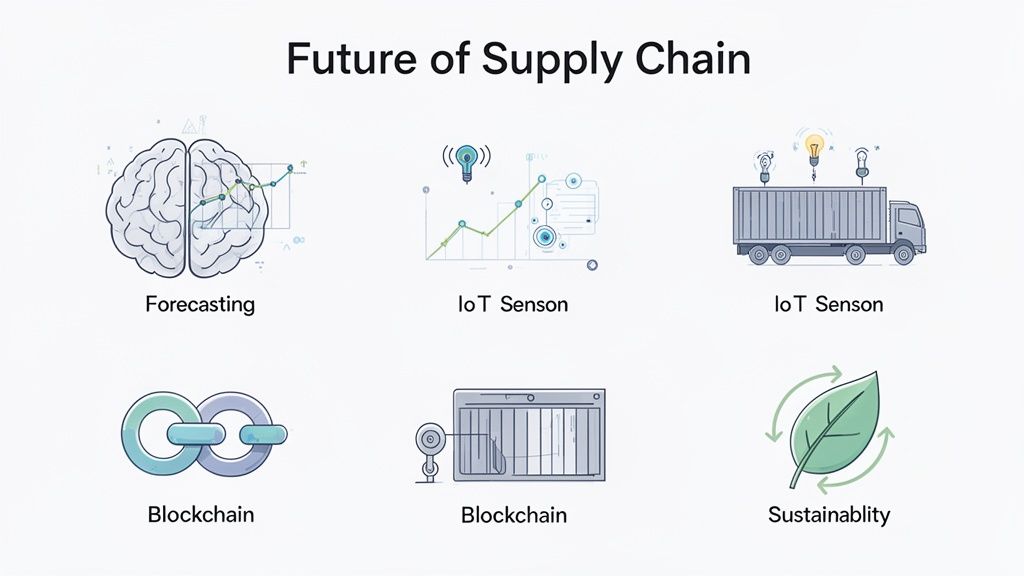
This constant evolution shows that supply chain management is a field packed with opportunities for clever improvements. Getting your head around these key technologies is crucial if you want to understand where the industry is going.
The Rise of Artificial Intelligence
Artificial Intelligence (AI) is one of the biggest game-changers for the modern supply chain. Think of it as a super-smart brain that can sift through enormous amounts of data to predict what’s going to happen and automate complex decisions with stunning accuracy. This is especially true for forecasting.
Instead of just looking at last year's sales, AI algorithms can analyse market trends, weather forecasts, social media chatter, and what competitors are up to. For a retailer, this could mean knowing exactly how many umbrellas to order just before a week of rain, avoiding both empty shelves and wasteful overstock. You can dive deeper into how AI is being used across different sectors by exploring courses in Artificial Intelligence.
The Internet of Things Creates Real-Time Visibility
The Internet of Things (IoT) is a network of physical devices—like containers, trucks, or even individual packages—that are fitted with sensors to connect and share data. In a supply chain, this creates a live, moment-by-moment view of where goods are and what condition they're in.
Picture a shipment of sensitive medicines that need to be kept cold. IoT sensors can monitor the temperature inside the truck every second of the journey. If things start to warm up, an alert is instantly sent to the logistics manager, who can step in before the product is ruined. This level of insight delivers:
- Real-Time Tracking: Pinpoint the exact location of any shipment at any time.
- Condition Monitoring: Make sure goods like fresh food or pharmaceuticals are kept in perfect conditions.
- Predictive Maintenance: Sensors on warehouse machinery or delivery trucks can predict a breakdown before it actually happens.
Blockchain Delivers Unbreakable Trust
Blockchain technology offers a new, incredibly secure way to record information. It's like a shared digital logbook that’s impossible to change. Every transaction or movement gets recorded as a "block" and added to a permanent "chain," creating a single, verifiable story for everyone involved.
For example, when tracking high-value goods like diamonds or organic produce, blockchain can provide an unbreakable record of every step from the mine or farm to the final shop. This guarantees the product is genuine and helps prevent fraud, building a huge amount of trust between suppliers, distributors, and customers.
By creating a single, shared source of truth, blockchain technology fosters a new level of transparency and accountability across the entire supply chain, reducing disputes and building stronger partnerships.
A Focus on Sustainability and the Circular Economy
Beyond just tech, there's a huge shift happening towards sustainability. Businesses are facing more pressure from customers and governments to make their supply chains greener. This has boosted the idea of the circular economy—a model focused on cutting out waste by reusing, repairing, and recycling materials.
This means rethinking how products are made so they last longer and are easier to fix. It also involves setting up clever reverse logistics systems to get used products back from customers and feed them back into the production cycle. This isn't just good for the planet; it can also open up new business opportunities and slash costs. As supply chains evolve, it's also worth understanding the latest in smart warehouse automation design to stay ahead.
How to Start Your Career in Supply Chain Management
Thinking about turning that interest in how things get from A to B into a full-blown career? It's more within reach than you might imagine. A job in supply chain management drops you into a dynamic field where you’re solving real-world puzzles every single day. It’s a massive area with room for all sorts of people, whether you’re a hands-on type who loves being in the thick of it or a data whiz who enjoys planning from behind the scenes.
For those who thrive in a bustling, physical environment, getting your start in warehousing or logistics is a fantastic way in. You could begin as a warehouse associate or a dispatch coordinator, learning the real nuts and bolts of how inventory is managed and goods are moved. These roles give you a brilliant ground-level view of the practical hurdles in getting products where they need to go.
Developing Core Professional Skills
If your talents are more geared towards analysis and planning, then roles in procurement or as a supply chain analyst are perfect starting blocks. These jobs are all about forecasting demand, crunching performance data, and forging strong relationships with suppliers. No matter which path you take, employers are always looking for a core set of skills that are essential for getting ahead in this industry.
These foundational skills include:
- Analytical Thinking: The ability to look at data, see the patterns, and spot a potential snag before it turns into a full-blown crisis.
- Problem-Solving: Having a knack for thinking on your feet to sort out unexpected delays, supplier dramas, or logistical hiccups.
- Clear Communication: The skill to coordinate smoothly with suppliers, transport companies, and your own teams to keep everyone on the same page.
Success in supply chain management often comes down to your ability to anticipate challenges and adapt quickly. It’s a field that rewards proactive thinking and a calm, organised approach to complex situations.
The need for these skills has never been clearer. During the pandemic, for instance, supply chain disruptions became a massive headache for New Zealand businesses. In 2022, a huge 31% of company directors flagged it as their biggest organisational risk. By 2023, that figure dropped sharply as global logistics started to find their feet again, really showing the value of skilled professionals who can build resilient systems. You can dive deeper into these findings on supply chain risk from Massey University.
Building Your Foundation Through Education
A great way to sharpen these in-demand skills and get the foundational knowledge that employers are looking for is through focused education. Flexible, self-paced online courses in business and logistics can get you up to speed with the principles of procurement, inventory management, and operational planning. These aren't just skills for SCM, either—they're incredibly valuable in many related fields.
Many of the core competencies, like managing timelines and juggling resources, transfer directly to other roles. For example, getting a grip on these concepts is a huge advantage if you’re thinking about how to become a project manager, since both fields demand meticulous organisation and a strategic eye. By investing in your knowledge, you’re taking a confident first step towards a really fulfilling career.
Your Top Supply Chain Management Questions Answered
To wrap things up, let's tackle some of the most common questions people have about supply chain management. Think of this as a quick-fire round to clear up any lingering confusion about the industry, its core ideas, and what it takes to build a career in it.
What Is the Main Difference Between Logistics and SCM?
This is a classic, and it’s easy to see why people mix them up. The simplest way to think about it is that logistics is one critical part of the much bigger supply chain picture. Logistics is all about the physical movement and storage of goods—think trucks, ships, warehouses, and keeping track of inventory. It's the 'how' and 'where' of getting things from A to B.
Supply chain management (SCM), on the other hand, is the entire strategic overview. It's the whole puzzle, not just a single piece. SCM covers everything from the very beginning—like finding raw materials and building relationships with suppliers—through to manufacturing, and then it includes managing all the logistics to get the final product to the customer.
Why Does Supply Chain Management Matter for Small Businesses?
It’s a common myth that SCM is only for huge corporations. In reality, smart supply chain management can be a small business’s secret weapon for growth. Getting it right helps them control costs by negotiating better deals with suppliers, cutting down on waste, and making sure cash isn’t tied up in stock that’s just sitting on a shelf.
But it’s not just about saving money. A reliable supply chain leads to happy, loyal customers. When you can consistently get your products into their hands without delays or stockouts, you build a reputation for dependability. That kind of trust is priceless for a small business trying to grow in a crowded market.
A streamlined supply chain can be a small business's secret weapon, directly impacting profitability and customer loyalty by ensuring the right product is in the right place at the right time.
What Are the Most Critical Skills for a Career in SCM?
To really succeed in the supply chain world, you need a unique mix of hard and soft skills. Of course, the technical know-how is important, but what employers are really looking for are people who also have:
- Problem-Solving: The knack for thinking on your feet and figuring out solutions when things inevitably go wrong—because they will.
- Analytical Abilities: You need to be comfortable with data. The job involves spotting trends and using that information to make processes more efficient and decisions smarter.
- Strong Communication: The ability to clearly coordinate with everyone from suppliers on the other side of the world to customers down the street and all the internal teams in between.
Ready to build these in-demand skills and launch a rewarding career? At Get Course New Zealand, we connect you with flexible, online courses designed to fit your life. Start your journey today by exploring our wide range of business and logistics study options at https://getcourse.co.nz.
Find Your Course
Compare courses across every field we write about, and enquire in under a minute.