%20(1).png)
Thinking about a career that genuinely makes a difference? If you're considering becoming a teacher in New Zealand, you're in the right place. The path isn't just about getting a qualification; it's a journey that involves meeting professional standards, getting registered, and ultimately, shaping the minds of young Kiwis.
This guide is your roadmap. We’ll cut through the jargon and lay out the real steps you need to take, from picking the right degree to landing your first job in the classroom.
If you’ve been weighing up the decision, the timing couldn't be better. Demand for passionate educators is on the rise across Aotearoa, with many regions facing shortages.
In fact, a Ministry of Education forecast paints a clear picture: under its most likely scenario, Kiwi schools could be short by around 750 primary teachers and 500 secondary teachers in 2025. This means that as soon as you're qualified, your skills will be in high demand. You can get a better sense of the numbers on 1News.
This isn't just a numbers game, though. It reflects a real need for dedicated people to step up and inspire the next generation.
A teaching career in Aotearoa offers far more than just job security. It's a chance to invest in our communities, spark a lifelong love of learning, and help young people build a brilliant future for themselves.
Your journey into teaching will look different depending on your background. Whether you're fresh out of high school, have a degree in another field, or are switching careers entirely, there's a pathway designed for you.
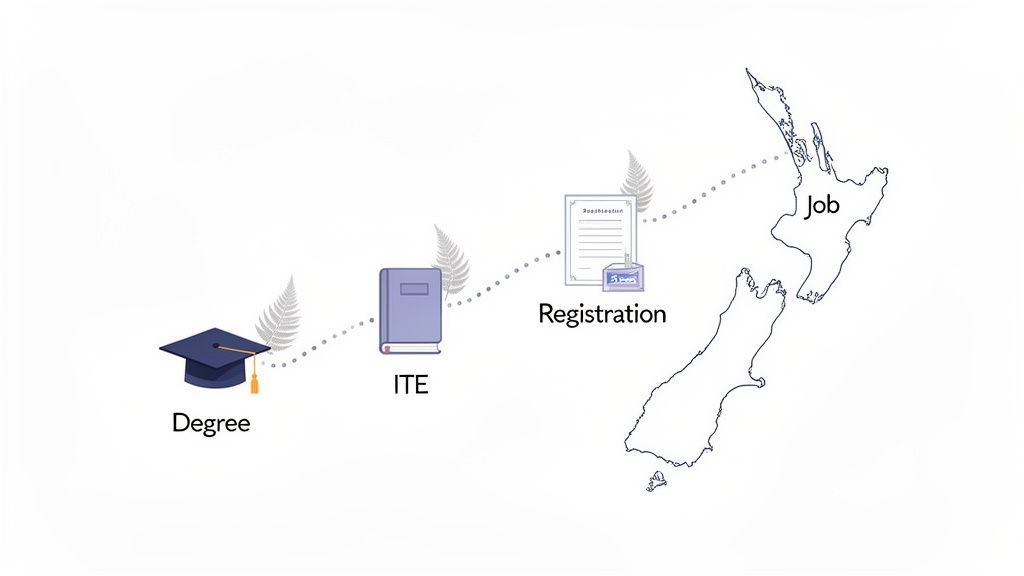
Essentially, all roads lead to the same destination: completing an Initial Teacher Education (ITE) programme and gaining registration with the Teaching Council of Aotearoa New Zealand. This is your official licence to teach.
Here’s a look at the most common routes:
For instance, if your passion lies in the foundational years, you might look into getting an online degree in early childhood education, which offers the flexibility to study around your life.
To help you see where you might fit, here’s a quick breakdown of the main qualification pathways.
This table summarises the most common routes into teaching in New Zealand, helping you identify which one aligns best with your existing qualifications and goals.
Each of these pathways is designed to equip you with the skills and knowledge needed to meet the Teaching Council's standards and thrive in a Kiwi classroom.
Your first big decision on the road to becoming a teacher in NZ is picking the right Initial Teacher Education (ITE) programme. This isn't just about ticking a box; it's about finding a qualification that genuinely fits your life, your existing qualifications, and where you want to go in your career. Think of it as choosing the right trailhead for your teaching journey.
The path you take will depend heavily on where you're starting from. For someone just finishing secondary school, a three-year undergraduate degree is the most direct route. But if you're a career-changer with a degree in science or history, a shorter, more focused qualification makes a lot more sense.
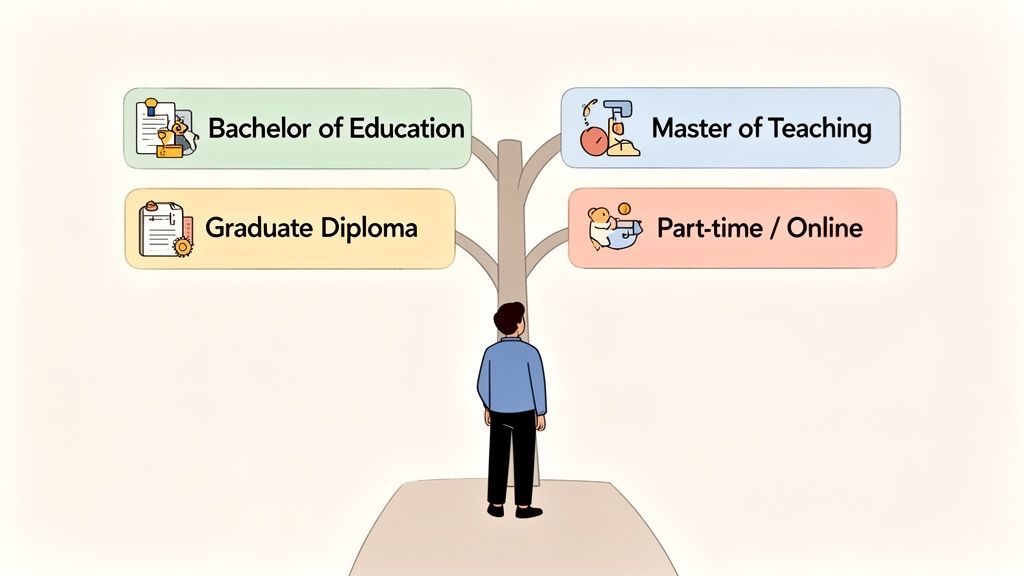
If you’re heading into tertiary study for the first time, the Bachelor of Education (BEd) or Bachelor of Teaching (BTchg) is your go-to. These are typically three-year degrees designed to build your knowledge from the ground up. You’ll cover everything from child development and educational psychology to curriculum design and classroom management.
A huge benefit of this pathway is the sheer depth of learning. You get extensive time for practical placements (practicums) in schools, which lets you gradually build confidence and see how the theory works in a real classroom.
Already have a bachelor's degree in another field? The Graduate Diploma in Teaching is an incredibly popular and efficient way into the profession. It's an intensive, one-year programme made specifically for graduates, building on the subject knowledge you already have.
For example, someone with a Bachelor of Science in Biology could complete a Graduate Diploma to become a secondary school science teacher. The diploma doesn’t waste time re-teaching you biology; it focuses squarely on the 'how' of teaching—pedagogy, classroom practice, and meeting the professional standards.
This accelerated route is a fantastic option for mature students and career-changers. It acknowledges your prior learning and gets you into the classroom faster, where your unique life experience can become a major asset.
This is often the most practical choice if you're juggling other commitments, as many providers now offer flexible ways to study.
For those who want a deeper academic challenge or have an eye on future leadership roles, postgraduate options are excellent choices. A Master of Teaching and Learning (MTchgLn) or a Postgraduate Certificate in Education (PGCertEd) can take your career to the next level. These programmes often blend advanced educational theory with the practical requirements for teacher registration.
A Master's degree, usually lasting 18 months to two years, lets you specialise in an area you're passionate about, like inclusive education or digital learning. It positions you perfectly for roles beyond the classroom down the track, such as curriculum development or educational leadership.
While picking your qualification, you also need to decide which age group you want to teach. The main sectors in New Zealand are:
Let your passion and a bit of pragmatism guide this choice. Do you love the boundless curiosity of young children, or are you excited to share your love for calculus with teenagers? It’s also smart to research which specialisations are in high demand. To get a better feel for it, you can explore more about primary teaching courses and their requirements.
The idea of going back to study can be daunting, especially if you have a job or a family to think about. Luckily, teacher education has become far more accessible. Many ITE providers now offer part-time, distance, and online learning options.
This flexibility means you can fit study around your life, not the other way around. You can often complete the theory coursework online and then do your practical placements in schools close to home. This model has opened the door for so many people who thought a career change was impossible, making the path to becoming a teacher in NZ more attainable than ever.
You've done the hard yards and finished your Initial Teacher Education (ITE) programme. Congratulations! You’re on the home stretch, but there’s one last crucial step before you can officially lead a classroom as a qualified kaiako (teacher).
You need to get registered with the Teaching Council of Aotearoa New Zealand. Think of this as your professional licence to teach—it’s the official stamp that confirms you meet the high standards required to shape young minds in Aotearoa. The process might seem a bit bureaucratic, but every part is there for a good reason: to ensure every child is taught by professionals who are qualified, safe, and ready for the role.
Let’s break down exactly what’s involved.
The key that unlocks the classroom door is a valid practising certificate. As a new graduate, the one you’ll be applying for is the Tōmua | Provisional Practising Certificate, which is valid for three years. This certificate gets you started in your career while you complete a two-year induction and mentoring programme at your first school.
The whole application is done online through the Teaching Council’s portal, Hapori Matatū. Before you log in, it’s a good idea to get your documents in order.
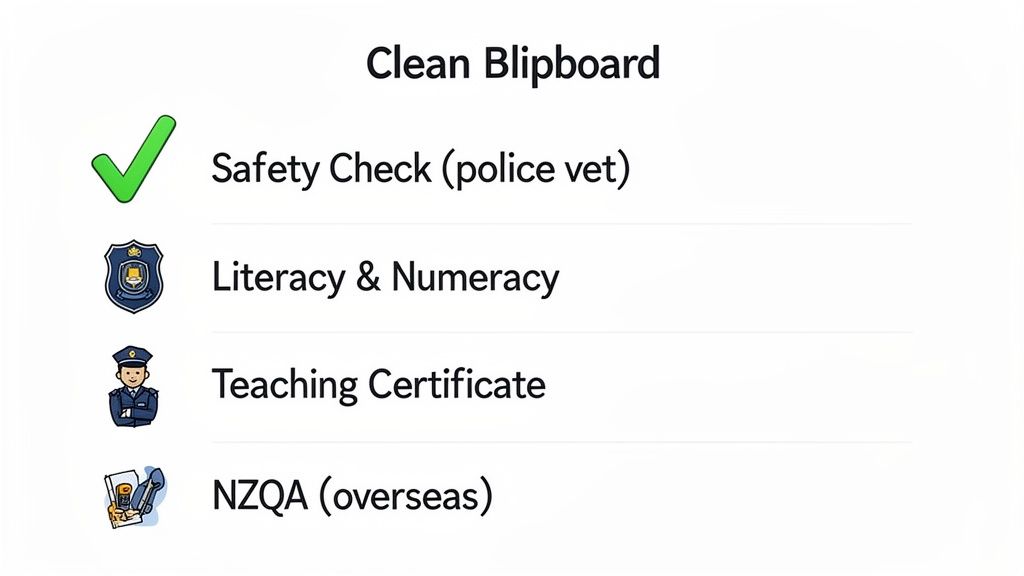
You’ll need:
To protect our tamariki (children), every applicant goes through a comprehensive safety check, including police vetting. This isn't just a quick background search; it's a thorough process required under the Children's Act 2014. The Teaching Council will check your record with New Zealand Police for any criminal convictions or other red flags that might make you unsuitable for working with children.
Honesty is absolutely critical here. You must declare any and all convictions on your application. Having a minor conviction from your youth doesn't automatically rule you out, but trying to hide it will raise serious questions about your integrity.
The ‘good character and fit to be a teacher’ assessment is a cornerstone of the registration process. The Council looks at your honesty, integrity, and professionalism to ensure you uphold the trust that the community places in its teachers.
To get your certificate, you also have to show you’ve met the national standards for literacy and numeracy. For most ITE graduates from 2023 onwards, this is pretty straightforward. Your university or provider will have assessed you against the Literacy and Numeracy | Te Reo Matatini me te Pāngarau standards and will confirm this directly with the Teaching Council.
If you finished your qualification a while ago or you’re applying from overseas, you might need to provide separate evidence. This could mean sitting a test or showing proof of equivalent qualifications. The goal is simply to confirm you have the core skills needed to teach effectively.
Did you earn your teaching qualification outside of New Zealand? You’ll have a couple of extra steps to take. Your first stop is the New Zealand Qualifications Authority (NZQA). You need to get your qualifications formally assessed to confirm they are comparable to an approved NZ ITE programme.
This International Qualification Assessment (IQA) report from NZQA is a mandatory part of your Teaching Council application, so get onto it early. Be prepared for this to take some time. After that, you'll also need to meet all the same language proficiency, safety check, and 'fit to be a teacher' criteria as locally trained graduates.
So, how long does this all take, and what’s the damage to your wallet? It's smart to apply for registration as soon as you have your final academic transcript in hand. The Teaching Council says processing can take up to eight weeks, particularly during the busy season at the end of the university year.
Now for some good news on the cost front. To help tackle teacher shortages, the government has recently been funding registration fees for new and returning teachers. This policy is a huge help, as it removes a significant financial barrier for graduates and people coming from overseas. You can read more about government support for new teachers on the Beehive website.
Knowing these steps will help you breeze through the admin and get you where you want to be—making a real difference in the classroom.
You’ve done the hard yards—qualification in hand, registration sorted—and now the really exciting part begins: finding your first teaching role in a Kiwi kura. Stepping into the job market can feel like a huge leap, but with the right game plan, you’ll be able to show schools what you’re made of and find a place that feels like a perfect fit.
The journey from graduate to employed teacher is all about translating your training into an application that truly shines.
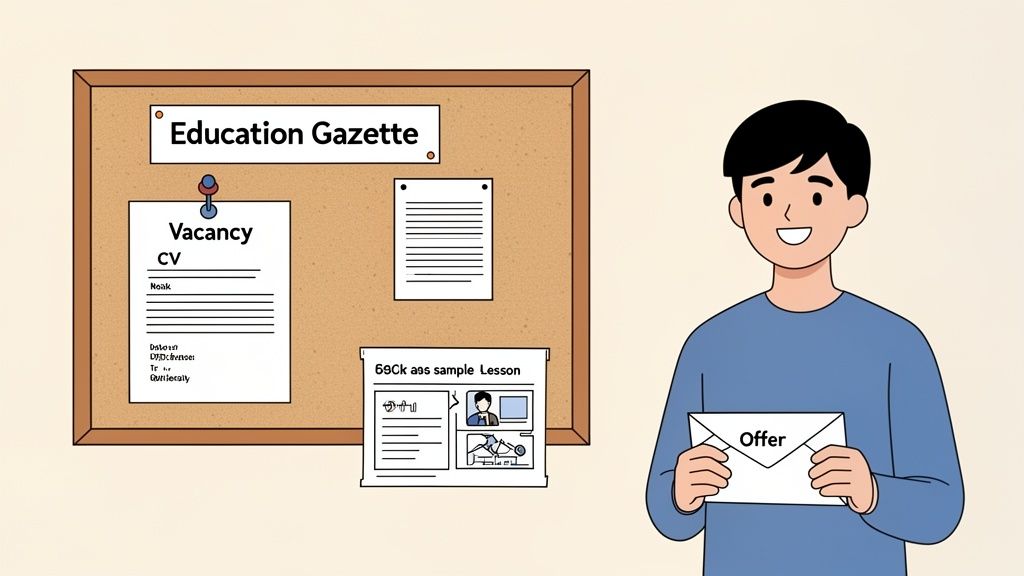
First things first, you need to know where to look. While you might spot the odd role on general job sites, the teaching profession in New Zealand has a couple of key places where almost all positions are advertised.
Get these sites bookmarked and check them often:
Relief teaching is a fantastic way to get your foot in the door. You’ll get a feel for different school cultures, build a network of contacts with principals and department heads, and prove your skills in a real-world setting. Plenty of new teachers land their first permanent job through connections they made while relieving.
Your CV and cover letter are your first impression, and you want to make a good one. Schools can be flooded with applications, so yours needs to be sharp, clear, and show exactly why you’re the right person for their community.
A generic, one-size-fits-all application just won’t cut it here. Every single one needs to be tailored to the specific school and role. Read the job description carefully and reflect their unique values in your letter. Make it clear what excites you about their school—is it their commitment to project-based learning, their strong arts programme, or their deep connection with the local iwi?
For your CV, make sure you:
Getting an interview means the school sees your potential. Your job now is to bring that application to life. School interviews in New Zealand are often as much about your personality and teaching philosophy as they are about your qualifications.
Be ready to talk about how you build positive relationships with students, what your approach to classroom management is, and what you believe makes for great learning. A huge focus for schools right now is a genuine commitment to Te Tiriti o Waitangi and culturally responsive practice. Expect questions on how you weave Te Reo Māori and tikanga into your teaching to help Māori learners succeed.
Many interviews also include a request to teach a short sample lesson. This is your chance to shine. Pick a topic you’re passionate about and plan something engaging and interactive that shows you can connect with students and manage a classroom. Focus on clear instructions, getting the kids involved, and creating a positive vibe. Honestly, this practical demonstration often says more than anything you could write in a cover letter.
Becoming a teacher in New Zealand is the start of a seriously dynamic and rewarding career path. Getting your practising certificate isn't the finish line; it’s really just the beginning of a lifelong journey of learning and growth. This isn't a dead-end job—it's a profession with a clear, structured pathway for salary progression and countless opportunities to pick up new skills and step into leadership roles.
Getting your head around this long-term view is crucial. It helps you see teaching not just as a job, but as a sustainable career you can build on for years. Let's break down how your salary will grow and the exciting directions your professional life can take.
One of the best things about teaching in Aotearoa is how transparent the pay structure is. You’re not left guessing. Teacher salaries are laid out in collective agreements negotiated between the Ministry of Education and teacher unions like the Post Primary Teachers' Association (PPTA) and the New Zealand Educational Institute (NZEI).
This means your pay is based on a clear scale that considers two main things:
This system gives you a great sense of security and ensures you're properly recognised for your growing expertise. You can literally map out your potential earnings for the first several years of your career with a pretty high degree of confidence.
A clear, unified pay scale creates fairness and transparency right across the profession. It lets you focus on what really matters—your growth as an educator—knowing that your financial progression is sorted.
While the base salary scale provides steady, reliable growth, it's not the only way to bump up your earnings and take on more responsibility. As you get more experience under your belt, all sorts of opportunities pop up to take on extra roles within your school, and these come with extra pay known as 'units'.
Units are allocated for taking on specific responsibilities, such as:
Taking on a role with one or more units doesn't just boost your paycheque. It helps you build invaluable leadership and management skills, which is perfect for setting yourself up for future career moves.
Education never stands still, and a real commitment to lifelong learning is at the heart of being a great teacher. Continuous Professional Development (CPD) is a massive part of your career, helping you stay on top of new teaching methods, classroom tech, and curriculum changes.
But CPD isn't just about ticking off a few workshops. It’s an ongoing cycle of reflection and growth that might involve:
This commitment to growth is formally recognised when you renew your practising certificate. Every three years, you'll need to show the Teaching Council that you’ve continued to meet the Standards for the Teaching Profession through ongoing professional learning. The rise of flexible learning has made this easier than ever, and you can learn more about the different pathways available through online education in NZ.
After a few years in the classroom, you might start thinking, "What's next?" The fantastic news is that a teaching background opens up a huge variety of career pathways, both inside and outside the school gates.
For example, you could set your sights on a senior leadership position within a school, such as:
On the other hand, you might discover your passion lies in supporting other teachers. Roles like a specialist classroom teacher or a resource teacher let you use your expertise to coach colleagues and improve learning outcomes for a wider group of students. Some teachers even move into advisory roles at the Ministry of Education or work for educational resource companies, using their hard-won classroom experience to shape the sector on a much larger scale.
Your journey in education is yours to shape. From a solid salary foundation to diverse leadership opportunities, becoming a teacher in New Zealand opens the door to a career filled with purpose, growth, and the chance to make a real, lasting impact.
Starting a new career path naturally brings up a lot of questions. To help you feel more confident about your journey, we’ve put together some clear, straightforward answers to the queries we hear most often from aspiring teachers in New Zealand. Think of this as your quick-reference guide to get you on the right track.
The honest answer? It really depends on your background and what qualifications you already have. There’s no single timeline, but a few common pathways exist.
If you’re starting your university journey from scratch, your most direct route is a Bachelor of Education (BEd) or a similar undergraduate degree. You can expect this to take three years of full-time study. This path gives you a solid grounding in both the theory and the practical, hands-on experience you’ll need in the classroom.
Got a degree in another subject already, like a Bachelor of Arts or Science? You’re in luck. You can fast-track your qualification with a one-year Graduate Diploma in Teaching. It’s an intensive programme designed for people changing careers, getting you qualified in just 12 months. Other postgraduate options, like a Master's degree, usually take between one and two years.
Don't forget to factor in the admin time! Once your study is done, you'll need to apply for your registration with the Teaching Council. This can take several weeks to process, so it’s wise to build that buffer into your planning.
Absolutely! New Zealand schools are always on the lookout for skilled teachers from around the globe. There's a well-trodden path for getting your overseas credentials recognised, and many international educators have built brilliant careers here.
Your first port of call will be the New Zealand Qualifications Authority (NZQA). This is a non-negotiable step to ensure your degree and teacher training are equivalent to a New Zealand Initial Teacher Education (ITE) qualification. Once the NZQA gives you the green light, you can move forward with your application to the Teaching Council.
You’ll still need to meet all the standard criteria for registration, which includes:
While good teachers are always needed everywhere, some subject areas and regions consistently have more vacancies. Keeping an eye on these trends can give you a real edge when you start looking for a job.
Right now, schools are crying out for teachers in a few key areas:
For the most up-to-date picture of what’s needed, your best bet is to check the official Education Gazette. A quick browse through the current vacancies will tell you exactly what schools are looking for right now.
Ready to take the next step towards a fulfilling career in education? Get Course New Zealand helps people find flexible, online courses that fit their lives. Explore a range of study options that can help you build the skills and knowledge for your teaching journey. Start browsing courses today at https://getcourse.co.nz.


