%20(1).png)

Thinking about a career as a business analyst in New Zealand? You've landed in the right place. This role is a fantastic move for anyone looking to build a career in a high-demand field, acting as the crucial link between business goals and the tech that makes them happen. It’s a rewarding path for those ready to dive in.

If you're weighing up a career change or hunting for a stable, interesting profession, understanding how to become a business analyst is a brilliant first step. This isn't just another job title. It’s your chance to be right at the heart of business innovation, making a real, tangible impact on how companies operate and succeed.
At their core, business analysts (or BAs) are the ultimate communicators and problem-solvers. They dig into business challenges, spot opportunities for improvement, and then translate those needs into clear, technical solutions that development teams can actually build. Think of them as the architects of business change—they ensure every tech project perfectly aligns with the big-picture strategy.
This guide is a practical roadmap designed specifically for Kiwis. Whether you’re fresh out of uni, looking to shift from a related field, or making a complete career pivot, the path to becoming a BA is more accessible than you might think.
Let's be honest, salary matters. One of the most compelling reasons to jump into a business analyst career is the significant earning potential, right from the get-go. The constant demand for skilled BAs in New Zealand has created a competitive market where good people are compensated well for their expertise.
The numbers really do speak for themselves. The median total compensation for a business analyst in NZ is an impressive NZ$130,761, with typical salary ranges sitting between NZ$80,678 and NZ$140,322. Even entry-level roles start strong, with a projected median of NZ$120,000, which just goes to show how much this skill set is valued from day one. For a deeper dive, you can explore more detailed salary insights for New Zealand BAs on Levels.fyi.
To give you a clearer picture, here's a breakdown of what you can expect to earn at different stages of your BA career in New Zealand.
As you can see, the financial growth is solid, making it a career with real long-term potential.
Beyond the attractive pay packet, business analysts enjoy fantastic job security. Their skills aren't siloed into one industry; they're essential across a huge range of sectors that are the backbone of New Zealand's economy.
This versatility means you’ll find opportunities in all sorts of environments, including:
The real value of a business analyst is their ability to bring clarity to complex situations. They’re the ones who ask the tough questions to make sure the final product actually solves the real problem, preventing costly mistakes and wasted effort down the line.
This constant need for process improvement and smart digital transformation means skilled BAs are always in demand. It's a genuinely future-proof career choice.

To make it as a business analyst, you need a smart mix of technical know-how and genuine people skills. While a university degree in business or IT is a common starting point, it's definitely not the only route in. Many of the best BAs have built their expertise through practical, industry-focused courses that cut to the chase and teach the job-ready skills employers are actually hiring for.
In New Zealand's competitive market, education is a cornerstone for landing a good BA role, often directly influencing your job prospects and salary. Robert Half's data shows that candidates hitting the 50th percentile for BA roles, earning around NZ$120,000 a year, typically have their skills backed up by a degree or certification. And with the tech sector booming and BA demand surging 22% year-on-year since 2022, having the right training has never been more critical.
Before you jump into any course, it's a great idea to conduct a skills gap analysis. This is basically a self-audit to see how your current abilities stack up against what a BA role demands. It’ll help you focus your learning where it really counts.
Hard skills are the technical, teachable abilities that form the foundation of your BA toolkit. They are the practical methods you'll use day-in, day-out to analyse problems and map out solutions. Think of these as the 'what' of the job – specific, measurable, and absolutely essential for getting things done.
Some of the most critical hard skills you'll need to develop are:
Your ability to translate a vague business idea like "we need a better ordering system" into a detailed set of functional requirements is where you provide immense value. It's about turning ambiguity into actionable steps.
While hard skills get you in the door, it’s your soft skills that will make you a truly effective—and sought-after—business analyst. These are the interpersonal qualities that define how you work with people, manage relationships, and navigate tricky business environments. They are the 'how' of your role.
The good news is that these are often transferable skills you've picked up in previous roles, whether that was in customer service, project coordination, or even retail management.
Here are the soft skills that set great BAs apart:
Many of these skills overlap with those needed for a data analyst, a role that also leans heavily on technical ability and clear communication. If you find you enjoy the data side of things, it might be worth exploring that career path too. You can find out more by reading our guide on what it takes to become a data analyst in NZ.
Choosing how you’ll get qualified is one of the first big decisions on your path to becoming a business analyst. The traditional university route is a solid option, but let's be realistic—for most working adults in New Zealand, it’s just not practical.
This is where flexible, self-paced online courses really shine. They offer a direct path to the skills you need without forcing you to put your life on hold.
These courses are designed for people already juggling jobs, families, and everything else life throws at them. They let you study when it works for you—whether that’s in the evenings after the kids are in bed or over a few dedicated hours on the weekend. This approach puts you firmly in the driver's seat, letting you progress at a speed that actually fits your life.
Unlike a broad three-year degree, industry-focused online courses are all about efficiency. They cut straight to the practical skills and knowledge that hiring managers are looking for right now. This means you can become job-ready in a matter of months, not years, giving you a much faster return on your investment.
For a deeper dive into the different training options out there, check out our guide on choosing the right business courses online.
Once you start looking, you'll see a few different types of qualifications pop up. Figuring out the difference is key to picking the one that best lines up with your career goals and current experience.
The best qualification for you is one that not only teaches you the theory but also forces you to apply it. Look for courses that include practical projects, case studies, and real-world scenarios so you can start building a portfolio of work from day one.
So, you've got a few pathways to consider. To make it easier to see how they stack up, here’s a quick comparison of the main options.
Each pathway has its place, but for many people looking to make a swift and effective career change in New Zealand, online courses offer the most direct route to getting hired.
Alongside courses that teach you practical skills, you'll hear a lot about professional certifications from global bodies. It's important to know that these aren't learning courses in the same way; they're credentials that validate your knowledge and experience against an internationally recognised standard. They become particularly valuable once you've got some real-world experience under your belt.
The two main players you need to know are:
Think of these certifications as a powerful signal to employers that you are serious about your craft. They show a commitment to best practices and can give you a real competitive edge in the job market, especially when you're going for senior roles.
Experience and certifications are a potent combination for career growth in New Zealand. As you move from entry-level to senior positions, the salary jumps are significant. For example, senior business analysts can command salaries between NZ$130,000 and NZ$150,000, and mid-career professionals often earn 30% more than their junior counterparts.
Pursuing IIBA certifications—supported by a community of over 2,000 members in NZ—is a proven strategy for unlocking this growth. You can discover more insights about IT business analyst salaries on PayScale. This structured approach helps turn your career ambitions into a six-figure reality.
This is often the biggest hurdle for career changers. How do you prove you can do the job before you’ve actually had the job? The secret is to craft a CV that tells a compelling story about your potential, focusing on what you can do, not just the titles you’ve held.
Let's be honest, a hiring manager knows you're new to the field. What they're really looking for is evidence that you've been proactive, built the right skills, and can actually apply them.
Your CV needs to stop being a list of old job duties and start being a showcase of your transferable skills and tangible achievements.
You've probably performed business analysis tasks without even realising it. The first step is to go back through your current and past roles, but this time, look at them through a BA lens. Think about any time you've spotted a problem, dug into its root cause, and suggested a fix.
For instance, did you ever:
Now, rephrase these experiences on your CV using proper business analysis terminology. Instead of saying, "helped the sales team with their new software," you could write, "collaborated with sales stakeholders to identify pain points and document functional requirements for a new CRM system." See the difference?
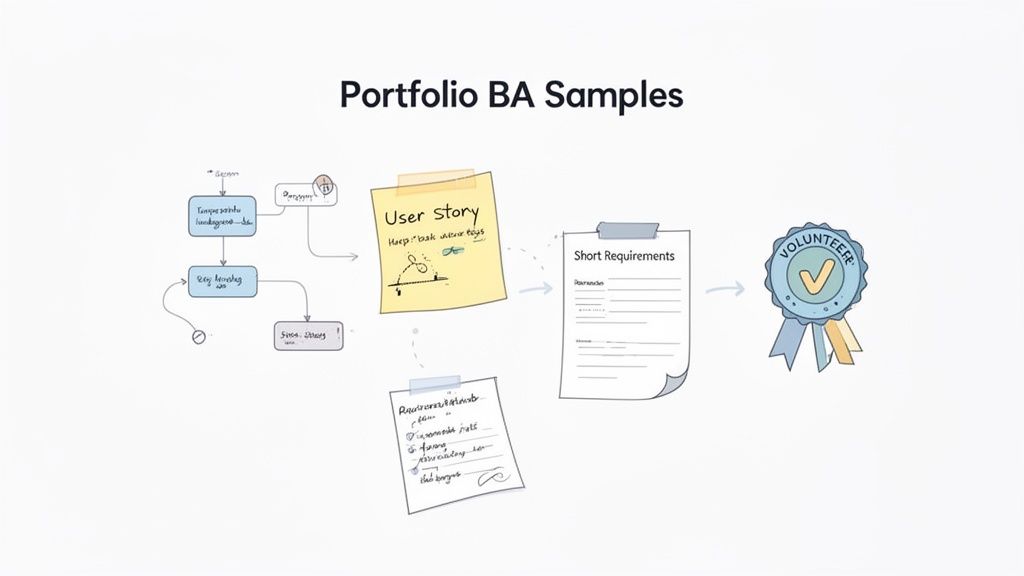
A portfolio is your ultimate proof. It’s where you move your skills from theoretical to proven by showing tangible work samples. It’s what you hand a hiring manager to say, "Look what I can actually do."
Your portfolio doesn't need to be huge, but it must be high-quality. The projects you completed during an online course are the perfect place to start.
Your portfolio is your secret weapon. While other candidates are just talking about their skills, you're providing concrete evidence. An impressive process map or a well-written set of user stories can often speak louder than years of unrelated experience.
Try to include a few key items that demonstrate a range of BA skills:
These pieces prove you understand the practical side of a business analyst's work. This kind of hands-on experience is also a great way to earn verifiable credentials. You can learn more about how this works by exploring what is micro-credentialing and how it can give your CV a real boost.
To truly round out your experience, you need to find chances to apply your skills in the real world. This doesn't have to be a paid job; the main goal is to get practical hours under your belt and a real-world project for your portfolio.
Think about offering your services to a local non-profit or community group. Many small organisations would be thrilled to have someone help them map out their volunteer onboarding process or document requirements for a new website feature. This not only gives you valuable experience but also shows initiative and a genuine passion for problem-solving.
Don’t forget about your online presence, either. Learning how to build a strong personal brand on LinkedIn can help showcase your skills and unique perspective, making you far more attractive to employers. By sharing your learning journey and portfolio pieces, you start to position yourself as an emerging expert in the field.
Right, you’ve polished your CV and your portfolio is starting to look the business. Now for the exciting part: landing your first role as a business analyst. This is where all that hard work starts to pay off, but you need to be smart, persistent, and confident about the skills you bring to the table.

Your job search in New Zealand will likely centre around a few key online platforms where most BA roles get advertised. Think of these as your digital front doors to opportunity. I’d recommend making it a daily habit to check for new listings. Set up alerts for keywords like "junior business analyst," "entry-level BA," or "business systems analyst" so you don’t miss a thing.
The local job market is definitely active, but you need to know where to spend your time. While networking can and does open doors, most of your initial search will happen online.
Focus your energy on these main platforms:
Don't just be a passive applicant, though. Get involved in the community. Jumping into online discussions or showing up at local industry meetups can put you on a hiring manager's radar long before they ever see your CV.
Getting an interview is a huge win! Being thoroughly prepared is what will turn that conversation into a job offer. Business analyst interviews are designed to test more than just your technical skills—they want to see your thought process and how you communicate under pressure.
You can usually expect the questions to fall into three main categories.
The goal of a BA interview isn't just to spit out the right answers. It's to show them how you think. They want to see you work through a problem, ask smart questions, and structure a logical response—just like you would on the job.
Once you understand these question types, you can prepare specific examples and frameworks to answer confidently, no matter what they ask.
The interview process will likely have a few stages, probably starting with a phone screen before moving to in-person or video calls. Each stage will test your skills in different ways.
To really nail the behavioural questions, get comfortable using the STAR method. It helps you tell a clear, compelling story that shows your skills in action.
If you prepare a few solid STAR examples from your past work or course projects, you'll walk into any interview feeling ready and in control.
Landing your first business analyst job is a massive achievement, but it’s really just the beginning of what can be an incredibly exciting and varied career journey. The skills you sharpen in that initial role are a powerful foundation, opening up a surprising number of pathways for growth and specialisation, especially within the New Zealand market.
Think of your BA career less like a single, straight line and more like a central hub with multiple tracks leading outwards. Once you've got a few years of experience under your belt, you can start intentionally shaping your career towards the areas that really spark your interest.
As you gain confidence and exposure to different projects, you might find yourself drawn to a particular area. Choosing to deepen your expertise can make you a highly sought-after expert and give your earning potential a significant boost.
Here are a few common specialisation paths we see BAs take:
Beyond specialising your technical skills, a natural next step for many BAs is moving into roles with more responsibility and strategic influence. Your ability to see the bigger picture, communicate clearly, and manage stakeholders positions you perfectly for leadership.
After you've proven yourself as a competent analyst, you could start aiming for roles like:
Your first BA role is your launchpad. The absolute key to long-term success is to stay curious, never stop learning, and actively find a mentor who can offer guidance and help you navigate your career choices.
This journey is dynamic and full of potential. Every bit of experience you build from day one is an investment in a secure, fulfilling, and ever-evolving future. By staying proactive and open to new opportunities, you can steer your career in pretty much any direction you choose.
Thinking about a new career path naturally brings up a lot of questions. To give you a bit more confidence as you consider becoming a business analyst, we’ve tackled some of the most common queries we hear from aspiring professionals right here in New Zealand.
Not at all. While being comfortable with technology is a plus, the real heart of a business analyst role is communication, creative problem-solving, and getting to the bottom of what a business truly needs.
Plenty of New Zealand’s most successful BAs come from completely non-technical fields like marketing, finance, or even customer service. Your main job is to be the bridge—the translator—between what the business wants to achieve and the technical teams building the solution.
A good online course will walk you through all the essential tech concepts you need. You'll learn about things like software development lifecycles and the basics of databases, but no one will ever expect you to become a programmer.
The most valuable skill you can bring to the table is the ability to ask brilliant questions. You can always learn the technical stuff, but it's curiosity and a knack for clear communication that really separates a great business analyst from the rest.
This really comes down to where you’re starting from and which learning path you take. If you’re beginning from square one with a self-paced online course, you could be job-ready in as little as 6 to 12 months with part-time study. This is a really popular route for Kiwis who need to balance learning with work or family commitments.
A full university degree, on the other hand, would naturally take about three years. The fastest and most direct path is to focus on practical, job-ready skills and build a portfolio that shows employers you can actually do the work. Many people successfully land their first BA role within a year of starting their dedicated learning journey.
Absolutely. This is exactly where flexible, online learning shines. Modern courses are built specifically for busy adults who need to fit their studies around existing jobs and family life.
This setup means you can chip away at your course in the evenings or on weekends, moving forward at a pace that feels right for you. The trick is to stay disciplined and block out consistent time each week. It keeps the momentum up and ensures you’re always moving towards your new career goal without having to press pause on the rest of your life.
Ready to take that first step towards a rewarding career as a business analyst? Get Course New Zealand is here to help you find and compare flexible, industry-focused online courses designed to get you job-ready.
Start exploring your options today at https://getcourse.co.nz.


